After nearly two decades in immigration practice, I can tell you that the J-1 visa causes more confusion — and more expensive mistakes — than almost any other nonimmigrant category. For foreign physicians especially, misunderstanding the two-year home residency requirement or mishandling a Conrad 30 waiver application can derail careers and uproot families. This guide lays out what the law actually says, where it tends to catch people off guard, and how to think strategically about the path forward.
What the J-1 visa is — and what it isn’t
The J-1 Exchange Visitor visa is a nonimmigrant classification that allows foreign nationals to take part in government-designated exchange programs in the United States. The legal basis for the program is the Mutual Educational and Cultural Exchange Act of 1961, commonly known as the Fulbright-Hays Act. The U.S. Department of State’s Bureau of Educational and Cultural Affairs oversees the program, while designated sponsor organizations — universities, hospitals, research institutions, and government agencies — administer individual exchange activities.
One point I make to every J-1 client from the outset: this is an exchange visa, not a work visa. Any compensation received during a J-1 program is incidental to the exchange purpose. That framing matters enormously when mapping out long-term immigration goals, because the program’s core premise — that the visitor will eventually return home — creates the legal hook that can complicate later green card applications.
J-1 holders may bring an accompanying spouse and minor children, who enter on J-2 derivative status. J-2 dependents are eligible to apply for employment authorization independently once admitted.
J-1 program categories
The exchange visitor program encompasses a wide range of activities. The categories most frequently encountered in immigration practice include the following:
| Category | Typical participants | Maximum duration | §212(e) commonly applies? |
|---|---|---|---|
| Alien Physician | Residents & clinical fellows sponsored by ECFMG | 7 years | Nearly always yes — automatic by statute for graduate medical training |
| Research Scholar | Postdoctoral and senior researchers | 5 years | Often yes, depending on funding and skills list |
| Professor | University faculty on exchange appointments | 5 years | Often yes |
| Student | Degree and non-degree students | Duration of program | Depends on funding and country skills list |
| Trainee / Intern | Participants in structured skill-development programs | 12–18 months | Rarely |
| Au Pair / Camp Counselor | Cultural and childcare roles | 1–2 years | Generally no |
Because this guide is aimed primarily at physicians and their employers, the remainder focuses on the Alien Physician category and its interaction with the Conrad 30 waiver program.
The two-year home residency requirement under INA §212(e)
Section 212(e) of the Immigration and Nationality Act imposes a mandatory two-year home country physical presence requirement on certain J-1 exchange visitors. When this provision applies, the individual must be physically present in their home country — or the country of last legal permanent residence — for an aggregate of at least two years after leaving the United States before they can obtain H, K, or L nonimmigrant visas or pursue lawful permanent residence through adjustment of status or an immigrant visa. Note that the bar is specifically on those visa categories and on adjustment of status — a J-1 holder subject to §212(e) may still travel to the U.S. on a B-1/B-2 visa while satisfying the requirement abroad.
Who is subject to §212(e)?
The requirement applies when any one of three statutory triggers is present. First, if the exchange program was financed in whole or in part — directly or indirectly — by the U.S. government or by the government of the exchange visitor’s home country. This includes programs funded through international organizations when that funding advances an exchange purpose. Second, if the exchange visitor’s field of expertise appears on the Department of State’s Exchange Visitor Skills List for their home country. Third, and most relevant for physicians, if the individual acquired J-1 status on or after January 10, 1977 to receive graduate medical education or training in the United States. This third prong applies automatically to physicians completing residencies or fellowships through ECFMG sponsorship — the funding source is irrelevant.
Attorney’s Note
Do not rely on the annotation on your DS-2019 or J-1 visa stamp alone to determine §212(e) applicability. Those annotations reflect the sponsor’s assessment at the time of issuance, but USCIS and the State Department make their own independent determinations. If you completed graduate medical training on J-1 status, assume the requirement applies and confirm it with counsel before making any immigration plans.
Do not rely on the annotation on your DS-2019 or J-1 visa stamp alone to determine §212(e) applicability. Those annotations reflect the sponsor’s assessment at the time of issuance, but USCIS and the State Department make their own independent determinations. If you completed graduate medical training on J-1 status, assume the requirement applies and confirm it with counsel before making any immigration plans.
A critical nuance: Once subject, always subject
If §212(e) applied to you at any point during your J-1 program — even if a later DS-2019 no longer reflects a basis for the requirement — it continues to bind you until you either fulfill the two-year physical presence abroad or obtain an approved waiver. This is one of the most frequently misunderstood aspects of J-1 status.
Waiver options for the two-year requirement
Congress recognized that a blanket two-year exile would create hardship in certain cases and wrote four waiver pathways into the statute:
- No Objection Statement. The home country government submits a statement to the State Department indicating it does not object to the exchange visitor remaining in the United States. However, for physicians — a critical limitation — a No Objection waiver does not clear the path to immigrant status or adjustment of status. It enables a change to certain nonimmigrant statuses (such as H-1B) but cannot be used as the basis for a green card application. Physicians whose ultimate goal is permanent residence should not treat this as a sufficient solution.
- Interested Government Agency (IGA) waiver. A federal agency with a defined national interest in the exchange visitor’s work — such as the Department of Veterans Affairs, the Department of Health and Human Services, or certain research agencies — can sponsor a waiver recommendation. IGA waivers are not limited to physicians, and they carry unlimited slots unlike the Conrad 30 program.
- Exceptional hardship or persecution. Filed on Form I-612, this waiver is available when the exchange visitor can demonstrate that compliance with the two-year requirement would impose exceptional hardship on a qualifying U.S. citizen or lawful permanent resident spouse or child, or when the individual would face persecution in the home country on account of race, religion, or political opinion. These are highly fact-specific applications.
- Conrad 30 (state-sponsored) waiver. Available exclusively to physicians. Each state may sponsor a defined number of waivers per federal fiscal year in exchange for the physician’s commitment to practice in a federally designated shortage area. This is the most common route for physicians seeking to build a long-term future in the United States.
The Conrad 30 program explained
Legislative update — 2025–2026
The Conrad 30 Waiver Program was created by Section 220 of the Immigration and Nationality Technical Corrections Act of 1994 and is codified at INA §214(l). The program was named for Senator Kent Conrad of North Dakota, who championed it as a mechanism to direct physician talent toward communities with the most acute healthcare access gaps.
The program’s central mechanism: a state health department uses one of its annual waiver slots to sponsor a recommendation to the State Department, which in turn recommends the waiver to USCIS. In exchange for receiving the waiver, the physician commits to at least three years of full-time practice at a health care facility located in a federally designated shortage area. Upon approval, the physician’s employer simultaneously files an H-1B petition, allowing the physician to begin work without needing to spend any time abroad.
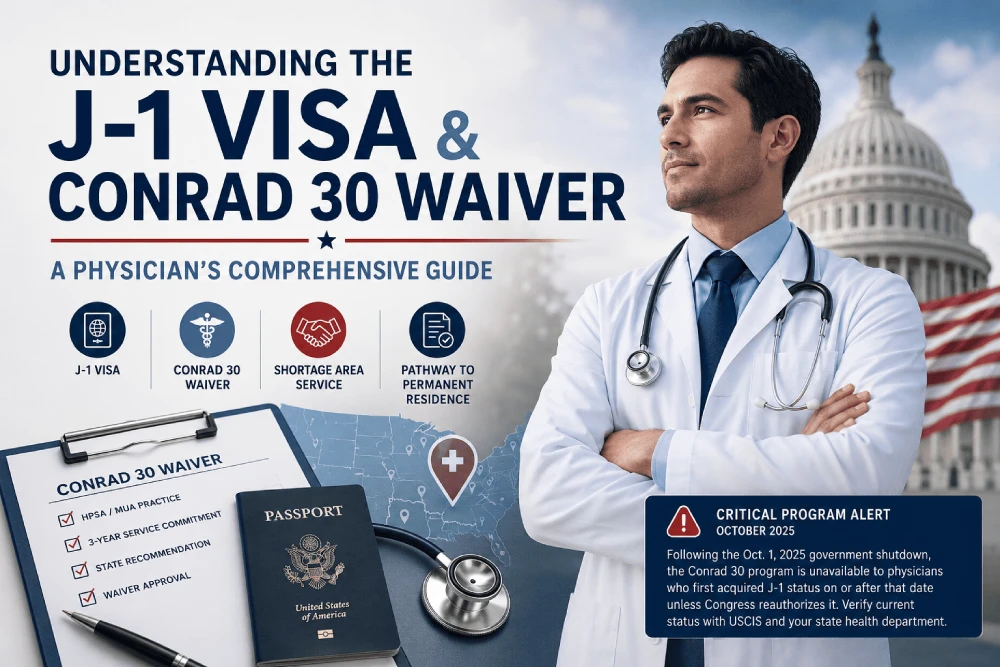
Current status: As of the October 1, 2025 government shutdown, physicians who first acquired J-1 nonimmigrant status on or after that date cannot access the Conrad 30 program unless Congress reauthorizes it. The Conrad State 30 and Physician Access Reauthorization Act (S.709 / H.R.1585), introduced in the 119th Congress in February 2025, would extend the program for three years and gradually increase available slots from 30 to 35 per state when utilization thresholds are met. As of the date of this writing, the bill remains pending and has not been enacted into law.
Physicians who acquired J-1 status on or before September 30, 2025 remain eligible under the existing statutory authority and should not delay pursuing the waiver if they qualify.
The ARC and DRA exception
Physicians employed in counties within the Appalachian Regional Commission or Delta Regional Authority service areas have access to separate waiver programs that operate with unlimited slots — outside the standard 30-per-state annual cap. Several state health departments actively encourage physicians practicing in ARC or DRA counties to apply through those programs first, preserving the state’s Conrad 30 slots for physicians in other qualifying locations. If your prospective employer is in an ARC or DRA county, verify with the state’s primary care office whether the separate program is available before filing a Conrad 30 application.
Eligibility and practical requirements
Federal law establishes baseline requirements under INA §214(l), but each state health department layered its own application criteria on top of the federal floor. What qualifies in one state may not be prioritized in another. That said, the following requirements are universal:
- The physician must hold valid J-1 status and be subject to §212(e) as a foreign medical graduate who completed graduate medical education or training in the United States.
- The physician must have completed the relevant USMLE steps and hold a valid, active medical license in the state where they intend to practice. USCIS cannot approve an H-1B for a physician who does not yet hold state licensure.
- A bona fide, signed employment contract must exist with a qualifying health care facility. That facility must be located in a Health Professional Shortage Area, a Medically Underserved Area, or a Medically Underserved Population. The contract must provide for full-time employment — generally a minimum of 40 hours per week — for at least three years.
- The physician must agree to begin employment within 90 days of receiving the Conrad 30 waiver approval — not 90 days from the expiration of the J-1 visa. This is a hard statutory deadline that many physicians overlook until it becomes a problem.
- The employing facility must be willing to file an H-1B petition with USCIS, since the Conrad 30 waiver operates in conjunction with H-1B status.
90-day employment start — do not miss this
Under INA §214(l), the physician must begin working for the waiver employer within 90 days of receiving the waiver. Failure to begin employment within this window can result in the waiver being voided and the two-year requirement being reimposed. Plan your H-1B filing, credentialing, and licensure timelines accordingly — and build in margin.
Slot availability and state priorities
States vary significantly in how they prioritize applications. Some weight primary care specialties heavily. Others score applications by HPSA score (higher scores indicate greater shortage severity). A handful of states have moved to rolling intake; others use fixed application windows and close once slots are reserved. Several states — particularly those in high-population regions — exhaust their 30 slots within weeks of the federal fiscal year opening on October 1. Physicians should research the target state’s program rules and application calendar well in advance of when they expect to need the waiver.
How the application process works
The Conrad 30 process spans three distinct federal and state bureaucracies, each with its own timeline and paperwork requirements. The sequence generally unfolds as follows:
Step 1 — Secure the employment contract
Everything else in the process depends on having a qualifying, signed contract in hand. The contract must reflect genuine full-time employment, a shortage-area location, and a minimum three-year term. Before signing, verify that the facility’s HPSA, MUA, or MUP designation is current — these designations are reviewed periodically and can be modified or removed. A contract with an employer that loses its designation between signing and filing creates serious complications. Have an attorney review the contract before you commit; the terms of that document will govern your life for the next three or more years.
Step 2 — State health department application
The physician or employer submits an application to the state’s primary care office or equivalent agency requesting that the state use one of its annual slots to recommend the waiver. Supporting documentation typically includes the employment contract, evidence of HPSA or MUA designation, the physician’s CV, ECFMG certification, medical license, USMLE scores, and all prior DS-2019 forms. States may require additional materials. Processing at the state level can range from a few weeks to several months depending on the state’s administrative capacity and intake volume.
Step 3 — State Department Waiver Review Division
Once the state approves the application and chooses to use a slot, it transmits the recommendation package to the State Department’s Waiver Review Division (WRD) in Washington. The physician completes Form DS-3035 (the J-1 Visa Waiver Review Application) and pays the associated filing fee directly with the State Department. The WRD conducts its own independent review, which typically takes eight to twelve weeks. If the WRD issues a favorable recommendation, the file transfers to USCIS.
Step 4 — USCIS H-1B petition and waiver finalization
While the waiver process is ongoing, the physician’s employer should be preparing — or have already filed — an H-1B petition. Premium processing (Form I-907) is available and can significantly compress USCIS timelines. Once USCIS approves the H-1B, the physician can begin employment. The three-year service obligation begins at that point and runs concurrently with the H-1B approval period.
From initial state filing to USCIS H-1B approval, plan for a minimum of six to ten months. In high-demand states or years with USCIS processing backlogs, twelve months is not unusual. Physicians should initiate the process no later than twelve to eighteen months before their J-1 program end date — earlier is always better.
The Physician NIW — a parallel green card strategy
Foreign physicians who are — or will be — working in federally designated shortage areas have access to a streamlined path to permanent residence through the Physician National Interest Waiver, authorized under INA §203(b)(2)(B). This provision, established through the Nursing Relief for Disadvantaged Areas Act of 1999, permits a physician to self-petition for an EB-2 immigrant visa without undergoing the PERM labor certification process — a significant procedural advantage.
To qualify for a Physician NIW, the physician must commit to five years of full-time clinical practice in a designated shortage area (HPSA, MUA, or Veterans Affairs facility; specialists may qualify through a Physician Scarcity Area). A state health department or federal agency must also provide an attestation letter confirming the work is in the public interest. The I-140 immigrant petition is then filed with USCIS.
Important intersection: Time spent practicing in a shortage area on a J-1 visa does not count toward the five-year NIW service requirement. However, time worked on an H-1B following a Conrad 30 waiver generally does. A physician completing a three-year Conrad 30 obligation has already completed sixty percent of the NIW service period. Filing an I-140 during or after the Conrad 30 service commitment is a powerful combined strategy that many of my physician clients pursue simultaneously.
Frequently asked questions
No — not if §212(e) applies to you. The statute specifically bars obtaining H, K, or L nonimmigrant visas and bars adjustment of status until either the two-year physical presence abroad is completed or an approved waiver is in hand.
Leaving your waiver position early can result in the reimposition of the two-year bar, making you ineligible for H, K, or L visas and adjustment of status.
It depends on whether your spouse independently held J-1 status. J-2 dependents generally are not subject to §212(e) unless they were also J-1 exchange visitors.
Yes. The waiver application is tied to the state where your qualifying employer is located, not where you completed residency training.
HPSA and MUA/MUP designations can be verified through the official HRSA data warehouse.
Treat that notation cautiously. USCIS and the State Department make independent determinations regarding §212(e) applicability.
Yes. Completing the service obligation can position physicians for employer-sponsored permanent residence or a Physician NIW pathway.
Federal law does not restrict Conrad 30 to primary care physicians, though states may prioritize them.
Options may include applying through another state, pursuing an IGA waiver, or waiting for the next fiscal year.
Additional employment generally requires a separate concurrent H-1B petition and compliance with waiver terms.
All three are HRSA designations, but they measure different access gaps. A Health Professional Shortage Area is designated when a geographic area, population group, or facility lacks sufficient medical providers relative to the population it serves – the metric is essentially a provider-to- patient ratio falling below a statutory threshold. A Medically Underserved Area reflects broader barriers to care access, incorporating poverty levels, infant mortality rates, and the percentage of elderly residents, not just provider counts. A Medically Underserved Population applies when a specific population group within an area faces access barriers even if the overall area is not designated as an MUA. A facility may hold multiple designations simultaneously, and the qualifying designation for Conrad 30 purposes can be any of the three.
If permanent residence is your goal, yes. A No Objection Statement is a waiver of the two-year requirement, but the statute specifically limits the immigration benefits it unlocks. Physicians who obtain a No Objection waiver can change to certain nonimmigrant statuses, including H-1B, but they cannot pursue immigrant visa status or adjustment of status on that basis. In other words, the No Objection path leads to a nonimmigrant dead end for physicians who want a green card. The Conrad 30 waiver – and the IGA waiver – are the pathways that fully clear the §212(e) bar and permit the physician to pursue permanent residence.
State health department review typically runs four to twelve weeks, though high-volume states may take longer during competitive intake periods. The State Department’s Waiver Review Division generally takes eight to twelve weeks to issue its recommendation after receiving the complete package. USCIS H-1B processing varies considerably: premium processing (Form I-907) compresses adjudication to fifteen business days; standard processing can take several months. Adding in the time required to secure a medical license, complete physician credentialing at the facility, and address any unexpected document requests, a realistic end-to-end timeline is eight to fourteen months from initial state filing to employment commencement. Begin twelve to eighteen months before your J-1 program end date.
Involuntary separation from the waiver employer due to facility closure is one of the recognized grounds for relief from the service obligation. The key is responding immediately — this situation requires urgent legal intervention, not a wait-and-see approach. You will need to document the closure and demonstrate that you are actively seeking a replacement qualifying employer in the same shortage area. The pending reauthorization legislation clarifies and strengthens protections for physicians who lose their position through no fault of their own, allowing up to 45 days from employment termination to identify and commit to a new qualifying employer before the waiver obligation is jeopardized.
Yes. J-2 dependents may apply to USCIS for employment authorization, and once an Employment Authorization Document is approved, the J-2 holder may work for any lawful employer in any occupation. The J-2 EAD is renewable for as long as the primary J-1 holder maintains valid status. This is one of the meaningful practical advantages that J-2 dependents hold compared to, for example, H-4 dependents, whose work authorization has faced a more complicated regulatory history.
Yes, provided that time was spent as physical presence in your country of nationality or last legal permanent residence — not merely transiting through it. The two-year period can be accumulated in aggregate; it does not need to be a single uninterrupted stay. If you have documented one continuous year of residence abroad, you need only one additional year to fully satisfy the §212(e) requirement without a waiver. Documenting this time rigorously matters: tax records, lease agreements, employment records, bank statements, and passport entry and exit stamps all help establish the physical presence required. Bring this documentation to any immigration consultation.
Yes, and this is often the smartest combined strategy available to foreign physicians in shortage areas. The Conrad 30 waiver resolves the §212(e) two-year bar and moves you into H-1B status. Separately, the Physician NIW under INA §203(b)(2)(B) allows you to self-petition for an EB-2 immigrant visa with a five-year full-time shortage area commitment — without your employer having to go through the PERM labor certification process. Time spent in H-1B status under a Conrad 30 obligation generally counts toward the NIW’s five-year service requirement. Filing the I-140 NIW petition early — ideally during your Conrad 30 H-1B period — locks in an early priority date, which can be decisive for nationals of countries with employment-based backlogs.
As of current policy, the answer is generally no. The Conrad 30 program has historically required the physician to be physically located at the shortage-area facility providing in-person patient care. Temporary guidance issued during the COVID-19 pandemic introduced some flexibility around telehealth, but that accommodation was not made permanent in the regulations. Hybrid arrangements — where a physician primarily practices in person at a qualifying facility but also provides some telehealth — may be acceptable, but a purely remote position would not satisfy the program’s in-person care requirement. This area is subject to continued policy development, and the pending reauthorization legislation may address it more explicitly. Consult current program guidance and legal counsel before relying on a telemedicine arrangement to satisfy your service obligation.
Start assembling your documentation well before you need it. Core items include every DS-2019 ever issued to you (from all sponsors and all program stages), all prior J-1 visa stamps in your passport, your medical degree and post-graduate training certificates, ECFMG certification, USMLE score reports, your current state medical license, a signed employment contract with the waiver employer, evidence of the employer facility’s active HPSA or MUA designation, your curriculum vitae, your home country passport, and any prior U.S. immigration approvals or filings. Individual states may require additional items. Missing a single document can delay state processing by weeks or months, so treat document collection as the first step of the process — not something to address later.
No. The Conrad 30 program is available exclusively to foreign medical graduates who held J-1 status for the purpose of receiving graduate medical education or training in the United States. Research scholars, professors, students, trainees, and other J-1 category participants are not eligible. If you are a non-physician J-1 holder subject to §212(e), your options are the No Objection Statement, an IGA waiver, the exceptional hardship or persecution waiver, or physically completing the two-year residence requirement. Each route has distinct eligibility criteria and downstream immigration consequences worth discussing with an attorney before committing to a course of action.
Get counsel before you file anything
The J-1 and Conrad 30 process involves multiple agencies, hard deadlines, and consequences that are difficult to reverse. The right strategy depends on your specific program history, specialty, target state, and long-term goals.
Schedule a consultation ↗Legal disclaimer: The content of this article is for general informational and educational purposes only. It does not constitute legal advice, does not create an attorney-client relationship, and should not be relied upon as a substitute for consultation with a qualified immigration attorney regarding your specific facts and circumstances. Immigration law changes frequently. The Conrad 30 program’s reauthorization status as of the publication date is described above; current program availability must be independently confirmed with USCIS and the relevant state health department. © 2026 KenjayLaw.com. All rights reserved.