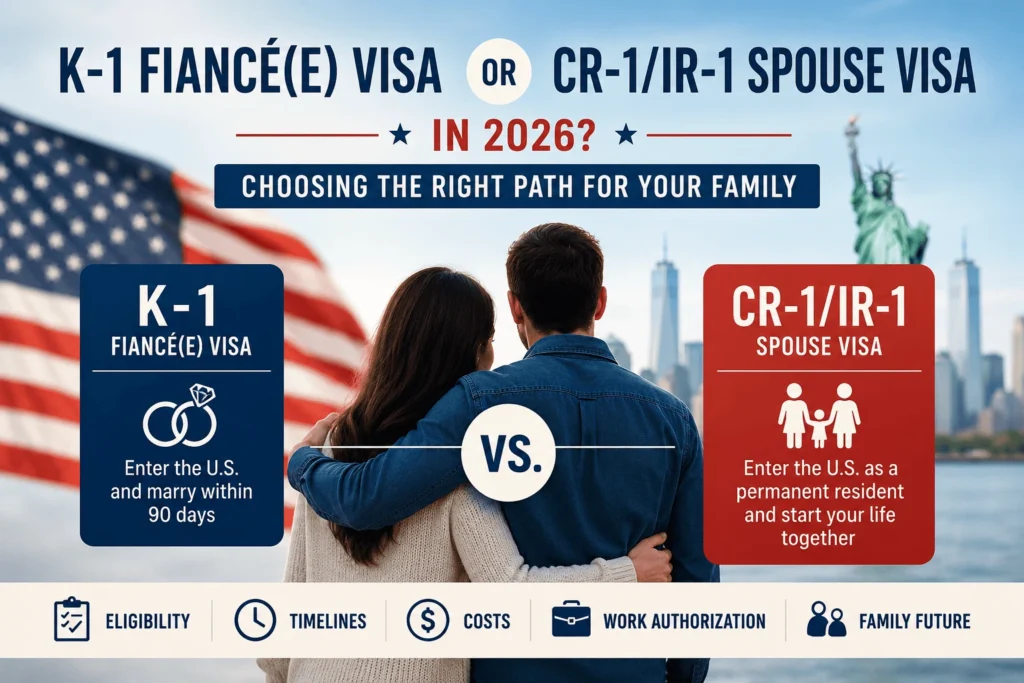
When two people in an international relationship decide to build their life together in the United States, one of the first and most important immigration decisions is how the foreign partner will come to the United States. For many couples, the decision comes down to two common options: the K-1 fiancé(e) visa or the CR-1/IR-1 spouse immigrant visa.
Both routes can ultimately lead to permanent residence, but they work very differently. They differ in eligibility, filing sequence, cost, work authorization, timing, and what happens after the foreign partner enters the United States.
There is no single best answer for every couple. The better option depends on whether you are already married, whether the U.S. partner is a U.S. citizen or lawful permanent resident, where the foreign partner lives, how quickly you want to reunite, and whether immediate work authorization is important after arrival.
Understanding the differences before filing can help couples avoid unnecessary delay, extra government fees, and avoidable immigration complications.
Understanding the K-1 fiancé(e) visa
The K-1 fiancé(e) visa is a nonimmigrant visa for the foreign fiancé(e) of a U.S. citizen. It allows the foreign fiancé(e) to enter the United States for the purpose of marrying the U.S. citizen petitioner.
The K-1 visa is available only to U.S. citizens. A lawful permanent resident, also called a green card holder, cannot file a K-1 petition for a fiancé(e).
The process begins when the U.S. citizen files Form I-129F, Petition for Alien Fiancé(e). To qualify, the couple generally must show that both partners are legally free to marry and that they have met in person at least once within the two years before filing. Limited exceptions may apply if meeting in person would violate strict and long-established cultural or religious customs, or would cause extreme hardship to the U.S. citizen petitioner.
After USCIS approves the petition, the case is forwarded through the National Visa Center to the appropriate U.S. embassy or consulate. The foreign fiancé(e) then completes the visa application process, attends a consular interview, and, if approved, receives the K-1 visa.
After entering the United States on a K-1 visa, the couple must marry within 90 days. That deadline is strict. The K-1 visa is intended for a single entry and cannot simply be extended if the couple does not marry within the required period.
After the marriage, the foreign spouse must file Form I-485 to adjust status to lawful permanent resident. This means the K-1 route usually has two major stages: first the fiancé(e) visa process abroad, and then the green card process inside the United States after marriage.
Work authorization for K-1 entrants
One practical issue couples should understand is work authorization.
A K-1 entrant does not arrive in the United States as a permanent resident and should not assume that he or she can immediately begin working. A K-1 entrant generally needs an Employment Authorization Document before working lawfully in the United States.
Although a K-1 entrant may request employment authorization after arrival, the 90-day K-1 period often makes that option impractical. In many cases, the foreign spouse requests employment authorization together with the adjustment-of-status application after the marriage. This can leave the new spouse unable to work for several months while waiting for the work permit.
For couples who depend on two incomes or want the foreign partner to work soon after arrival, this is an important factor.
Understanding the CR-1/IR-1 spouse visa
A spouse immigrant visa becomes available after the couple is legally married. The process usually begins when the U.S. citizen or lawful permanent resident files Form I-130, Petition for Alien Relative, for the foreign spouse.
For spouses of U.S. citizens, the case is generally processed in the immediate-relative category. For spouses of lawful permanent residents, the case falls under the F2A family-sponsored preference category, which may be affected by Visa Bulletin availability, country of chargeability, and monthly priority-date movement.
For spouses of U.S. citizens, the immigrant visa is usually classified as either CR-1 or IR-1, depending on the length of the marriage at the time the foreign spouse is admitted to the United States.
A CR-1 visa is generally issued when the couple has been married for less than two years at the time of admission. The spouse becomes a conditional permanent resident and receives a two-year green card. Before the card expires, the couple must file Form I-751 to remove the conditions and obtain a ten-year green card.
An IR-1 visa is generally issued when the couple has been married for at least two years at the time of admission. In that situation, the spouse generally receives a ten-year green card and does not need to file Form I-751 to remove conditions.
The major advantage of the spouse visa route is that the foreign spouse generally becomes a lawful permanent resident upon admission to the United States. This means the spouse may generally work immediately after entry and does not need to file a separate adjustment-of-status application after arrival.
A note about the K-3 spouse visa
This article focuses on the two most common family immigration options: the K-1 fiancé(e) visa and the CR-1/IR-1 spouse immigrant visa.
A K-3 spouse visa technically exists for certain spouses of U.S. citizens, but in many modern cases it is not a practical route. If the Form I-130 immigrant petition reaches the National Visa Center before or at the same time as the K-3-related petition, the K-3 process may be administratively closed and the case usually proceeds through the CR-1 or IR-1 immigrant visa process.
For most married couples, the practical comparison is therefore between a spouse immigrant visa and any other case-specific options that may apply.
Key differences between the K-1 and spouse visa routes
Marital status
The K-1 fiancé(e) visa is for couples who are not yet married. The couple must intend to marry in the United States within 90 days after the foreign fiancé(e) arrives.
The spouse visa route requires a valid legal marriage before the immigrant visa is issued.
Who can sponsor
Only a U.S. citizen can sponsor a foreign fiancé(e) for a K-1 visa.
A U.S. citizen may petition for a spouse as an immediate relative. A lawful permanent resident may also petition for a spouse, but the case is usually classified under the F2A preference category and may be subject to Visa Bulletin waiting periods.
Process sequence
With the K-1 route, the foreign fiancé(e) enters the United States first, marries the U.S. citizen within 90 days, and then files for adjustment of status.
With the spouse visa route, most of the green card process is completed before the foreign spouse enters the United States. The spouse enters as a permanent resident after the immigrant visa is approved and issued.
Work authorization
A spouse who enters on a CR-1 or IR-1 immigrant visa generally becomes a lawful permanent resident upon admission and may generally work immediately.
A K-1 entrant generally must wait for an Employment Authorization Document before working. In practice, many K-1 applicants request employment authorization after marriage when filing the adjustment-of-status package.
Cost
The K-1 route often costs more overall because it involves the fiancé(e) visa process first and then a separate adjustment-of-status filing after marriage.
The April 2024 USCIS fee rule changed the cost structure for adjustment cases. Work permit and travel document applications that were previously included with some adjustment filings at no additional charge now generally require separate filing fees. Because the K-1 route requires adjustment of status after marriage, the total government filing cost is often higher than the spouse visa route.
Government fees can change, and applicants should always confirm the current USCIS and Department of State fee schedules before filing.
New and changing government fees
Couples should carefully verify all current government fees before filing. K visa applicants must pay the applicable Department of State visa application fee, and adjustment-of-status applicants must pay applicable USCIS filing fees.
Recent federal legislation has also created additional immigration-related fee provisions, including fee provisions affecting some nonimmigrant visa applicants. Because implementation details and collection procedures may change, K-1 applicants should confirm the latest Department of State and USCIS fee information before budgeting or filing.
Conditional residence
A foreign spouse who becomes a permanent resident less than two years after the marriage generally receives conditional residence. This can happen whether the spouse enters on a CR-1 visa or adjusts status after entering on a K-1 visa and marrying the U.S. citizen petitioner.
Conditional residence is valid for two years. The couple must timely file Form I-751 to remove the conditions before the conditional green card expires.
This step is important and should not be overlooked.
Timeline
Processing times for both routes change frequently based on USCIS workloads, consular operations, country-specific conditions, security checks, and case-specific issues.
In some cases, the K-1 route may reunite an engaged couple in the United States sooner at the front end. However, the spouse visa route may produce a smoother overall path to permanent residence because the foreign spouse generally enters the United States as a green card holder and does not need to file a separate adjustment-of-status application after arrival.
Any timeline estimate found online should be checked against current government processing information and the facts of the specific case.
Which option is better?
The best option depends on the couple’s facts and goals.
The K-1 fiancé(e) visa may be appropriate if the couple is not yet married, the U.S. partner is a U.S. citizen, and the couple wants to marry in the United States after the foreign partner arrives. It may also be attractive where front-end reunification is the main concern.
The spouse visa route may be better if the couple is already married or is willing to marry before starting the immigrant visa process. It often provides a cleaner path to permanent residence, immediate ability to work after admission, and fewer filings after arrival.
For many couples, the spouse visa route is less expensive overall and less administratively burdensome. However, the right choice depends on the couple’s relationship status, financial considerations, desired timeline, country conditions, and long-term immigration plan.
How Kenjay Law can help
At Kenjay Law, we help individuals and families choose the right family-based immigration strategy with clarity and confidence. Our team assists with fiancé(e) visas, spouse immigrant visas, adjustment of status, consular processing, affidavits of support, evidence preparation, and related immigration issues.
Every couple’s situation is different. Before choosing a K-1 fiancé(e) visa or a spouse visa, it is important to understand the legal requirements, timing, costs, and practical consequences of each route.
Contact Kenjay Law to schedule a consultation and discuss the best path for your family.
Frequently asked questions
Can a green card holder petition for a fiancé(e)?
No. The K-1 fiancé(e) visa is available only to U.S. citizens. A lawful permanent resident who wants to bring a partner to the United States generally must marry first and then file a spouse-based immigrant petition. That case usually falls under the F2A family-sponsored preference category and may be affected by Visa Bulletin availability.
What happens if we do not marry within 90 days after K-1 entry?
The 90-day deadline is strict. If the couple does not marry within 90 days, the K-1 entrant is expected to depart the United States. Remaining in the United States without marrying and without taking proper legal steps can create serious immigration problems.
Couples should plan carefully before the foreign fiancé(e) travels.
Can we switch from a K-1 to a spouse visa partway through?
Not directly. The K-1 fiancé(e) visa and spouse visa are separate processes with separate petitions. A pending Form I-129F cannot simply be converted into a spouse-based Form I-130 case.
Changing strategy may require withdrawing or abandoning one process and starting another, which can result in lost time and government fees.
Can my fiancé(e) or spouse work right away?
It depends on the route.
A spouse who enters the United States on an approved CR-1 or IR-1 immigrant visa generally becomes a permanent resident upon admission and may generally work immediately.
A K-1 entrant does not enter as a permanent resident and generally needs an Employment Authorization Document before working. Many K-1 entrants request work authorization after marriage when filing adjustment of status, and approval can take time.
Do we have to get married in the United States?
For the K-1 fiancé(e) visa, yes. The K-1 is specifically for entering the United States to marry the U.S. citizen petitioner within 90 days after arrival.
For a spouse visa, the marriage must already exist before the immigrant visa is issued. The marriage may have taken place abroad, in the United States, or in another legally valid location, as long as it is recognized as valid for immigration purposes.
What is conditional residence?
Conditional residence applies when the marriage is less than two years old at the time the foreign spouse becomes a permanent resident. The spouse receives a two-year conditional green card.
Before the card expires, the couple must file Form I-751 to remove the conditions and request a ten-year green card. This requirement can apply whether the spouse entered on a CR-1 visa or adjusted status after a K-1 marriage.
Which route is cheaper?
For many couples, the spouse visa route is less expensive overall because the foreign spouse usually enters as a permanent resident and does not need a separate adjustment-of-status filing after arrival.
The K-1 route often costs more because it requires the fiancé(e) visa process first and then the green card process after marriage. Current government fees should always be verified before filing.
Is one route faster?
Each route can be faster in a different sense.
The K-1 route may sometimes bring an engaged couple together in the United States sooner. The spouse visa route may be faster overall to full permanent residence because the spouse generally enters as a green card holder and avoids a later adjustment-of-status process.
Processing times change frequently, so couples should check current government processing data and seek case-specific guidance before deciding.
Disclaimer
This article is provided for general informational purposes only and does not constitute legal advice. Reading this article does not create an attorney-client relationship. Immigration laws, government filing fees, visa procedures, and processing times change frequently. For advice about your specific circumstances, consult a licensed immigration attorney. This version is ready for publication after adding Kenjay Law’s internal links and confirming the exact government fees on the date of posting.