An experienced H1B immigration lawyer can decide whether your application gets turned down or opens the door to a strong career in the United States. The H1B visa stands as one of the toughest yet most valuable routes for skilled workers seeking jobs in America in specialty occupations.
It goes beyond a simple visa. This experience can define your future career, provide a global experience, and possibly lead to permanent residence.
Most people miss this point completely. They see it as an easy paperwork exercise. The truth is it counts as a closely examined legal step where small details can make or break the outcome.
It is important to have employer regulations, necessary documents, and all regulations. One mistake can spoil the entire work. This is why it becomes a clever idea to collaborate with good legal assistance.
What is an H-1B visa?
The H1B visa is a U.S. non-immigrant work visa for skilled workers in fields such as technology, engineering, healthcare, finance, and more.
It allows American companies to bring in foreign experts for positions that require advanced knowledge or technical skills. The visa is valid for up to 3 years and can be renewed for up to 6 years, or longer if conditions allow.
Above all, it offers a clear path to permanent residency and ranks among the top immigration options for professionals from around the world.
Importance of applying for an H-1B visa
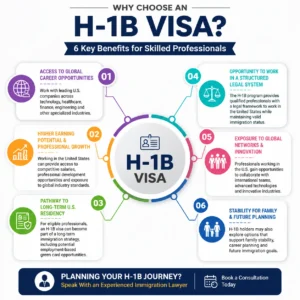
Filing for an H1B visa does not just equate to finding a job in the United States. It provides you with a structured means of developing your career globally, achieving financial stability, and achieving permanent immigration objectives.
Skilled workers gain entry to an environment that mixes fresh ideas, high-level tasks, and chances to work across borders.
The true benefit shows up in the possibilities that go beyond the first job. When you follow a solid plan, the visa lays the groundwork for a lasting stay in America.
Access to global career opportunities
The H1B visa allows professionals to work for leading U.S. companies in technology, healthcare, finance, and engineering. Such an experience accelerates career advancement and opens opportunities that do not exist in the home country.
Higher earning potential and professional growth
United States jobs tend to be better paid, more modern, and equipped with the most up-to-date equipment and systems. Over time, these factors build a stronger career standing and support steady financial progress.
Pathway to long-term U.S. residency
A major advantage of the H1B visa is its link to permanent residency. Good planning turns it into the starting point for getting a Green Card and settling down in the United States for the long run.
Opportunity to work in a structured legal system
The H1B visa protects your job under American labor rules. You are provided with work security, employment conditions, and a regulated professional environment.
Exposure to global networks and innovation
One position in the United States will connect you with talent across numerous nations, hybrid teams, and significant initiatives. This relationship expands your network and puts you at the center of emerging industry changes and innovations.
Stability for family and future planning
The H1B visa allows family members to accompany you in order to live, go to school, and establish themselves in the United States. This creates long-term security and elevates the standard of living for all involved.
Challenges of the H-1B visa application process
Many people believe the H1B visa only requires meeting basic qualifications. In practice, it involves stiff competition and heavy rules that must be followed.
- Limited annual visa cap with lottery-based selection
- Strict documentation and eligibility requirements
- Complex employer compliance rules
- High rate of Requests for Evidence (RFEs)
- Changing USCIS scrutiny and policies
Even strong candidates get rejected over small technical problems or a weak presentation of their case. Most applications fall short not from missing qualifications but from missing a proper plan.
Role of an H-1B immigration lawyer in the application process
An experienced H1B immigration lawyer takes a difficult process and turns it into an organized effort aimed at approval.
Eligibility mapping and case direction
A skilled H1B immigration attorney would start by examining your credentials, the job description, and the circumstances of the employer to determine whether the case is compliant with H1B regulations. Instead of rushing, they establish an open outline that clarifies which category they belong to, how to position the role, and which actions increase the probability of success.
Structuring a legally strong application
The H1B process requires more than handing in papers. It calls for creating a solid case that stands up to review. A lawyer organizes the full application with clear legal language so the job title, your skills, and employer information match exactly what USCIS expects.
Managing employer-side compliance
Success in H-1B cases often depends on the employer meeting all the rules. The H1B immigration attorney ensures that the Labor Condition Application is submitted correctly, the wage rate is selected properly, and the occupation is categorized properly. This measure eliminates risks that normally lead to delays or refusals.
Preparing high-impact documentation
Each paper you send in affects the final decision. Lawyers review and organize the supporting files so they remain relevant, complete, and directly tied to the petition. This removes any loopholes and creates a significantly better file.
Drafting a clear and convincing petition
The petition brings together every part of your case. Lawyers write it to explain your duties, your special skills, and the reasons you qualify under H1B rules. The language stays precise and legal, created to persuade USCIS examiners.
Handling RFEs with legal precision
When USCIS asks for more information, the reply needs careful thought. An H1B immigration lawyer reviews the request, puts together a comprehensive response, and adds evidence that addresses the exact issue. This response frequently decides between denial and approval.
Managing timelines and filing accuracy
The H1B process operates under tight timeframes and multiple steps. Attorneys verify that all filings are done in a proper manner, that is in time and does not involve minor errors. This reduces the risk of being rejected due to errors in paperwork.
Guiding beyond initial approval
A lawyer’s job continues after approval. They assist in the stamping of visas, renewing of visas, transferring of visas, and other Green Card arrangements to ensure that the whole process of immigration remains on track and within the regulations.
H-1B visa documents checklist
Preparing the correct documents is one of the most important steps in an H-1B visa application. A qualified immigration lawyer for H1B visa matters can help applicants and employers organise required documents, identify missing information and prepare a complete petition that meets USCIS requirements.
Whether you are applying for your first H-1B visa, transferring employers or responding to USCIS concerns, working with the best H1B attorney in the USA can help ensure that your application is properly prepared and supported with strong evidence.
Common documents required for an H-1B application
The documents required may vary depending on the applicant’s background, employer and immigration history. Common documents include:
Applicant documents
- Passport Copy – A valid passport copy showing personal details and previous travel information.
- Current Visa Documents – Copies of current and previous U.S. visas, if applicable.
- I-94 Record – Current and previous arrival/departure records showing immigration status.
- Educational Certificates and Degree Documents – Degrees, diplomas and academic credentials supporting the applicant’s qualifications.
- Degree Transcripts – Official academic transcripts showing completed coursework and educational background.
- Experience Letters – Employment verification letters demonstrating previous professional experience.
- Resume/CV – Updated professional history, skills, qualifications and work experience.
Employment and employer documents
- Employment Offer Letter – Details about the offered position, salary, employment terms and responsibilities.
- Job Description – A detailed explanation of job duties, required skills and why the role qualifies as a specialty occupation.
- Employer Documents – Company information, financial records, organisational details and supporting business documents.
- Labor Condition Application (LCA) – Documentation confirming compliance with Department of Labor requirements.
Immigration history and supporting evidence
- Previous immigration records
- Prior USCIS approval notices
- Previous H-1B petitions, if applicable
- Change-of-status documents
- Supporting evidence requested by USCIS through a Request for Evidence (RFE)
How an H-1B immigration lawyer helps with documentation
An H-1B attorney can review documents before submission to identify missing information, inconsistencies or potential issues that may affect the petition. Legal guidance can help ensure that educational qualifications, job responsibilities, employer requirements and supporting evidence are properly prepared according to USCIS requirements.
A well-organised document package can help create a stronger H-1B petition and reduce avoidable delays during the application process.
H-1B visa timeline considerations
The H-1B process generally involves several important stages:
Employer registration
Employers must first complete the H-1B registration process during the designated registration period. Accurate information during this stage is essential because selected registrations move forward to the petition filing stage.
Lottery selection
Since H-1B visas are subject to annual limits, eligible registrations may be selected through the USCIS lottery system. Selection allows the employer to proceed with preparing and submitting the H-1B petition.
Petition preparation
After selection, employers and applicants must prepare supporting documents, including job details, educational qualifications, employment records and other evidence required by USCIS.
USCIS filing
The completed H-1B petition must be filed with USCIS within the permitted filing period. Proper form completion, supporting documentation and filing accuracy are important to avoid unnecessary delays.
Receipt notice
After receiving the petition, USCIS issues a receipt notice confirming that the application has been accepted for processing.
Petition review
USCIS reviews the submitted petition and supporting evidence. During this stage, USCIS may approve the petition, request additional evidence through an RFE or take further action depending on the application.
Approval
Once approved, the applicant may continue with the next steps required for employment authorization and visa processing, depending on their individual circumstances.
Visa stamping (where applicable)
Applicants who require visa stamping may need to complete additional steps through a U.S. embassy or consulate before travelling to the United States.
H-1B processing times can vary depending on USCIS workload, filing category, premium processing availability, employer circumstances and individual case factors. Working with an experienced H-1B immigration lawyer can help ensure important deadlines are tracked and applications are prepared accurately throughout the process.
Common mistakes applicants make without legal help
Trying to manage an H1B case without expert legal advice often leads to avoidable errors that could sink the whole application.
- Choosing an incorrect job classification
- Submitting incomplete or weak documentation
- Ignoring employer compliance requirements
- Poorly responding to RFEs
- Missing deadlines or filing errors
These problems go beyond small issues. They hit approval chances directly. After a denial, fixing the damage gets much tougher.
When should you hire an H-1B immigration lawyer?
Timing can be the difference between a successful and unsuccessful application.
You should bring in a lawyer:
- Before H1B lottery registration
- While finalizing your job offer
- During documentation preparation
- Immediately after receiving an RFE
- When planning transfers or extensions
Getting help early means the application starts on solid ground, which cuts down on problems and makes the whole effort run more smoothly.
Conclusion
The H1B visa process demands serious attention. It forms a high-stakes immigration route in which every piece, from the documents to the rules, affects where your future lies.
Partnering with an experienced H1B immigration lawyer ensures your application is built with a clear plan for success, rather than simply being submitted. The process loses its guesswork, risks drop, and you gain a straightforward route ahead.
If you mean business about winning your H1B visa and building a lasting career in the United States, choosing the right legal support can make all the difference.
Kenjay Law brings a careful, detail-focused approach to H1B applications that helps both professionals and employers navigate complex immigration steps with greater confidence.
Frequently asked questions about H-1B immigration lawyers
What does an H-1B immigration lawyer do?
An H-1B immigration lawyer helps applicants and employers prepare petitions, review eligibility, organise documentation and address USCIS requirements.
Why should I hire an immigration lawyer for an H-1B visa?
An attorney can help identify potential issues, prepare supporting evidence and guide applicants through the H-1B process.
How do I choose the best H-1B immigration lawyer in the USA?
Look for experience with employment immigration, H-1B petitions, USCIS procedures and RFE responses.
Can an H-1B lawyer help with an RFE?
Yes. An attorney can review USCIS concerns and prepare additional evidence to respond effectively.
Can a lawyer help with an H-1B transfer?
Yes. Immigration lawyers assist professionals changing employers while maintaining valid H-1B status.
Can an H-1B visa lead to a green card?
Many H-1B holders later explore employment-based green card options depending on eligibility.