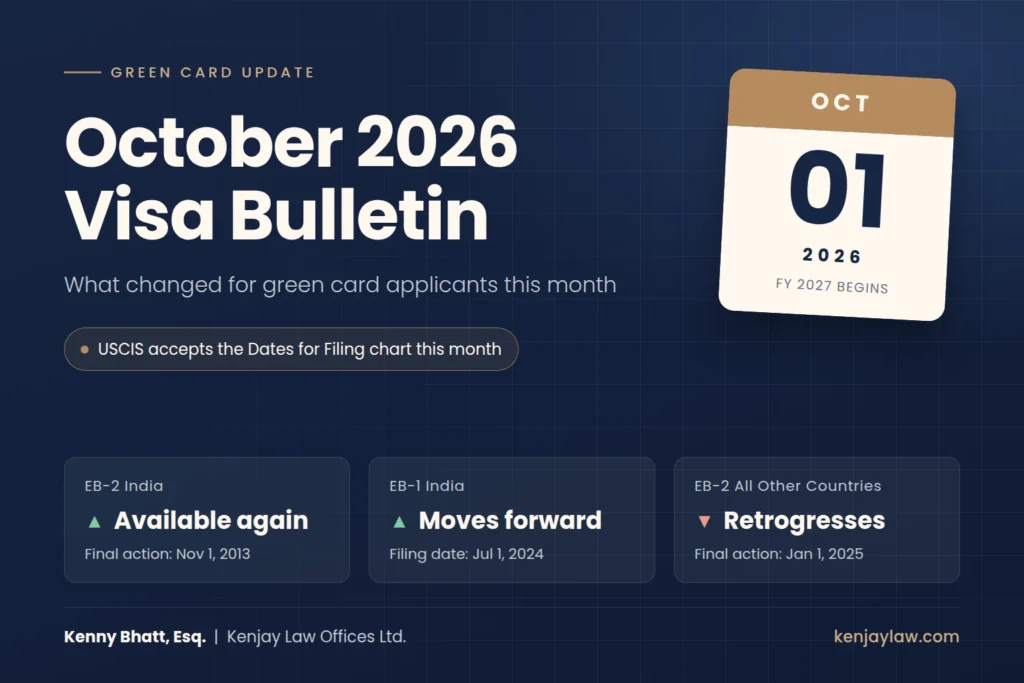
Updated September 30, 2026: The U.S. Department of State has published the October 2026 Visa Bulletin, the first bulletin of fiscal year (FY) 2027. USCIS has confirmed that for October, applicants in both employment-based and family-based categories may use the Dates for Filing chart to file Form I-485. In August and September, employment-based applicants were limited to the stricter Final Action Dates chart, so this is a meaningful change.
Every year around this time, clients start calling with the same question: “Can I finally file?” For many people, October 2026 brings good news. EB-2 India is available again, EB-1 India takes a big step forward, and China gains in most categories. But professionals from most other countries will find that EB-2 and EB-3 have moved backward, which will surprise many people who were current just a month ago.
Below, I explain what changed, who can file this month, and the steps I am recommending to our own clients.
October 2026 Visa Bulletin: key changes at a glance
- EB-2 India is back. After being unavailable since July, it returns with a final action date of November 1, 2013 and a filing date of January 15, 2015.
- EB-1 India moves forward. The final action date advances to February 1, 2023, and the filing date reaches July 1, 2024.
- EB-5 India (unreserved) reopens with a final action date of December 1, 2023.
- China advances in most categories, including a jump of more than two years in the EB-3 filing date.
- EB-2 retrogresses for all other countries, Mexico and the Philippines. It was current in September. The final action date is now January 1, 2025.
- EB-3 also moves back for all other countries and Mexico.
- EB-4 filing date jumps two years, and Congress has extended the religious worker category through December 11, 2026.
- Family-based movement is mostly for Mexico and the Philippines. F2A final action advances one month to September 22, 2026 for most countries.
Which chart should you use in October 2026?
For October 2026, USCIS will accept I-485 applications based on the Dates for Filing chart for all family-sponsored and employment-based preference categories.
The two charts do different jobs:
- Dates for Filing tells you when you can submit your adjustment of status application. Once it is filed, you can usually apply for a work permit (EAD) and a travel document (advance parole) while you wait.
- Final Action Dates tells you when USCIS or a U.S. consulate can actually approve your green card. Filing early does not make approval come early.
To qualify, your priority date must be earlier than the date listed for your category and your country of chargeability. “C” means current, so any priority date qualifies. “U” means no visa numbers are available at all.
Keep in mind that USCIS chooses the chart one month at a time. November could go back to the Final Action Dates chart. If you can file now, I would not wait.
Employment-based Final Action Dates for October 2026
These dates control when a green card can be approved. Where a date changed from September 2026, the old date is shown in brackets.
| Category | All other countries | China (mainland-born) | India | Mexico | Philippines |
| EB-1 | Current | Jul 1, 2023 | Feb 1, 2023 (was Oct 15, 2022) | Current | Current |
| EB-2 | Jan 1, 2025 (was Current) | Oct 1, 2021 (was Sep 1, 2021) | Nov 1, 2013 (was Unavailable) | Jan 1, 2025 (was Current) | Jan 1, 2025 (was Current) |
| EB-3 Skilled Workers and Professionals | May 15, 2024 (was Sep 1, 2024) | Jan 8, 2022 (was Jan 1, 2022) | Jan 1, 2014 | May 15, 2024 (was Sep 1, 2024) | Aug 15, 2023 (was Aug 1, 2023) |
| EB-3 Other Workers | Jan 1, 2022 (was Apr 1, 2022) | Oct 1, 2019 (was May 1, 2019) | Jan 1, 2014 | Jan 1, 2022 (was Apr 1, 2022) | Jan 1, 2022 (was Dec 1, 2021) |
| EB-4 | Dec 15, 2022 | Dec 15, 2022 | Dec 15, 2022 | Dec 15, 2022 | Dec 15, 2022 |
| Certain Religious Workers | Dec 15, 2022 | Dec 15, 2022 | Dec 15, 2022 | Dec 15, 2022 | Dec 15, 2022 |
| EB-5 Unreserved | Current | Dec 1, 2016 | Dec 1, 2023 (was Unavailable) | Current | Current |
| EB-5 Rural, High Unemployment and Infrastructure | Current | Current | Current | Current | Current |
Employment-based Dates for Filing for October 2026
This is the chart that matters most this month, because USCIS is accepting I-485 filings based on it.
| Category | All other countries | China (mainland-born) | India | Mexico | Philippines |
| EB-1 | Current | Jul 1, 2024 | Jul 1, 2024 | Current | Current |
| EB-2 | Mar 15, 2026 | Jan 1, 2023 | Jan 15, 2015 | Mar 15, 2026 | Mar 15, 2026 |
| EB-3 Skilled Workers and Professionals | Aug 1, 2024 | Apr 1, 2024 | Jan 15, 2015 | Aug 1, 2024 | Jan 1, 2024 |
| EB-3 Other Workers | Jun 1, 2022 | Oct 1, 2020 | Jan 15, 2015 | Jun 1, 2022 | Jun 1, 2022 |
| EB-4 and Certain Religious Workers | Jan 1, 2025 | Jan 1, 2025 | Jan 1, 2025 | Jan 1, 2025 | Jan 1, 2025 |
| EB-5 Unreserved | Current | Mar 1, 2021 | May 1, 2024 | Current | Current |
| EB-5 Set-Asides | Current | Current | Current | Current | Current |
How your filing window changed from September. In September, employment-based applicants had to file under the Final Action Dates chart. Comparing that to October’s Dates for Filing chart shows the real change:
- EB-1 India: from October 15, 2022 to July 1, 2024, about 20 more months of priority dates that can now file.
- EB-2 India: from Unavailable to January 15, 2015.
- EB-3 India: from January 1, 2014 to January 15, 2015.
- EB-3 China: from January 1, 2022 to April 1, 2024.
- EB-4 (all countries): from December 15, 2022 to January 1, 2025.
- EB-2 all other countries: from Current to March 15, 2026.
- EB-3 all other countries: from September 1, 2024 to August 1, 2024, a small step backward even with the friendlier chart.
India: the biggest gains this month
EB-1 India
EB-1 India is the headline. The final action date moves from October 15, 2022 to February 1, 2023. Because USCIS is accepting the Dates for Filing chart, EB-1 India applicants with a priority date before July 1, 2024 may be able to file an I-485 this month. That includes many EB-1A (extraordinary ability), EB-1B (outstanding professors and researchers) and EB-1C (multinational managers and executives) applicants whose I-140 petitions were filed in 2023 and early 2024.
EB-2 India
EB-2 India had been unavailable since July because India used up its share of FY 2026 visa numbers. With the new fiscal year, it returns with a final action date of November 1, 2013 and a filing date of January 15, 2015. This helps both PERM-based EB-2 cases and EB-2 National Interest Waiver (NIW) cases.
One thing I want to be clear about: EB-2 India is available again, but it is not current. The backlog is still more than a decade long. The final action date also landed earlier than the July 15, 2014 date the State Department projected over the summer, so EB-2 India applicants got less movement than many hoped.
EB-3 India
EB-3 India does not move. The final action date stays at January 1, 2014, and the filing date stays at January 15, 2015, for both skilled workers and professionals and for other workers. Since EB-2 and EB-3 India now share the same filing date, and their final action dates are only two months apart, moving an approved case from EB-2 to EB-3 offers little benefit for most Indian applicants this month. Whether a category change makes sense depends on your petition, your job and your timeline, so please review it with an attorney before taking any step.
EB-5 India
In June 2026, the State Department announced that India had used all of its FY 2026 unreserved EB-5 visas and said the category would reopen when FY 2027 began. That has now happened. India unreserved EB-5 returns with a final action date of December 1, 2023 and a filing date of May 1, 2024. The rural, high-unemployment and infrastructure set-aside categories remain current.
For Indian investors who were stuck at the end of FY 2026, this is welcome news. But a visa number is only one part of an EB-5 case. Your source of funds, the path those funds took, the project’s structure and paperwork, and the investment risk all need careful review.
China: gains in most categories
China moves forward in most employment categories. The EB-2 final action date advances one month to October 1, 2021. EB-3 advances to January 8, 2022, and EB-3 Other Workers jumps five months to October 1, 2019. EB-1 and EB-5 unreserved final action dates hold steady.
The bigger story for China is on the filing chart. The EB-3 filing date jumps to April 1, 2024, now well ahead of EB-2 China at January 1, 2023. The EB-5 unreserved filing date leaps four years, from March 1, 2017 to March 1, 2021. If you were born in mainland China, have an EB-2 case and have a 2023 priority date, it may be worth asking whether an EB-3 petition makes sense. That depends on your employer and your job, so please do not act on this table alone.
All other countries, Mexico and the Philippines: EB-2 and EB-3 move back
This group takes the hit in October. EB-2 was current in September. It now has a final action date of January 1, 2025 and a filing date of March 15, 2026. The EB-3 final action date moves back from September 1, 2024 to May 15, 2024, and EB-3 Other Workers moves back to January 1, 2022. The Philippines is the exception in EB-3, where the final action date inches forward to August 15, 2023.
The State Department says these retrogressions are needed to keep FY 2027 green card use within the quarterly and annual limits. In plain words, there are more people in line than there are visa numbers for the first part of the year.
Here is what that means for you:
- If your EB-2 priority date is before March 15, 2026, you can still file your I-485 in October. Approval will wait until the final action date moves past your priority date.
- If your priority date is March 15, 2026 or later, you cannot file your I-485 in October.
- If your I-485 is already pending and your priority date is now behind the cutoff, your case is not denied. It simply waits. Keep renewing your work permit and advance parole on time.
EB-4 and religious workers
The EB-4 final action date stays at December 15, 2022 for every country, while the filing date jumps two years to January 1, 2025. Congress extended the non-minister religious worker (SR) category through December 11, 2026 under H.R. 6500, which was signed on September 2, 2026. That is a short extension. If you are a religious worker who qualifies to file now, I would not wait to see whether Congress extends it again.
Family-based green cards: October 2026
Family-based applicants inside the United States again file under the Dates for Filing chart, just as in September. Most of the movement this month is for Mexico and the Philippines, along with a small step forward for F4 India. For China and most other countries, F1, F2B, F3 and F4 hold steady.
Family-based Final Action Dates (approval)
| Category | All other countries, China and India | Mexico | Philippines |
| F1: unmarried sons and daughters of U.S. citizens | Jan 22, 2020 | Sep 8, 2008 (was Jan 1, 2008) | Nov 1, 2013 (was May 1, 2013) |
| F2A: spouses and children under 21 of green card holders | Sep 22, 2026 (was Aug 22, 2026) | Mar 22, 2026 (was Aug 22, 2025) | Sep 22, 2026 (was Aug 22, 2026) |
| F2B: unmarried sons and daughters (21 or older) of green card holders | Aug 22, 2019 | May 15, 2010 (was Feb 15, 2009) | Oct 1, 2013 (was Jun 1, 2013) |
| F3: married sons and daughters of U.S. citizens | Oct 22, 2014 | Jul 1, 2001 | Jul 22, 2006 (was Feb 22, 2006) |
| F4: brothers and sisters of adult U.S. citizens | Oct 22, 2011 (India: Dec 15, 2006, was Nov 1, 2006) | Apr 22, 2001 (was Apr 8, 2001) | May 15, 2008 (was Aug 22, 2007) |
Family-based Dates for Filing (when you can file in October)
| Category | All other countries, China and India | Mexico | Philippines |
| F1 | Feb 1, 2020 | Dec 1, 2008 | Apr 22, 2015 |
| F2A | Current | Current | Current |
| F2B | Sep 1, 2019 | Mar 22, 2011 (was May 15, 2010) | Oct 1, 2014 (was Oct 1, 2013) |
| F3 | Nov 1, 2014 | Dec 1, 2002 (was Jul 15, 2001) | Oct 22, 2006 (was Aug 8, 2006) |
| F4 | Nov 1, 2011 (India: Feb 1, 2007, was Dec 15, 2006) | Apr 30, 2001 | Mar 22, 2009 (was Mar 22, 2008) |
F2A remains current on the filing chart for every country. If you are the spouse or unmarried child under 21 of a green card holder, and you are in the United States and otherwise eligible to adjust status, you may be able to file your I-485 now. Keep in mind that a “Current” filing date does not mean immediate approval; the F2A final action date still applies.
One point that often surprises families: spouses, unmarried children under 21, and parents (when the citizen is 21 or older) of U.S. citizens are “immediate relatives.” They do not appear in the visa bulletin at all, because there is no annual limit on their green cards. Learn more on our family-based immigration page.
Why October dates can still move backward later
October starts a new fiscal year, so a fresh supply of visa numbers becomes available. That is why categories that ran out over the summer, such as EB-2 India and EB-5 India, can reopen on October 1.
The State Department has not yet announced the final FY 2027 limits. For now, the October bulletin uses the legal minimum of 140,000 employment-based visas as a placeholder. For comparison, the final FY 2026 employment-based limit was 186,317, because family numbers left unused in the prior year were added to it.
The demand has not gone away. If more people file than expected, dates can slow down or move backward later in the year. I treat every October date as a starting point, not a promise.
Before you file your I-485 this October
A qualifying priority date gets you in the door. It does not guarantee a clean filing. These are the issues I am watching most closely right now:
- Use the right form edition. USCIS released a new edition of Form I-485 dated September 18, 2026. Filings on older editions are being rejected.
- Include your medical exam. Form I-693 must be filed together with the I-485. A package without it can be rejected.
- Prepare for the new public charge rules. Applications filed on or after September 18, 2026 fall under DHS’s revised public charge framework, which gives officers wider discretion. Read our public charge overview before you file.
- Check your status and travel history. Gaps in status, unauthorized work or past travel can affect eligibility. Our post on advance parole travel and the unlawful presence bars explains one of the most common traps.
- Consular applicants, plan for delays. Presidential Proclamation 10998 still restricts visa issuance for nationals of 39 countries. A federal court vacated the separate 75-country immigrant visa pause in CLINIC v. Rubio, but the government has appealed. A current date on paper does not always mean a quick interview.
For a wider look at last month’s policy changes, see our September 2026 U.S. immigration update.
My advice: if you can file this month, file this month
My rule is simple. When USCIS accepts the Dates for Filing chart and your priority date qualifies, file that month. Filing windows can close with little warning, and a pending I-485 gives you protections that a waiting case does not.
- Find your priority date. It appears on your I-797 approval or receipt notice for the I-140 or I-130.
- Confirm your country of chargeability. It is usually your country of birth, not your citizenship. In some cases, you can use your spouse’s country of birth instead.
- Compare it with the October 2026 Dates for Filing chart. If your date is earlier than the date listed, you may file this month.
- Book your I-693 medical exam now. Civil surgeon appointments fill up quickly every October.
- Gather your documents early. Birth certificates, passports, I-94 records, pay stubs, tax returns and, for employment cases, an employment verification letter.
- Plan for your spouse and children. If a child is close to 21, get advice early. For applications filed on or after August 15, 2025, USCIS calculates a child’s age under the Child Status Protection Act (CSPA) based on the Final Action Dates chart, not the date you file under the Dates for Filing chart.
- Employers, update your planning. EB-2 employees from all other countries with priority dates on or after March 15, 2026 cannot file this month, so H-1B extensions may need to be planned further ahead.
Frequently asked questions
1. Can I use the Dates for Filing chart for my employment-based I-485 in October 2026?
Yes. USCIS has confirmed that the Dates for Filing chart applies to all employment-based and family-sponsored preference adjustment filings for October 2026.
2. Is EB-2 India current in October 2026?
No. EB-2 India is available again, but it is not current. The final action date is November 1, 2013, and the filing date is January 15, 2015.
3. How much did EB-1 India move?
The final action date moved from October 15, 2022 to February 1, 2023. The filing date is July 1, 2024, and USCIS is accepting that chart this month.
4. Is EB-5 India available again?
Yes. Unreserved EB-5 India returns with a final action date of December 1, 2023 and a filing date of May 1, 2024. The rural, high-unemployment and infrastructure set-aside categories remain current.
5. Why did EB-2 retrogress for applicants from other countries?
The State Department says demand is higher than the visa numbers available, and the retrogression keeps FY 2027 usage within the quarterly and annual limits.
6. My I-485 is pending, and my priority date is now behind the cutoff. Will it be denied?
No. Retrogression delays approval; it does not cancel your case. You can continue to renew your work permit and advance parole while you wait.
7. Does filing under the Dates for Filing chart mean I will get my green card sooner?
Not directly. Approval still depends on the Final Action Date. Filing early does let you apply for a work permit and a travel document. It does not lock in a child’s age under the CSPA, because USCIS now uses the Final Action Dates chart for that calculation.
8. Is the religious worker (SR) category still open?
Yes, through December 11, 2026, after Congress passed H.R. 6500. It uses the same dates as the rest of EB-4.
9. Will USCIS accept the Dates for Filing chart again in November 2026?
No one knows yet. USCIS decides month by month. If you qualify now, filing in October is the safer choice.
Speak with Kenjay Law Offices Ltd.
The visa bulletin looks like a simple table, but the right next step depends on your category, your country of chargeability, your immigration history and your family. Kenjay Law Offices Ltd., led by Kenny Bhatt, Esq. (Ph.D. in Law), helps individuals, families, employers and investors with EB-1, EB-2 NIW, PERM, EB-5, employment-based and family-based green cards across all 50 states.
Contact us:
- Phone: (224) 800-1585
- Email: info@kenjaylaw.com
- WhatsApp: +91 75748 95353
Disclaimer: This article provides general information based on the October 2026 Visa Bulletin and USCIS guidance available as of September 30, 2026. It is not legal advice and does not create an attorney-client relationship. Visa bulletin dates and USCIS chart selections change monthly, and eligibility depends on the facts of each case.