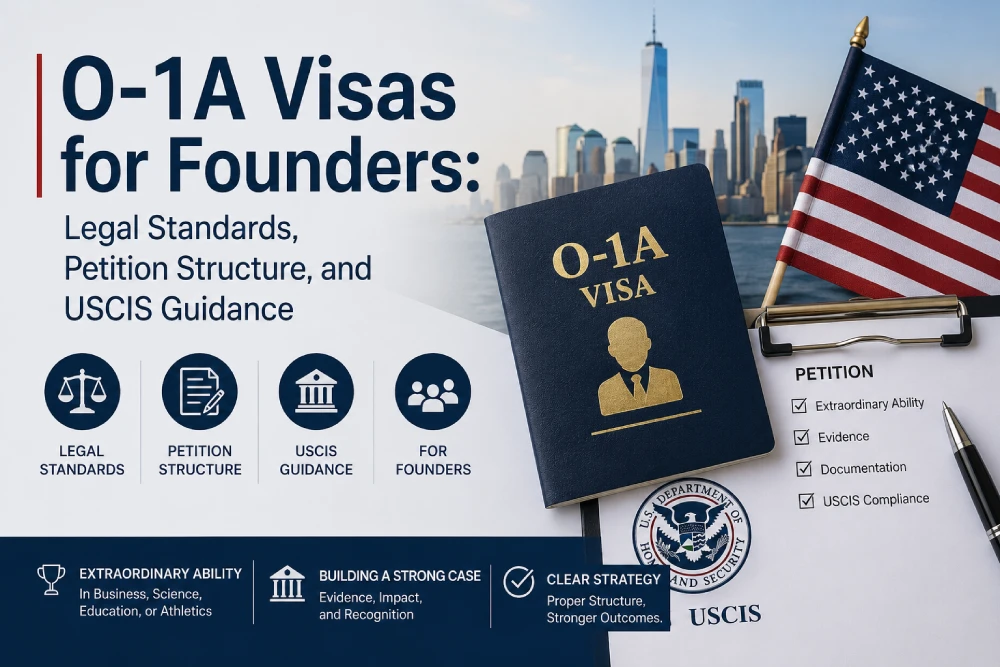
The O-1A classification is a powerful nonimmigrant option for founders who can demonstrate extraordinary ability in business, science, education, or athletics. Unlike investment-based immigration categories, the O-1A is not driven by capital contribution or ownership percentage alone. Instead, it turns on whether the beneficiary has sustained national or international acclaim and is coming to the United States to continue work in the area of extraordinary ability.
For founders, the O-1A can be especially useful because USCIS now recognizes that entrepreneurial talent can be shown through a wide range of evidence. A founder may qualify through awards, press coverage, significant funding, critical roles, original contributions, commercial success, and letters from recognized experts or relevant government entities. The petition must still be carefully structured, however, because the beneficiary cannot self-petition directly.
What is the O-1A visa?
The O1 visa is a nonimmigrant visa for people who have reached the top of their field in business, science, education, or athletics. To qualify, the founder must show sustained national or international acclaim and continuing work in the area of extraordinary ability.
For founders, this usually means building a case around recognition, influence, innovation, and impact rather than simply company ownership.
Petitioner structure
A valid O-1A filing requires a U.S. petitioner. That petitioner may be a U.S. employer, a U.S. agent, or, in certain founder cases, a separate U.S. legal entity owned by the beneficiary. The key issue is not merely ownership, but whether the entity has the authority and practical ability to petition for the founder in a bona fide working relationship.
This distinction matters in adjudication. USCIS examines whether the petitioner is real, whether the employment or engagement is legitimate, and whether the founder’s duties are sufficiently defined. A petition that fails to explain the relationship between the founder and the filing entity invites avoidable scrutiny.
Extraordinary ability evidence
USCIS evaluates O-1A petitions by reference to regulatory criteria. A strong founder case should not simply list accomplishments; it should map evidence to the governing categories and explain why the evidence demonstrates sustained acclaim. Common categories include major awards, membership in associations requiring outstanding achievement, published material about the beneficiary, judging the work of others, original contributions of major significance, authorship in professional publications, and employment in a critical or essential capacity for distinguished organizations.
For founder petitions, the most persuasive evidence often includes a combination of the following:
- Independent press coverage in recognized outlets.
- Proof of venture funding, revenue growth, or meaningful product adoption.
- Patents, licenses, or other indicia of innovation.
- Evidence that the founder holds a critical role in a company with a strong market or industry footprint.
- Expert letters that describe the founder’s impact in concrete, non-conclusory terms.
USCIS policy update
USCIS’s January 8, 2025 Policy Manual update is particularly relevant to founder filings. The update clarified how adjudicators evaluate evidence for O-1A petitions and provided more useful examples for entrepreneurs and innovators. It also confirmed that a separate U.S. legal entity owned by the beneficiary may file the petition, so long as the entity and work arrangement are properly structured and supported by the record.
The same update is important for extensions. USCIS may limit an extension to one year when the beneficiary is continuing the same event or activity, while longer extensions may be available in other circumstances. For founders whose work evolves as a company grows, this distinction should be addressed proactively in both the initial filing and any future extension request.
Practical filing considerations
A founder O-1A petition should present a coherent legal theory. The petition should identify the petitioner, describe the role, establish the beneficiary’s extraordinary ability, and tie the proposed work in the United States to the same area of distinction. USCIS will be looking for consistency between the founder’s record, the company’s structure, and the duties described in the petition.
In practice, the strongest cases are built well before filing. Counsel should evaluate whether the founder has sufficient independent recognition, whether the company structure supports the petition, and whether the evidence can withstand a close review. If the record is not yet mature enough, it is often better to strengthen the profile before filing than to force a petition prematurely.
Conclusion
The O-1A remains one of the most important immigration tools for founders with a substantial record of achievement. When properly structured, it can support entrepreneurship in the United States without requiring a traditional employer-employee arrangement in the ordinary sense. But success depends on legal precision, documentary depth, and a petition strategy aligned with current USCIS guidance.
Talk to an O-1A lawyer
If you are a founder considering an O-1A visa, the best next step is a legal review of your background and company structure. A well-prepared petition can make the difference between a strong filing and a weak one.
At Kenjay Law, we help founders build O-1A petitions that are strategic, credible, and aligned with current USCIS guidance.
FAQs
Can a founder self-petition for an O-1A?
No. The founder must have a U.S. petitioner, such as a U.S. employer, agent, or qualifying legal entity. In some founder cases, a separate U.S. company owned by the beneficiary may file the petition if the structure is legitimate.
Do I need venture funding to qualify?
No. Funding can strengthen a case, but it is not required. USCIS focuses on whether the founder can show extraordinary ability through evidence such as press, awards, original contributions, critical roles, and other recognized achievements. The O-1A can be a strong option for entrepreneurs with public recognition and achievement, especially when they do not want to rely on a minimum investment threshold or an investment-based immigration path
How much evidence do I need?
USCIS generally expects proof that satisfies at least three of the eight O-1A criteria, though the full record must still show sustained acclaim and a high level of distinction.
What changed in USCIS’s latest guidance?
USCIS clarified how it evaluates O-1A evidence for entrepreneurs and confirmed that a separate legal entity owned by the beneficiary may file in appropriate cases. The guidance also addresses extension timing and how USCIS may treat continuing versus expanded work.
Is the O-1A a good option for startup founders?
It can be, especially for founders with a strong public record, industry recognition, and a real U.S. business structure. The case must be supported by evidence, not just a promising business plan.
What is the biggest mistake founders make in O-1A cases?
The most common mistake is treating the petition like a startup pitch instead of a legal filing. USCIS wants evidence tied to the regulatory criteria, a legitimate petitioner structure, and a clear explanation of why the founder qualifies under the extraordinary ability standard.