Many international students find that life after graduation centers on getting a job. However, the biggest obstacle seems to be when your student scenario is not in line with your job objectives. The shift between an F1 visa and the H1B can be rather tricky, as one has to make sure that dates, forms, sponsor support, and rules have to fit just right. Even one error might hurt your permission to work or your chance to remain in the United States.
That is the reason it pays to learn about the F1 to H1B visa steps ahead of time. Switching from F-1 student status to H-1B work status ranks among the usual routes for graduates from other countries, yet it demands good preparation. Grasping the contrast in F1 vs H1B, the way sponsorship operates, and the right moment to bring in an H1B visa lawyer helps you dodge expensive setbacks.
What is an F-1 visa?
An F-1 visa is a student visa that allows you to study at an American school as a full-time student. It is a learning goal, not a lifelong job, used by schools.
With F-1 status, you receive permission for work only in certain cases, such as:
- On-campus employment: Allow for 20 hours per week
- CPT (Curricular Practical Training): Let you gain work experience same as internship
- OPT (Optional Practical Training): 12 Hours of temporary employment
What is an H-1B visa?
The H-1B visa is a non-immigrant work visa that enables American companies to hire skilled foreign workers for specialized jobs. These positions usually require expert skills and a bachelor’s degree, at a minimum, or something equivalent. USCIS sees H-1B as tied to the employer, so you cannot file for yourself.
H-1B status opens a path to ongoing work and may later support green card efforts.
F-1 vs. H-1B: What’s the difference?
Grasping F1 vs H1B lets you prepare your switch in the best way.
| Factor | F-1 Visa | H-1B Visa |
| Primary Purpose | Study | Work |
| Sponsorship | School | Employer |
| Work Permission | Limited | Full-time |
| Duration | Based on the program | Usually 3 years, extendable |
| Immigration Intent | Temporary | Dual intent allowed |
How does the F-1 to H-1B visa transition work?
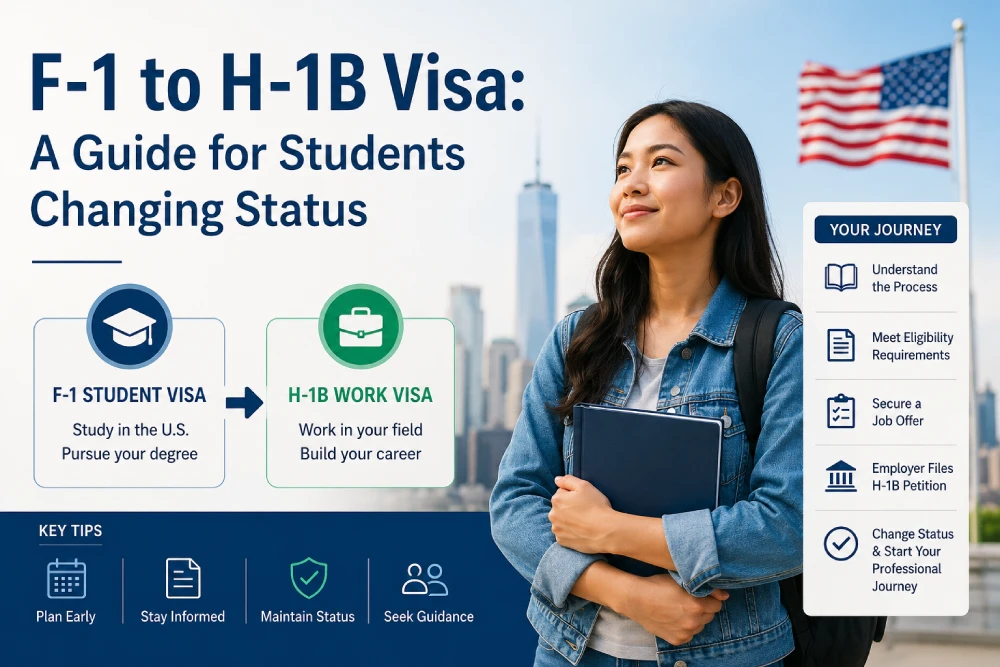
The official way to change your immigration status from a student visa (F-1) to a work visa (H-1B) is the F1 to H1B visa transition. It frequently occurs after you complete school or during your OPT, once you have a sponsor willing to support you. The steps will be carried out on an uptight schedule and will require collaboration between you, the company, and the government offices.
Step 1: Secure a job offer from an H-1B sponsoring employer
The first step in the F1 visa to H1B process is to find a company that is willing to process your H-1B request. Because H-1B depends on the employer, you cannot submit it alone. The position also needs to fit as a specialty occupation.
Step 2: Employer completes H-1B registration
The company has to submit your registration while the H-1B cap period is open. This counts as the initial formal entry into the H-1B lottery. Getting picked in the lottery comes before they can send the full petition.
Step 3: File the H-1B petition
Once the selection occurs, the employer submits Form I-129 and supporting documents requesting permission to change your status to H-1B, rather than your F-1 status.
Required documents often include:
- Job offer details
- Degree and transcripts
- Passport and visa documents
- Current F-1 status proof
Step 4: Wait for USCIS decision
USCIS audits the petition and may approve it, reject it, or request additional evidence. It is extremely important not to discontinue your F-1 status at this juncture.
Step 5: Status changes from F-1 to H-1B
After approval, your status updates on the official H-1B beginning date, which is normally October 1. This completes your F1 to H1B visa conversion and allows you to work in a full-time position under the H-1B status.
What is cap-gap and why does it matter?
Timing stands out as one of the top worries in the F1-to-H1B process. Your F-1 status or OPT work authorization could expire before the H-1B starts. That leaves an open space where you risk losing legal status or work rights. The Cap-Gap rule exists exactly to fix that kind of space.
Cap-Gap is a short-term extension that allows F-1 students to remain in the country and continue working, in most cases, while their H-1B petition is pending (or pending approval).
Why Cap-Gap matters:
- Prevents interruption in legal status
- Helps you continue working during the transition
- Protects against gaps between OPT and H-1B start date
- Provides stability while waiting for H-1B activation
Missing Cap-Gap coverage leaves many students open to additional status issues during the F1-to-H1B visa transition.
Common challenges in F-1 to H-1B transition
The steps certainly appear simple; however, real-world issues complicate everything.
Timing issues with OPT expiration
Should your OPT end before your H-1B filing or approval, your work schedule may be affected.
Employer sponsorship delays
Certain companies put off submitting documents or fail to meet deadlines.
Lottery uncertainty
H-1B picks run very competitive, so not all entries win the selection.
Change of status errors
Wrong details on forms can lead to holdups, rejections, or status trouble.
When should you start planning?
The best students begin well in advance.
You do well to begin planning your F1 to H1B visa transition:
- During the final academic year
- During OPT
- Before H-1B registration opens
Beginning shortly increases the effectiveness of your collaboration with employers and maintains transparency in legal procedures.
Important things to avoid during F-1 to H-1B transition
It is best to be careful when undertaking the F1 to H1B visa process, yet it is very easy to make mistakes, and this aspect may cause holdups, status incongruence, or even a rejected petition. In this switch, guarding your legal position and schedule counts a lot. Learning what to skip helps you skip extra headaches.
Letting your F-1 status or OPT expire
A frequent error involves overlooking key end dates. Be mindful of your OPT dates, grace period, and H-1B final deadlines. Any break in status might harm your legal stay or work rights inside the United States.
Assuming your employer knows the full process
Not all companies grasp every H-1B schedule, paper needs, or Cap-Gap details. Keep yourself updated and confirm that the employer gets solid legal help for your F1 visa to H1B transition.
Traveling internationally without legal advice
Leaving the country with a pending status change can harm the request. Sometimes officials see it as dropping the change request. Check with an H1B visa lawyer first before any trip.
Delaying document preparation
Putting off gathering transcripts, visa papers, job letters, or ID records adds stress and slows submission.
Keep ready:
- Passport
- I-20
- OPT documents
- Degree records
- Employment documents
Working outside authorized status
Avoid taking any job beyond your authorized F-1 work authorization or before H-1B activation. Work without approval can trigger major immigration problems.
Ignoring requests for evidence (RFE)
When USCIS asks for more details, answer fast and correctly. Slow or partial replies can hurt the final decision on your petition.
Handling complex situations without legal support
With past visa problems, status breaks, or tricky employer issues, going solo raises the chance of mistakes. Getting help early from an H1B visa lawyer supports a safer switch.
What happens after H-1B approval?
Once your H-1B gains approval:
- Your work authorization becomes employer-specific
- Your visa category changes officially
- You can continue employment under H-1B rules
- Future green card planning becomes possible
This step completes your shift from student to professional immigration status.
Conclusion
Moving from an F1 visa to an H1B involves far more than forms. It counts as one key legal change during your time in the United States. Handled right, the switch creates chances for steady career progress and later immigration options. Handled poorly, it leads to holdups, status trouble, or lost chances.
Legal help really counts for this reason. Kenjay Law guides students, professionals, and companies through complex immigration transitions with clear steps and accuracy. No matter whether you seek aid with an F1-to-H1B visa status change, company filings, or a smart legal strategy, our team of experts works to reduce risk and safeguard your path ahead.
If you plan to move from student status to work status, reaching out for solid legal backing at the start can change everything.