Selecting the appropriate U.S. work visa is not a simple matter of filling out forms. It prepares your entire immigration. There are numerous types of visas, each of which is specific to jobs and circumstances, and that is why many people become lost, and a single misstep can cost you time and money.
Whether you are a specialist in your area, a person with a desire to invest, or simply a company that has decided to establish its shop in the U.S., it all depends on whether you know what visa suits you. We should take a stroll through it just to see where you are.
What is a work visa and why is it important?
A work visa is a formal authorization from the U.S. government that permits an individual from another nation to come to the United States, reside, and accept employment under established regulations. It is always related to a cause, such as working for a particular employer, performing a particular job, or doing business.
The visa is strictly limited in terms of duration, eligibility, and adherence requirements. Illegal employment in the U.S. is considered unauthorized employment.
Work visas are important because they provide a clear, legal means for talented individuals and companies globally to be absorbed into the U.S. economy.
They ensure that the employer and the worker undergo the right procedures. This is used to save jobs, remuneration rates, and working conditions and keep all within immigration laws.
The major reasons why a work visa is essential are:
- The right to work in the United States.
- Security for both the employer and the employee under United States labor and immigration laws.
- Availability of international career and career development.
- Specified long-term stay or permanent residence (in some visa types) pathway.
- Opportunities to expand the business of companies entering and operating in the U.S.
Types of U.S. work visas you need to know
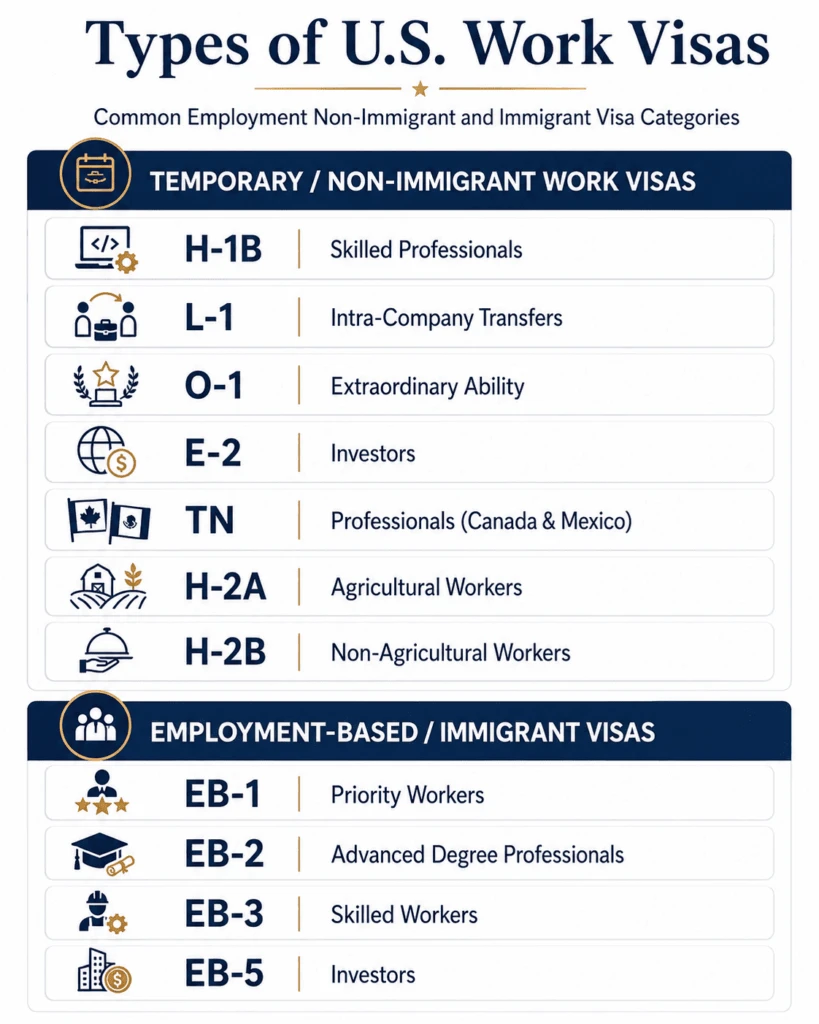
The H-1B visa is designed to accommodate individuals in specialized fields such as IT, engineering, healthcare, and finance. You must be sponsored by an American employer, and it is annual because the demand is high.
H-1B visa for skilled professionals
The H-1B visa targets individuals employed in technical fields such as IT, engineering, healthcare, and finance. You have to be sponsored by an American employer, and there is an annual lottery since the demand is very high. This visa is highly competitive and is used frequently when companies want to bring in talent from other countries.
Documents Required:
- Degree certificates
- Job offer letter
- LCA approval
- Employer details
Duration: Up to 6 years
L-1 visa for intra-company transfers
The L-1 visa permits foreign companies to bring their personnel to an American subsidiary. It has two types: L-1A, which covers executives and managers, and L-1B, which covers employees with specialized knowledge. It is particularly effective when a company needs to expand or relocate employees.
Documents Required:
- Company relationship proof
- Employment records
- Organizational charts
- Business documents
Duration: 5 to 7 years
O-1 visa for extraordinary ability
An O-1 visa is issued to individuals who have accomplished something remarkable in the fields of business, science, the arts, or even sports. You must have strong evidence of your awareness, and it should focus on actual achievements rather than degrees.
Documents Required:
- Awards and achievements
- Recommendation letters
- Portfolio or publications
- Work contracts
Duration: Initial 3 years
E-2 visa for investors
The E-2 visa allows individuals to invest in and operate a business in the United States. It suits entrepreneurs who plan to manage the company themselves and make a solid investment.
Documents Required:
- Investment proof
- Business plan
- Source of funds
- Company documents
Duration: Renewable 2-year
TN visa for professionals (Canada and Mexico)
The TN visa is available through the USMCA for qualified professionals from Canada and Mexico. It usually processes faster and only covers certain approved occupations.
Documents Required:
- Proof of citizenship
- Job offer letter
- Qualification proof
- Employer details
Duration: Up to 3 years
H-2A visa for agricultural workers
The H-2A visa also allows employers in the U.S to hire foreigners to work on farms temporarily where the locals are not available. It is usually applied to seasonal labor such as planting and harvesting.
Documents Required:
- Employer petition
- Job contract
- Labor shortage proof
- Worker documents
Duration:
Seasonal temporary period
H-2B visa for non-agricultural worker
The H-2B visa is used for temporary work outside agricultural work in the hotel, construction, and landscaping sectors. Employers are required to demonstrate that they have urgent requirements and cannot find sufficient U.S. employees.
Documents Required:
- Employer petition
- Labor certification
- Job details
- Worker information
Duration:
Up to 1 year
EB-1 visa for priority workers
The EB-1 visa is granted to individuals with extraordinary ability, outstanding researchers, or multinational managers. It is more mobile than most and does not require labor certification; therefore, high-level talent is attracted to it.
Documents Required:
- Achievement proof
- Employment records
- Recommendation letters
- Company documents
Duration:
Permanent residency
EB-2 visa for advanced degree professionals
The EB-2 visa is intended for individuals with higher education or exceptional ability. It also provides a National Interest Waiver in certain examples, thus you might not require an employer sponsor.
Documents Required:
- Degree certificates
- Work experience proof
- Supporting documents
- Employer details (if required)
Duration:
Permanent residency
EB-3 visa for skilled workers
The EB-3 visa applies to skilled workers and professionals as well as certain unskilled positions. It necessitates employer sponsorship and labor certification, and the waiting periods are usually lengthy.
Documents Required:
- Job offer letter
- Labor certification
- Qualification proof
- Employer documents
Duration:
Permanent residency
EB-5 Visa for Investors
The EB-5 visa offers an opportunity to obtain a green card by investing in an American-based business that will create jobs. It is targeted at individuals with substantial wealth who desire permanent residence.
Documents Required:
- Investment proof
- Business plan
- Job creation plan
- Source of funds
Duration:
Conditional then permanent
How the main U.S. work visa types compare
| Visa category | Generally suitable for | Sponsorship or qualifying basis | Temporary or permanent |
|---|---|---|---|
| H-1B | Specialty-occupation professionals | U.S. employer sponsorship | Temporary |
| L-1 | Managers, executives and specialized-knowledge employees transferring within a qualifying organisation | Qualifying multinational employer | Temporary |
| O-1 | Individuals with extraordinary ability or achievement | U.S. employer or eligible agent petition | Temporary |
| E-2 | Eligible treaty-country nationals investing in and directing a U.S. business | Qualifying treaty investment | Temporary |
| TN | Eligible Canadian and Mexican professionals in qualifying occupations | Qualifying U.S. professional position | Temporary |
| H-2A | Temporary or seasonal agricultural workers | U.S. employer sponsorship and applicable labour procedures | Temporary |
| H-2B | Temporary or seasonal non-agricultural workers | U.S. employer sponsorship and applicable labour procedures | Temporary |
| EB-1 | Priority workers, certain outstanding researchers and multinational managers or executives | Depends on the EB-1 subcategory | Permanent |
| EB-2 | Advanced-degree professionals and people with exceptional ability | Employer sponsorship or qualifying National Interest Waiver | Permanent |
| EB-3 | Skilled workers, professionals and certain other workers | Generally requires employer sponsorship | Permanent |
| EB-5 | Qualifying immigrant investors | Investment and job-creation requirements | Permanent |
Which type of U.S. work visa may fit your situation?
The appropriate visa depends on why the applicant wants to work in the United States and how the proposed employment is structured.
You have a U.S. specialty-occupation job offer
The H-1B category may be relevant when the position requires highly specialized knowledge and the applicant has the required educational or equivalent professional background.
You are transferring within a multinational company
The L-1 category may be considered when an eligible employee is transferring from a foreign organisation to a qualifying U.S. parent, subsidiary, affiliate or branch.
You have extraordinary ability or major achievements
The O-1 category may be appropriate for applicants who can document extraordinary ability or achievement in business, science, education, arts, athletics, motion pictures or television.
You plan to invest in a U.S. business
The E-2 classification may be available to eligible nationals of treaty countries who make a qualifying investment and will develop and direct the U.S. enterprise.
You are a Canadian or Mexican professional
The TN classification may be considered by eligible Canadian and Mexican citizens entering the United States to work in an approved USMCA professional occupation.
The position is temporary or seasonal
H-2A applies to qualifying temporary agricultural employment, while H-2B applies to qualifying temporary non-agricultural work.
Your goal is permanent residence
EB-1, EB-2, EB-3 or EB-5 may be relevant when the applicant is seeking permanent residence based on achievements, qualifications, employer sponsorship or investment.
The Department of State’s visa directory identifies different categories according to the purpose of travel, including specialty occupations, intracompany transfers, extraordinary ability, treaty investment, temporary labour and employment-based immigration.
How to choose the right work visa
To select the appropriate U.S. work visa, it is not necessary to go with the most popular one. It is about choosing something that fits your background, your mission, and what you desire in the long run. Choosing the wrong one is among the primary causes of stalled or rejected applications.
Start with your professional profile
Your qualifications, work experience, and present occupation dictate what you are eligible for. For example, a person who works in a technical specialty would be eligible for the H-1B, whereas a manager with an overseas company would be much better suited to the L-1. Identifying the visa with your real profile gives your application a high profile.
Understand your employment or business setup
Consider your case scenario. Is it an American company that is hiring you, leaving your current employer, or beginning your business? Each case leads to a different visa, and by selecting the appropriate one, you can avoid compliance issues in the future.
Align with long-term immigration goals
The easier ones are the L-1A visa or the EB ones, in case you wish to settle permanently in the U.S. Temporary visas can be okay in the short run, however, they can limit your choices in future unless you are keen.
Evaluate eligibility and documentation strength
It is not sufficient to fulfill the minimum requirements. Your paperwork must clearly support your story. The job description, your qualifications, and the company’s setup must align with visa regulations to avoid additional requirements or rejection.
Consider processing time and limitations
Some visas have lottery or annual quotas, whereas others may be submitted at any time. You will know the timelines, caps, and the pace at which each is progressing, which will help you set realistic expectations and avoid surprises.
Avoid guesswork and misalignment
Another error is to use it in an inappropriate category or without a complete understanding of the rules. All visas are very strict, and even minor discrepancies will negatively affect your prospects.
Common challenges applicants face
To obtain a U.S. work visa, one must not only have the necessary qualifications on paper but also meet other requirements. It requires a lot of care, timing, and attention to detail. The majority of the population gets into trouble not because of a lack of qualifications but because they are not aware of how precise the process can be.
Choosing the wrong visa category
One of the biggest errors is selecting a visa based on what seems popular instead of what actually fits. That leads to applications that do not align well and increases the risk of denial.
Weak or inconsistent documentation
The U.S. immigration officers require all documents to be coherent, complete, and well-organized. The slightest variations in forms or supporting papers may lead to delays or Requests for Evidence.
Difficulty in proving eligibility
It is one thing to say you meet the rules. It is another thing to show clear proof that satisfies USCIS. Many applicants struggle to demonstrate specialized knowledge, executive duties, or outstanding ability in a convincing way.
Employer-related compliance issues
Many work visas require sponsorship from a U.S. employer. Any loopholes in the company paperwork, pay regulations, or business formation may be detrimental to the whole application.
Handling requests for evidence (RFEs)
RFEs happen often and can be complicated. If the response is not strong and well-prepared, it can slow things down significantly or even lead to denial.
Missing deadlines and timelines
Visa processes run on tight schedules. Missing registration periods, filing dates, or reply deadlines can mean losing your chance or getting the application rejected.
Changing immigration policies
Immigration laws and how they are understood may shift quickly. People who rely on outdated or inaccurate information should be surprised.
Conclusion
The majority of applicants fail due to a lack of qualification. Their failure is a result of choosing the wrong visa, not reading the essential information in the documentation, or not fulfilling all the compliance requirements. U.S. immigration is rather unforgiving, and any slight mistake can lead to delays or denial.
This is the very reason why we are here. We consult with professionals, entrepreneurs, and businesses at Kenjay Law to identify the most appropriate visa strategy, assemble effective applications, and ensure that everything meets USCIS requirements. We do not just submit papers. We build strong cases to get approved.
Frequently asked questions about U.S. work visa types
What are the main types of work visas in the United States?
Common temporary work-related options include H-1B, L-1, O-1, E-2, TN, H-2A and H-2B. Employment-based immigrant categories include EB-1, EB-2, EB-3, EB-4 and EB-5.
What are employment nonimmigrant visas?
Employment nonimmigrant visas allow eligible foreign nationals to work temporarily in the United States for an approved employment, investment, transfer or professional purpose. The requirements depend on the individual visa classification.
What is the difference between a nonimmigrant work visa and an employment-based immigrant visa?
A nonimmigrant work visa generally authorises a temporary stay for a particular purpose. An employment-based immigrant visa provides a potential pathway to lawful permanent residence.
Do all U.S. work visa types require employer sponsorship?
No. Many temporary categories require a petition from a U.S. employer or eligible agent, but some work-related classifications are based on investment, nationality or another qualifying arrangement. Certain permanent categories may also permit self-petitioning when their separate requirements are met.
Which work visa is suitable for an intracompany transfer?
The L-1 visa is generally used for qualifying managers, executives and specialized-knowledge employees transferring between related foreign and U.S. organisations.
Which U.S. work visa is available to investors?
The E-2 classification may be available to eligible treaty-country nationals who make a qualifying investment in a U.S. enterprise. The EB-5 category is a separate immigrant investor route with permanent residence as its objective.
Which visas are available for seasonal workers?
The H-2A category applies to qualifying temporary or seasonal agricultural work. H-2B applies to qualifying temporary or seasonal non-agricultural employment.
Can a temporary work visa lead to a green card?
Some temporary visa holders may later pursue permanent residence through an eligible employment-based, family-based or other immigration category. Holding a temporary visa does not automatically guarantee green-card eligibility.
Which work visa is best for skilled professionals?
The appropriate category depends on the profession, qualifications, nationality, employer, achievements and proposed duties. H-1B, O-1, TN and certain employment-based categories may be relevant in different circumstances.
How do I choose between different types of work visas?
Compare the purpose of employment, sponsorship requirements, qualifications, nationality restrictions, duration, numerical limitations and long-term immigration goals. Legal review can help identify the category that best matches the applicant’s circumstances.