The EB-1A extraordinary ability category and the EB-2 National Interest Waiver (NIW) remain the two leading self-petition green card options in 2026. Both let a qualified foreign national file an immigrant petition without an employer sponsor and without PERM labor certification, but they rest on different legal standards and carry very different Visa Bulletin consequences. Choosing well depends on your record, your proposed U.S. work, your country of chargeability, and your priority-date goals.
What is EB-1A?
EB-1A is the first-preference category for individuals with extraordinary ability in the sciences, arts, education, business, or athletics (INA § 203(b)(1)(A); 8 C.F.R. § 204.5(h)). The applicant must show sustained national or international acclaim and rank among the small percentage at the very top of the field. Being educated, successful, or experienced is not enough; USCIS wants objective proof of recognized achievement.
Under Kazarian v. USCIS (9th Cir. 2010), officers apply a two-step test: first they confirm the record meets at least three of the ten regulatory criteria (or one major international award), then they make a separate “final merits determination” on whether the evidence as a whole truly shows top-of-field standing. USCIS continues to apply the final-merits review carefully. For that reason, a petition that merely checks three regulatory categories may still be denied if the record, viewed as a whole, does not establish sustained acclaim and top-of-field standing.
What is EB-2 NIW?
EB-2 NIW combines the second-preference category with a waiver of the job offer and labor certification requirements. You must first meet the EB-2 threshold with an advanced degree (or foreign equivalent), a bachelor’s degree plus five years of progressive specialty experience, or exceptional ability. You then qualify for the waiver under Matter of Dhanasar, 26 I&N Dec. 884 (AAO 2016), by showing that (1) your proposed endeavor has substantial merit and national importance, (2) you are well positioned to advance it, and (3) on balance it benefits the U.S. to waive labor certification.
On January 15, 2025, USCIS issued important NIW guidance in the Policy Manual. The guidance does not replace the Matter of Dhanasar framework, but it clarifies how USCIS evaluates EB-2 eligibility, national importance, the connection between the applicant’s qualifications and the proposed endeavor, and the weight given to supporting evidence such as recommendation letters and business plans. Broad descriptions such as “health care,” “technology,” or “business development,” without a specific proposed endeavor and independent support, are less likely to be persuasive.
EB-1A vs. EB-2 NIW: The core difference
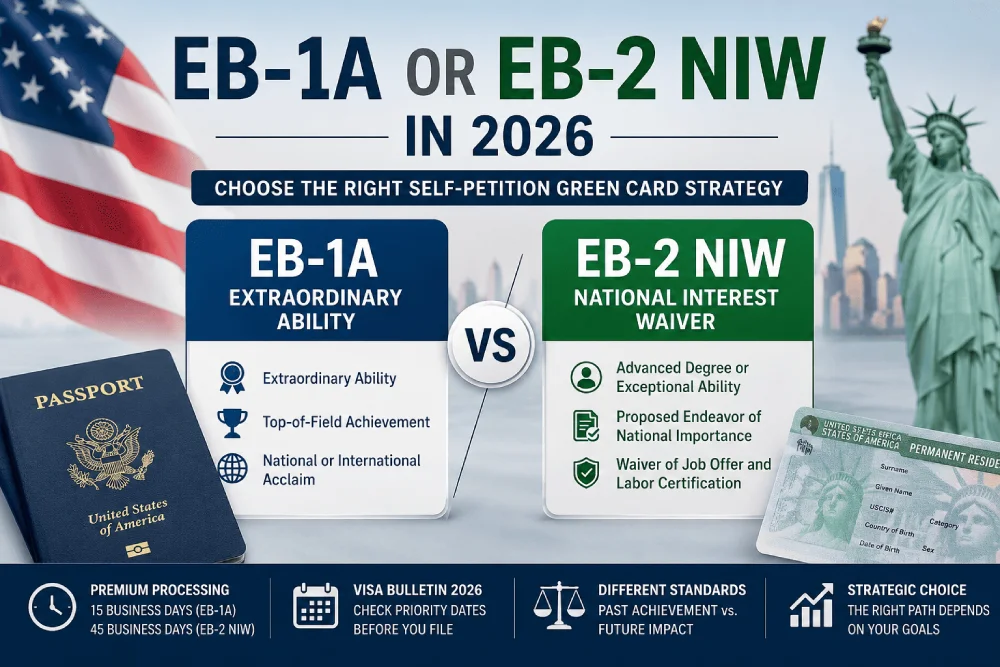
EB-1A centers on the applicant’s recognition and whether the record shows top-of-field standing. EB-2 NIW centers on EB-2 eligibility plus a proposed endeavor important enough to justify waiving labor certification. In short, EB-1A looks at what you have achieved; NIW looks at what you will do and why it matters to the United States.
Evidence that supports each petition
EB-1A evidence
EB-1A petitions draw on the ten regulatory criteria, including: major awards; selective memberships; published material about you; judging the work of others; original contributions of major significance; scholarly authorship; artistic exhibitions; leading or critical roles for distinguished organizations; high remuneration; and commercial success in the performing arts. Because of the final-merits step, meeting three criteria is only the start: a strong petition explains why the evidence matters and places your achievements in the context of your field.
EB-2 NIW evidence
Strong NIW petitions document both your qualifications and the importance of the work: degrees and credential evaluations; experience letters; publications, citations, or patents; business plans, funding, contracts, or revenue records; evidence of government or industry interest; independent expert letters; and a specific proposed endeavor statement. Under the 2025 guidance, the most common failure is defining the endeavor too broadly.
Premium processing in 2026
Premium processing is available for both EB-1A and EB-2 NIW I-140 petitions. EB-1A carries a 15-business-day timeframe; EB-2 NIW carries a 45-business-day timeframe. It buys speed, not approval — within the window USCIS must approve, deny, or issue a Request for Evidence or Notice of Intent to Deny. Effective March 1, 2026, the Form I-907 premium fee for these I-140 classifications is $2,965. Always confirm the current USCIS fee schedule before filing.
Visa bulletin considerations in 2026
An approved I-140 does not by itself produce a green card; you also need an available visa number. As of the July 2026 Visa Bulletin, USCIS requires employment-based applicants to use the Final Action Dates chart. EB-1 is current for most countries, but EB-1 India has retrogressed and EB-1 China carries a cutoff. EB-2 is current for most countries, but EB-2 China is backlogged and EB-2 India is unavailable for the remainder of fiscal year 2026 (ending September 30). For applicants born in India or China, EB-1A can offer a real timing advantage if the higher standard is met; for others, NIW may still be the stronger, better-supported option. Because the bulletin shifts monthly, review the latest Department of State bulletin and USCIS filing-chart guidance before filing.
Which option is better in 2026?
There is no universal answer. EB-1A may suit applicants with substantial independent recognition; EB-2 NIW may suit applicants with strong qualifications and an endeavor of clear national importance who do not yet meet the extraordinary ability bar. Some applicants file both to preserve options and use a priority date — each petition is prepared separately. You can also file NIW first, build evidence, and pursue EB-1A later.
| Factor | EB-1A | EB-2 NIW |
| Best for | Top-of-field achievers | Strong professionals with a national-interest endeavor |
| Standard | 8 C.F.R. 204.5(h); Kazarian | Matter of Dhanasar (2016) |
| Self-petition | Yes | Yes |
| Focus | Past achievement and acclaim | Future endeavor and U.S. benefit |
| Difficulty | Higher bar | More accessible, evidence-driven |
Frequently asked questions
Does EB-1A or EB-2 NIW require an employer sponsor?
No. Both allow self-petitioning without a job offer or labor certification. EB-1A applicants must intend to keep working in their field; NIW applicants request a waiver of the job-offer and labor-certification requirements.
Is EB-1A harder than EB-2 NIW?
Generally, yes – EB-1A requires sustained national or international acclaim. NIW is more flexible but still demands strong, independent evidence and a specific endeavor, especially under the January 2025 guidance.
Can entrepreneurs qualify?
Yes, when the evidence supports the standard. EB-1A focuses on recognition and achievement; NIW focuses on the endeavor’s national importance and your ability to advance it. A detailed business plan with tangible proof of progress is essential.
Does premium processing guarantee approval?
No. It only requires USCIS to act within the timeframe – an approval, denial, Request for Evidence, or Notice of Intent to Deny.
Speak with Kenjay Law
Self-petition cases turn on how evidence is selected, organized, and legally argued. Kenjay Law helps entrepreneurs, researchers, executives, physicians, scientists, and other professionals evaluate EB-1A and EB-2 NIW options and build a filing strategy grounded in current law, USCIS policy guidance, and Visa Bulletin realities. Contact us to schedule a consultation about which path fits your case.
This article is for general informational purposes only and is not legal advice. Immigration laws, USCIS policies, filing fees, processing times, and Visa Bulletin dates change frequently, and reading this article does not create an attorney-client relationship. For advice about your specific facts, consult a qualified immigration attorney.