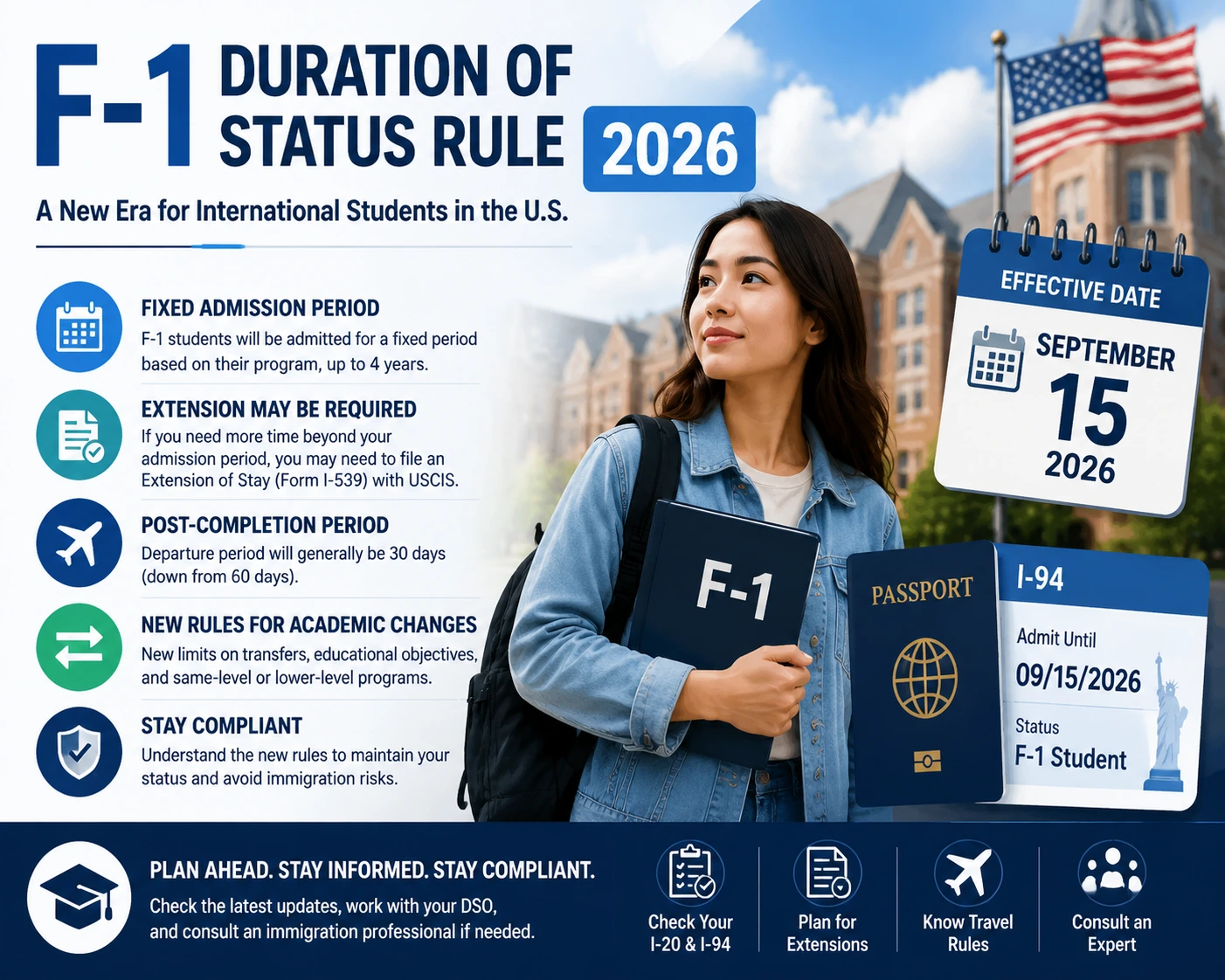
On July 17, 2026, the Department of Homeland Security (DHS) published a final rule that replaces “duration of status,” commonly shown as D/S on Form I-94, with date-specific periods of admission for F academic students, J exchange visitors, and I representatives of foreign information media. The rule is published at 91 Fed. Reg. 44,976 (July 17, 2026) and is scheduled to take effect on September 15, 2026.
Until September 15, 2026, the existing D/S framework remains in effect. DHS classified the regulation as a major rule subject to congressional review and stated that it will publish a further notice if that process changes the effective date or terminates the rule. Individuals and organizations should therefore prepare for implementation while continuing to monitor official developments.
One distinction is essential: this rule changes a person’s period of admission and authorized stay not the expiration date printed on a visa stamp. A visa generally permits a person to request admission at a port of entry. After admission, the Form I-94 ordinarily controls how long the person may remain, while the Form I-20, Form DS-2019, employment authorization document, and applicable program rules govern the activities the person may undertake.
What “duration of status” meant
Federal regulations have used D/S for F students since the late 1970s and for most J and I nonimmigrants since 1985. Under that system, most F and J nonimmigrants received no calendar expiration date on Form I-94. They could remain while properly maintaining status through the authorized program or training period and the applicable departure period.
D/S was never permission to remain indefinitely. An F-1 student still had to pursue a full course of study, make normal progress, obtain authorization for employment, and comply with the other conditions of F status. A J-1 exchange visitor likewise had to follow the terms of the approved exchange program. The practical difference was that a school’s designated school official (DSO) or a program’s responsible officer (RO) could often update the program record and issue a new Form I-20 or DS-2019 without a separate extension-of-stay adjudication by U.S. Citizenship and Immigration Services (USCIS).
The new date-specific admission periods
For admissions or readmissions on or after September 15, 2026, the general framework will be:
| Classification | General period of admission | Important special rule |
| F-1 student and F-2 dependents | Program length shown on Form I-20, but no more than four years per admission, plus the applicable 30-day departure period | English-language-training students are limited to an aggregate 24 months, including breaks and annual vacation, plus 30 days. The existing aggregate 12-month limit for study at a public high school remains. |
| J-1 exchange visitor and J-2 dependents | Program length shown on Form DS-2019, but no more than four years per admission, plus the applicable 30-day departure period | Department of State limits for the particular J program category continue to apply. |
| I foreign-media representative and dependents | Time needed to complete the qualifying assignment, but no more than 240 days per admission | A person presenting a passport issued by the People’s Republic of China, other than a Hong Kong SAR or Macau SAR passport, is generally limited to 90 days. |
F and J nonimmigrants may still be admitted up to 30 days before the program start or report date. The 30-day pre-program period and the 30-day post-program period do not count against the four-year maximum.
CBP will place a specific “admit until” date on the Form I-94. That date must be checked after every entry. The program or employment authorization may end before the I-94 date because the I-94 can include the 30-day period for departure or for seeking other lawful authorization.
The rule does not make the same structural change to M-1 vocational students, who were already admitted for date-specific periods rather than D/S.
A new USCIS extension-of-stay process
A new Form I-20 or DS-2019 will not, by itself, extend a date-specific period of admission. A person who needs additional time generally must either:
- file an extension-of-stay application with USCIS using the form designated by USCIS—currently Form I-539; or
- depart the United States and seek a new admission from U.S. Customs and Border Protection.
An extension filing generally requires the filing fee, supporting evidence, and an updated, properly endorsed Form I-20 or valid Form DS-2019, as applicable. USCIS may require biometrics or an interview. The final rule does not make a biometrics appointment mandatory in every case.
USCIS must receive a timely extension request no later than the expiration of the authorized period shown on Form I-94, including the 30-day departure period where the regulation permits filing during that period. Waiting until the departure period creates additional risk: an F-1 student who files during that 30-day period may continue a full course of study while the application is pending but may not begin or continue practical training or other employment until USCIS approves the required applications.
A timely filed F-1 extension request generally places the student in a period of authorized stay while USCIS adjudicates it and permits continued study. Certain existing on-campus employment, curricular practical training, and qualifying hardship employment may continue for a limited period if all regulatory conditions are met and the filing occurred before the departure period. A pending application does not guarantee approval, cure a prior status violation, or create unrestricted employment authorization. If USCIS denies the request after the prior admission period has expired, the principal and dependents generally must depart immediately.
New restrictions on school transfers and academic changes
The rule does considerably more than replace D/S. Unless DHS formally delays or suspends implementation of these provisions, it also imposes the following limits:
- An F-1 student below the graduate level may not transfer schools or change an educational objective—defined as a major or educational level during the first academic year of the program unless SEVP authorizes an exception for extenuating circumstances.
- An F-1 student at the graduate level or above may not change a major or educational level during the program.
- A graduate-level F-1 student may not transfer schools during the program unless SEVP authorizes an exception for extenuating circumstances.
- An F-1 student who completes a U.S. program after September 15, 2026, may pursue another F-1 program only at a higher educational level, not at the same or a lower level.
The final rule permits DHS, through September 14, 2028, to delay or suspend these academic-mobility restrictions if implementation is infeasible. Any delay or suspension must be announced through the Federal Register and the DHS Study in the States website. Students should confirm the current implementation status before relying on an exception or making an academic change.
OPT, STEM OPT, and H-1B cap-gap protection
The final rule does not eliminate Optional Practical Training (OPT), the STEM OPT extension, or H-1B cap-gap protection. It does, however, change the filing structure in many cases.
Outside the transition exception discussed below, an F-1 student seeking post-completion OPT will generally need an employment-authorization application and either a USCIS extension-of-stay application or a new admission after travel. A STEM OPT request may likewise require both an employment-authorization filing and an extension-of-stay filing when the requested training extends beyond the current admission period.
The rule preserves the existing automatic extension of an eligible STEM OPT employment authorization document for up to 180 days while a timely STEM OPT application is pending. It also preserves cap-gap protection for eligible F-1 beneficiaries of timely, nonfrivolous cap-subject H-1B petitions requesting a change of status. Under the regulation, the cap-gap extension may continue until April 1 of the relevant fiscal year or the approved petition’s validity start date, whichever is earlier, unless a terminating event occurs.
Temporary OPT and STEM OPT transition relief
An F-1 student who was admitted for D/S, is covered by the transition provision, and timely files Form I-765 for post-completion OPT or STEM OPT on or before March 18, 2027, generally does not also have to file Form I-539 for the requested training period. DHS may extend this temporary exemption in six-month increments by publishing a notice in the Federal Register.
Travel can change the result. A transition student who departs before filing for OPT or STEM OPT and returns with a fixed-date admission generally must follow the new filing structure. Travel while an extension or employment-authorization application is pending can also affect whether USCIS treats an extension request as abandoned. Individual review before travel is strongly recommended.
Transition rules for people already in the United States
F and J nonimmigrants admitted for D/S
A person who is properly maintaining F or J status on September 15, 2026, and was admitted for D/S generally does not need to file Form I-539 merely because the new rule takes effect. The person may remain until the later of:
- the expiration date on the applicable employment authorization document; or
- the program end date on the applicable Form I-20 or DS-2019 valid on September 15, 2026,
but not beyond the four-year transition limit ending September 15, 2030. The legacy departure period then applies: 60 days for an F nonimmigrant and 30 days for a J nonimmigrant. The regulation identifies the outside dates as November 14, 2030, for F nonimmigrants and October 15, 2030, for J nonimmigrants.
This protection depends on continued maintenance of status. A person who needs time beyond the transition period, extends a program, starts a new program, seeks practical or academic training covered by the rule, or makes another covered change generally must obtain a USCIS extension. A person who leaves the United States and seeks readmission on or after September 15, 2026, should expect CBP to issue a new date-specific Form I-94 under the new framework.
I nonimmigrants admitted for D/S
An I nonimmigrant properly maintaining D/S on September 15, 2026, is generally authorized to remain for the time needed to complete the qualifying activity, but no later than May 13, 2027. The outside transition date is December 14, 2026, for an I nonimmigrant presenting a PRC passport subject to the 90-day rule. An extension is required to remain beyond the applicable transition date.
Unlawful presence becomes a calendar-based risk
A date-specific I-94 creates a clear expiration point. If a person remains after that date without a timely filed request that provides a period of authorized stay or another lawful basis to remain, unlawful presence will generally begin the following day. A properly and timely filed extension request can prevent unlawful-presence accrual while it remains pending, but it does not erase unlawful presence or status violations that occurred earlier. The calculation is fact-specific, particularly after a denial, withdrawal, travel, or unauthorized activity.
The three- and ten-year unlawful-presence bars are generally triggered by departure or removal after the statutory threshold is reached not merely by reaching a particular day while still in the United States. More than 180 days but less than one year of unlawful presence can result in a three-year bar in the circumstances specified by law; one year or more can result in a ten-year bar. Statutory exceptions and waivers may apply. Anyone approaching or passing an I-94 deadline should obtain individualized legal advice rather than attempt to calculate unlawful presence without reviewing the complete immigration history.
Practical steps to take before september 15, 2026
- Identify the admission category. Determine whether the current Form I-94 shows D/S or a calendar date and whether the transition rules apply.
- Create one consolidated timeline. Compare the Form I-94, Form I-20 or DS-2019, EAD, passport, visa, program-completion date, and any planned OPT, academic training, transfer, or change-of-status filing.
- Check Form I-94 after every entry. Download the record from the CBP I-94 website and promptly address any apparent error.
- Prepare extension requests early. DHS encourages filing within the six months before the authorized stay expires. Allow time for the DSO or RO recommendation, supporting evidence, filing fee, delivery, and receipt processing.
- Do not rely on mailing by the deadline. The regulation uses the USCIS receipt date to determine whether an extension request is timely.
- Review travel before departure. Reentry can convert a transition D/S admission into a fixed-date admission, and travel can alter or abandon a pending extension request depending on the circumstances.
- Review academic changes in advance. A school transfer, new major, new educational level, program extension, or second degree may require more than a SEVIS update.
- Employers should audit affected records. The I-94, EAD, Form I-20 or DS-2019, and USCIS receipt notices may have different end dates and different legal functions.
Frequently asked questions
1. When does the final rule take effect?
The scheduled effective date is September 15, 2026. The existing D/S rules remain in effect until then. Because the regulation is subject to congressional review and could also be affected by later agency action or litigation, confirm the rule’s status before relying on it.
2. Does every F-1 or J-1 nonimmigrant currently in the United States need to file form I- 539 immediately?
No. A person properly maintaining F or J status under D/S on September 15, 2026, is generally covered by the transition rule and does not file solely to convert the I-94 to a date-specific admission. A filing may nevertheless be required for a program extension, new program, training period, or other covered change.
3. What if a doctoral program takes longer than four years?
The four-year limit is a maximum per admission or extension, not a lifetime limit on F or J status. A qualified person may seek a USCIS extension or depart and apply for readmission. An extension is discretionary and must satisfy the applicable eligibility and filing requirements.
4. Is an updated Form I-20 or DS-2019 enough to remain beyond the Form I-94 date?
Generally, no. Under the fixed-date system, the updated school or sponsor document supports the requested period but does not itself extend the I-94. A timely USCIS extension or a new admission is generally required.
5. Is the F-1 grace period still 60 days?
It depends on the admission. An F nonimmigrant covered by the D/S transition retains the legacy 60-day departure period. A person admitted or readmitted under the new fixed-date framework generally receives 30 days after the program or authorized practical training, subject to continued compliance and the specific facts.
6. Does the rule cancel OPT or STEM OPT?
No. Both remain available, but many applicants under the fixed-date system will need to coordinate Form I-765 with an extension-of-stay application or travel and readmission. A temporary exception applies to certain transition applicants who timely file Form I-765 on or before March 18, 2027.
7. Can an F-1 student still transfer schools or change a major?
Possibly, but the new restrictions depend on the academic level, timing, and whether SEVP authorizes an exception. Graduate-level changes are particularly limited. Confirm whether DHS has delayed or suspended implementation before taking action.
8. How does the rule affect J-1 exchange visitors?
J-1 visitors will generally receive a fixed admission tied to the Form DS-2019 program end date, capped at four years. A sponsor’s extension of the DS-2019 will not, standing alone, extend the authorized stay; a USCIS extension will generally also be required.
9. How does the rule affect foreign media representatives?
Most I nonimmigrants will be admitted for the qualifying assignment for up to 240 days at a time. Certain holders of PRC passports, excluding Hong Kong SAR and Macau SAR passports, are generally limited to 90 days at a time. Eligible I nonimmigrants may request extensions.
10. Does the visa expiration date determine how long a person may remain in the United States?
No. The visa is generally an entry document. After admission, the Form I-94 ordinarily identifies the authorized period of stay. The program document and any EAD separately control the activities or employment that are authorized.
How Kenjay Law can help
The new rule requires careful coordination among the Form I-94, program documents, employment authorization, USCIS filing deadlines, travel, and future immigration plans. Kenjay Law assists students, exchange visitors, foreign-media professionals, dependents, and employers with individualized status reviews, extension and change-of-status strategies, work-authorization planning, and travel analysis.
To discuss how the final rule affects a specific timeline, contact Kenjay Law to schedule a consultation.
Official government sources
Disclaimer
This article provides general information as of July 18, 2026, and is not legal advice. It does not create an attorney-client relationship with Kenjay Law or Kenny Bhatt, Esq. Immigration rules, agency instructions, filing requirements, and effective dates can change, and the application of law depends on individual facts. The rule remains subject to congressional review and potential litigation, and its effective date or specific provisions may change. Readers should obtain advice from a qualified immigration attorney before acting or declining to act. Prior results do not guarantee a similar outcome.