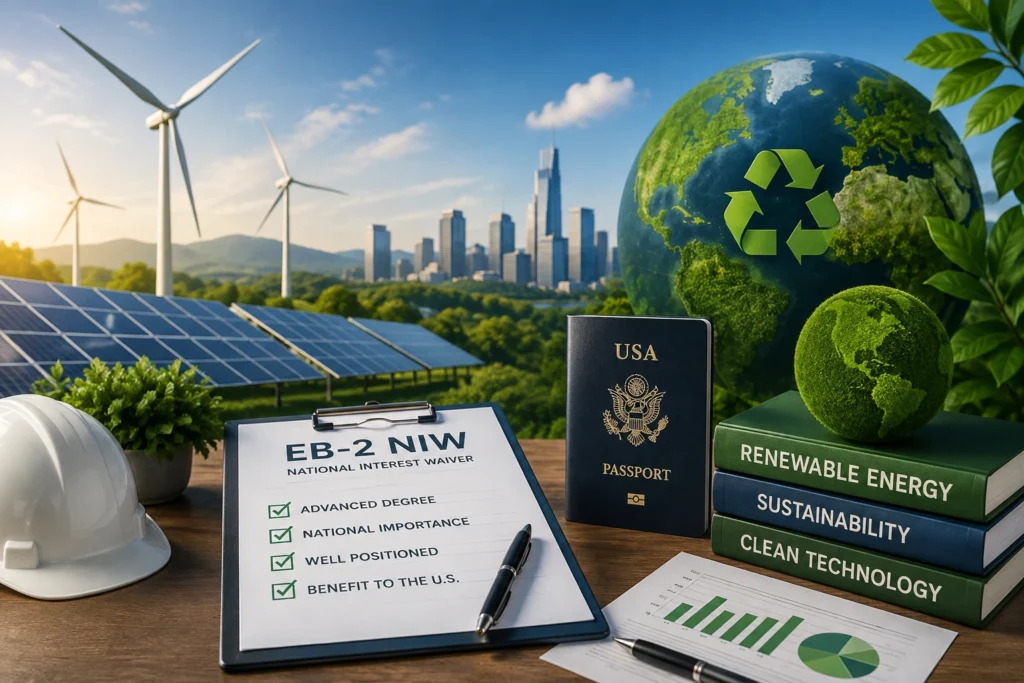
EB-2 National Interest Waiver cases are often prepared by professionals in the renewable energy and sustainability fields. USCIS will not approve a petition for an employee who just works in solar energy, battery storage, climate science, water management, environmental engineering, or other critical fields. The petition must clearly specify the applicant’s proposed activity, what it is likely to lead to, the applicant’s capability to advance the activity, and how it benefits the United States to avoid the job-offer process and labor certification.
On January 15, 2025, USCIS issued new guidance on NIW. The legal standard was unchanged, but the guidance on evaluating basic EB-2 eligibility, the proposed endeavour, the importance of the nation, and the evidence demonstrating that the applicant is prepared to carry out the proposed endeavour was updated
What is the EB-2 national interest waiver?
An EB-2 NIW is a special category to allow a qualified applicant to submit Form I-140 without a permanent job offer or the PERM labor certification process. The applicant can petition on their own but must pass two distinct law hurdles.
Step 1: Qualify for the EB-2 category
- Advanced Degree: A master’s degree from or an equivalent from a foreign country to the United States, or at least five years of progressive post-baccalaureate experience in the specialty.
- Exceptional Ability: If it passes at least three of the regulatory criteria then a review of the full record to determine if the applicant’s expertise is above and beyond what is generally encountered in the profession.
The applicant’s education, experience, or exceptional ability must connect to the proposed endeavor. Clearing the EB-2 threshold by itself does not prove eligibility for the national interest waiver.
Step 2: Satisfy the three-part Dhanasar test
1. The proposed endeavor has substantial merit and national importance.
2. The applicant is well positioned to advance the proposed endeavor.
3. On balance, it would benefit the United States to waive the job-offer and labor-certification requirements.
Key point: USCIS looks at the national importance of the applicant’s particular endeavor—not just the importance of renewable energy or sustainability as a general field.
Who may qualify for EB-2 NIW in renewable energy and sustainability?
There is no separate EB-2 NIW category specifically for renewable energy professionals. An applicant must first qualify for the underlying EB-2 classification and then demonstrate that the proposed endeavor meets the National Interest Waiver requirements.
Professionals whose work may be relevant to an EB-2 NIW petition can include:
- Renewable energy engineers.
- Solar energy professionals.
- Battery and energy storage specialists.
- Electrical and power systems engineers.
- Grid modernization professionals.
- Environmental engineers and scientists.
- Sustainability professionals.
- Energy efficiency specialists.
- Clean manufacturing professionals.
- Water and resource management specialists.
- Researchers working on energy technologies.
- Founders developing energy or sustainability technologies.
- Consultants working on infrastructure, resilience, or energy systems.
Working in an important industry does not automatically establish NIW eligibility. The petition should explain the applicant’s specific proposed endeavor, its potential impact, the applicant’s qualifications and progress, and why waiving the job offer and labor certification requirements would benefit the United States.
What the 2025 USCIS guidance means for energy professionals
The updated guidance drives home several practical rules:
- A broad statement such as “I will work in renewable energy” is not a complete proposed endeavor.
- A résumé or job description does not, by itself, explain what the applicant plans to accomplish in the United States.
- National importance rests on the endeavor’s potential prospective impact, not only the reputation or value of the industry.
- The endeavor does not always need to operate nationwide. A state, regional, or employer-based project may qualify when the evidence shows broader implications, significant impact, scalability, transferability, or value to an important U.S. problem.
- Past achievements matter, but USCIS also looks at the applicant’s plan, progress, resources, support, and realistic pathway for advancing the proposed work.
Use current energy policy as supporting evidence, not as the legal test
Federal programs, agency reports, industry data, and national energy priorities can help show why a problem matters. They do not replace the Dhanasar analysis, and they can shift over time. A strong NIW petition should rest on durable, documented benefits rather than one political phrase, one tax credit, or one temporary funding program.
Depending on the applicant’s actual work, relevant benefits may include:
- improving grid reliability, transmission, interconnection, resilience, or cybersecurity;
- spending less energy, waste, downtime, water, or resources;
- improving the use of batteries, long-duration storage, thermal management, recycling or second-life technologies; or
- enhancing domestic manufacturing, critical-mineral processing, or supply-chain security; and
- providing secure power, cooling or load control for data centers and sophisticated manufacturing; or
- enhancing water treatment, reuse, desalination, drought resistance, or flood resistance; and
- improving the quality of the environment, emissions, or health by quantifiable technical changes.
Environmental benefits must be presented forthrightly and truthfully. These can be more influential when they are linked to measurable outcomes (e.g., cost savings, reliability, public health, resource efficiency, resilience, or wider adoption).
Prong one: Define a specific proposed endeavor
The goal of any endeavor statement should be to identify the problem that the applicant will address, the work or method he or she will pursue, who will benefit, and the expected outcome.
Too general: “I will keep on pursuing a career in renewable energy and will continue to support sustainability in the USA.”
More effective: “Will design and test thermal-management solutions for utility-scale lithium-iron-phosphate battery systems, aiming to minimize degradation from heat and increase storage-system life for hot-climate applications, which could contribute to more reliable electricity service and less replacement expense for utilities.
The second sentence is not necessarily acceptable. It is stronger because it identifies a problem, describes a process, mentions possible beneficiaries, and supports a possible impact with evidence.
Evidence that may support national importance
- Any government report, utility study, agency plan or reliable industry data that identifies the problem; or
- Evidence that the method or technology is readily accessible to more than one organization, region or industry;
- Adoption, licensing, pilot programs, or third-party use;
- Any evidence of substantial economic, infrastructure, environmental, public health or supply chain impacts; and
- Letters of explanation from utilities, customers, public agencies or qualified experts regarding the overall value and meaning of the work.
Examples of renewable energy proposed endeavors
A strong proposed endeavor generally describes more than a job title or an intention to continue working in renewable energy. It should identify the problem being addressed, the work the applicant plans to perform, potential beneficiaries, and the expected impact.
Examples may include:
Grid modernization and reliability
An electrical engineer may propose developing or implementing technologies that improve grid reliability, transmission efficiency, energy system resilience, or the integration of distributed energy resources.
Battery storage and energy systems
An energy storage specialist may focus on improving battery safety, thermal management, operating life, efficiency, recycling, or utility-scale energy storage performance.
Solar energy development
A solar professional may propose improving photovoltaic system performance, reducing project costs, increasing deployment efficiency, strengthening grid integration, or developing technologies that improve solar energy reliability.
Energy efficiency and industrial sustainability
An engineer or sustainability professional may focus on reducing energy consumption, water use, waste, operating costs, or emissions across industrial facilities or other large-scale systems.
Sustainable manufacturing
A professional may work on manufacturing processes, materials, supply chains, recycling technologies, or production systems that improve efficiency, resilience, or domestic manufacturing capacity.
These examples do not establish eligibility by themselves. The strength of an EB-2 NIW petition depends on the applicant’s individual qualifications, evidence, proposed endeavor, and ability to satisfy the applicable legal standard.
Prong two: Show that the applicant is well positioned
USCIS considers the entire record. There is no minimum number of publications, patents, projects, citations, awards, or recommendation letters required. Specific and reliable evidence is linked to the proposed venture.
Some evidence that could be useful is:
- educational qualifications, special training, licenses, certificates and experience;
- measurable results and completed projects, including megawatts commissioned, costs saved, efficiency achieved, downtime avoided, water saved and waste reduced;
- publications, citations included in context, peer review, conference presentations, patents, or licensed technology;
- grants, awards, competitive funding, government contracts, or selection for technical programs;
- standards committees, advisory roles, professional leadership, or technical recognition;
- contracts, pilots, customers, letters of intent, investment, revenue, or a detailed implementation plan for founders and consultants; and
- letters from supervisors, collaborators, customers, government partners, or independent experts who can give detailed and verifiable facts.
Recommendation letters should support, not replace, the documentary record. No legal requirement of a minimum number and no rule to require a fixed number of independent recommenders. Quality, detail, and credibility are more important than quantity.
Prong three: Explain why the waiver benefits the United States
The third prong calls for a balancing analysis. The petition should explain why the benefits of the applicant’s proposed contributions justify waiving the normal job-offer and labor-certification requirements in that particular case.
Relevant considerations may include:
- the work naturally spans several employers, clients, research partners, or projects;
- the applicant is an entrepreneur, consultant, or self-employed professional for whom traditional employer sponsorship may be impractical;
- the applicant has unusual knowledge, technology, experience, relationships, or a record of results that cannot be fully captured through one labor-certified position;
- the United States would benefit from the applicant’s contributions even if other qualified U.S. workers are available; and
- the public value or time-sensitive nature of the work supports allowing the applicant to advance the endeavor without being tied to one permanent job offer.
A labor shortage may give useful background, but a petition should not rest only on the claim that no qualified U.S. worker exists. That is not the NIW standard.
EB-2 NIW vs. PERM for renewable energy professionals
Renewable energy professionals considering employment-based permanent residence may encounter both the traditional EB-2 process involving PERM labor certification and the EB-2 National Interest Waiver.
The two pathways have important differences.
EB-2 with PERM labor certification
A traditional employer-sponsored EB-2 case generally requires a permanent job offer from a qualifying U.S. employer and completion of the PERM labor certification process before the immigrant petition is filed.
EB-2 National Interest Waiver
An EB-2 NIW applicant may request that the job offer and labor certification requirements be waived when the applicant qualifies for EB-2 and establishes that granting the waiver would be in the national interest.
This can be particularly relevant for researchers, engineers, founders, consultants, and other professionals whose proposed work may extend across employers, projects, customers, research institutions, or industries.
However, avoiding PERM does not mean that the EB-2 NIW standard is easier in every case. The applicant must independently establish eligibility for EB-2 and satisfy all three parts of the National Interest Waiver analysis.
The appropriate immigration strategy depends on the applicant’s qualifications, proposed endeavor, employment situation, evidence, country of chargeability, and long-term plans.
How different professionals may document their cases
Researchers and university professionals
Connect the research program to a specific U.S. problem, and articulate what the applicant will bring to the research program. Examples of useful evidence: publications, citations, grants, peer review, patents, invited presentations, collaborations, and evidence of use or adoption.
Industry engineers and technical managers
Document technical responsibility, operational scale, completed systems, safety or reliability improvements, cost savings, efficiency gains, and third-party use. Clearly distinguish the applicant’s own role from the work of the employer or project team.
Founders, consultants, and self-employed professionals
Provide a comprehensive plan, market validation, financial resources, customer interest, contracts or letter of intent, pilot test results, intellectual property, partnerships, and a realistic implementation timeline. Though not a formal requirement in all instances, a business plan is often very significant when the future project is based on a company or consulting practice.
Professionals working with confidential information
It is not enough to say that the information is confidential to avoid the requirement for proof. Often, results are presented by presenting redacted project records, letters from the employer or customer, general performance data, patent submissions, technical summaries, and expert explanations.
Evidence checklist for renewable energy professionals
The evidence required for an EB-2 NIW petition depends on the applicant and proposed endeavor. Renewable energy and sustainability professionals may consider documentation that demonstrates both past achievements and a realistic ability to advance future work.
Potential evidence may include:
- Degrees, academic records, and professional training.
- Professional licenses and certifications.
- Employment and experience letters.
- Technical project documentation.
- Evidence of energy or cost savings.
- Evidence of improved efficiency or reliability.
- Project scale, capacity, or performance data.
- Patents or intellectual property.
- Publications and citations.
- Conference presentations.
- Peer review or technical judging.
- Awards or professional recognition.
- Government or industry contracts.
- Grants or competitive funding.
- Letters from qualified experts.
- Customer or partner letters.
- Pilot project results.
- Contracts or letters of intent.
- Evidence of technology adoption.
- Business plans for founders and entrepreneurs.
- Evidence of funding, investment, or commercial interest.
- Documentation showing how the work addresses a broader U.S. need.
The evidence should be connected directly to the proposed endeavor. Simply submitting a large volume of documents without explaining their relevance may not establish that an applicant is well positioned to advance the proposed work.
Common weaknesses that can lead to an RFE or denial
- A proposed endeavor that is only a job title, résumé summary, or general intention to work in the field.
- Evidence showing that renewable energy is important without explaining the applicant’s specific endeavor.
- A local or employer-specific project with no explanation of broader implications or significant impact.
- Future plans unsupported by progress, resources, contracts, technical detail, market evidence, or a practical implementation plan.
- Generic recommendation letters that repeat praise but give few verifiable facts.
- Inconsistent dates, job titles, education, or project descriptions across immigration filings and supporting records.
- A mismatch between the applicant’s EB-2 qualification and the proposed endeavor.
- Reliance on a temporary policy, tax incentive, or political slogan as the main national-importance argument.
- Failure to distinguish the applicant’s contribution from the work of an employer, research group, or team.
Important 2026 visa and filing considerations
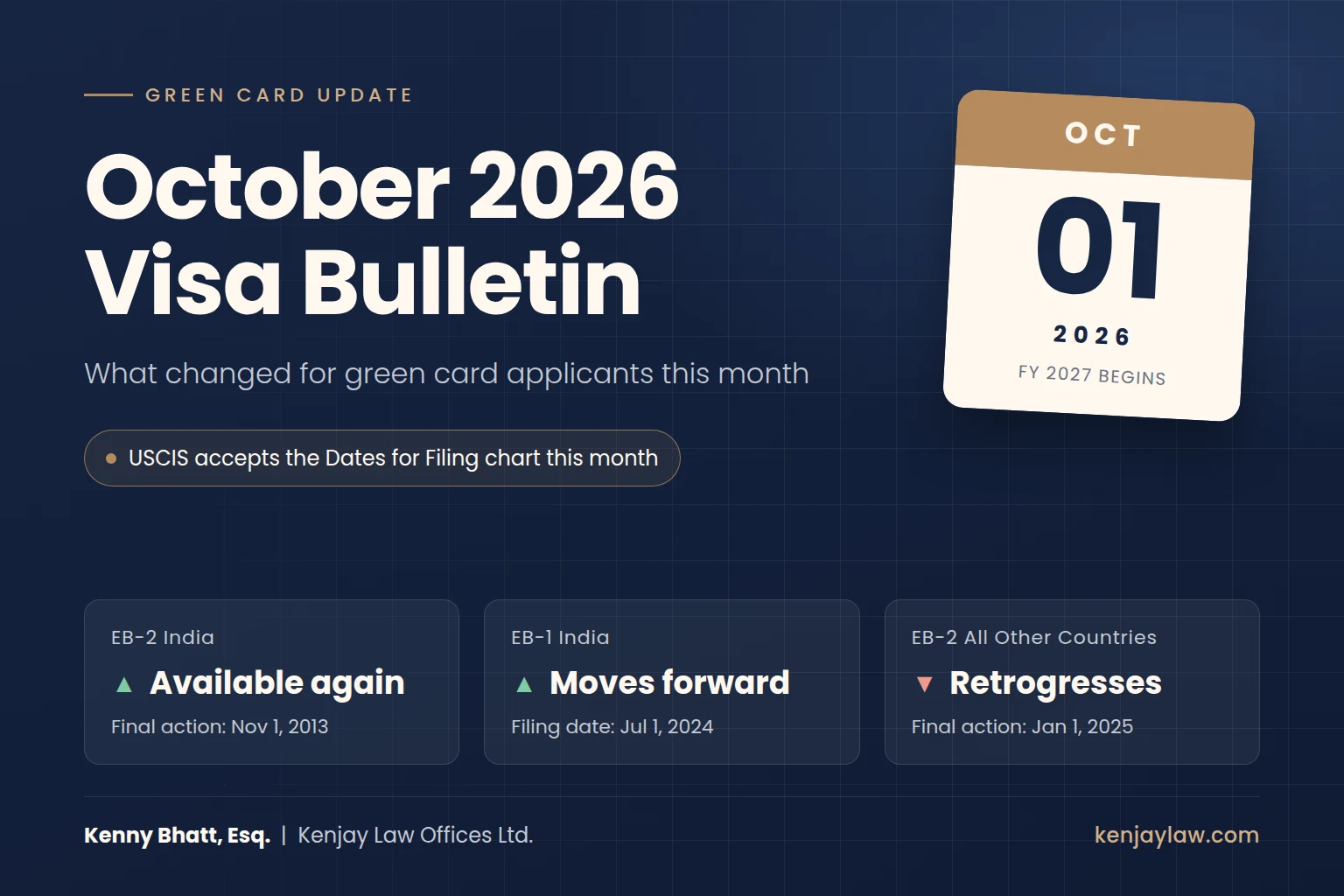
Visas are subject to change on a monthly basis. The information below is correct as of 03.08.2026. Applicants should check the latest Department of State Visa Bulletin and the USCIS adjustment-of-status filing chart before filing.
Visa bulletin and priority dates
The EB-2 Final Action Date in the August 2026 Visa Bulletin is current for all countries except India and September 1, 2021, for applicants born in China. The Department of State announced that the FY 2026 India EB-2 per-country limit had been reached. New annual movement limits will be established on 1 October 2026, but movement will be subject to future visa availability.
Typically, an approved Form I-140 will create a priority date and maintain a place in line for immigrant visas. In some married cases, cross-chargeability may allow use of the spouse’s country of chargeability. These rules should be reviewed based on the family’s individual facts.
Premium processing
NIW Form I-140 petitions can be filed for premium processing by filing Form I-907. If the premium processing fee is paid by mail and it is dated on or after March 1, 2026, the premium-processing fee will be $2,965. USCIS has 45 business days to make an adjudicative decision. Premium processing buys speed, not approval, and an RFE or other notice may extend the overall case timeline.
I-140 approval is not a green card
The filing of Form I-140 does not grant lawful status, employment authorization, permanent residence, or lawful right to remain in the United States. The applicant is required to apply for adjustment of status or consular processing as a separate process from their initial visa application if the applicant has a visa number and meets all requirements for adjustment of status or consular processing.
Fees and processing times
USCIS processing times and filing fees are subject to change. Before applying, applicants should check the current Form I-140 fee, if any, the Asylum Program Fee, if applicable, the premium processing fee, and the subsequent adjustment of status or consular processing fees.
Frequently asked questions
Do I need a Ph.D.?
No. Qualification can be obtained by a master’s degree, by a qualifying bachelor’s degree plus five years of progressive post-baccalaureate experience, or by exceptional ability. The evidence and the proposed venture are more important considerations than a specific academic qualification.
Can I file while I am in H-1B, F-1, or J-1 status?
In general, you can submit Form I-140 as long as you are in one of the above statuses, but the immigration intent implications vary. H-1B allows for dual intent. Please see the advice before traveling to Japan, renewing visas, and applying for an F-1 and J-1 visa. A J-1 applicant who will be subject to the two-year home-residence requirement will need to discuss this with the officer.
Can a state or regional project have national importance?
Yes. National importance is not determined only by geographic size. The evidence must show broader implications, significant impact, scalability, transferability, or value to an important U.S. problem.
How many publications, citations, or recommendation letters do I need?
No minimum exists. The industry, the founders, and the engineers can use projects and measurable outcomes, patents, adoption, standards development, customers’ evidence, or impact on operations rather than a big academic body of work.
Can my spouse and children receive green cards through my case?
A spouse and unmarried children under 21 may qualify as derivative beneficiaries, subject to visa availability and their individual eligibility. An I-140 approval alone does not give derivatives work authorization or permanent residence
Can I file Form I-140 while living outside the United States?
Yes. Form I-140 may be filed while the applicant is abroad. After approval and when a visa number is available, the applicant may complete immigrant-visa processing through a U.S. consulate.
Can I change employers after NIW approval?
The NIW is not tied to one sponsoring employer, but the approval is based on the proposed endeavor described in the petition. A move within the same or a closely related area is generally easier to explain than a complete change of field.
Can I file EB-2 NIW and EB-1A petitions at the same time?
Yes. The categories have different legal standards, and each petition must independently qualify. A filing strategy should consider the applicant’s evidence, priority date, country of chargeability, and long-term immigration plan.
Is a professional engineering license required?
No. A professional license may strengthen the evidence and may help satisfy an exceptional-ability criterion, but it is not required for every NIW case.
Should I wait for energy policy to become more favorable?
There is no general legal reason to wait for a political change. Filing strategy should depend on the strength of the evidence, the applicant’s status, visa availability, and whether the proposed endeavor is ready to be documented.
The bottom line
Renewable energy and sustainability professionals may have strong EB-2 NIW cases, but the petition must be built around the individual applicant, not the importance of the industry alone. The strongest cases usually present a specific proposed endeavor, reliable evidence of the applicant’s past achievements and present ability, a credible plan for future work, and a clear explanation of the endeavor’s broader prospective impact.
Before filing, applicants should identify what can be proved, what can be measured, what independent evidence is available, and what gaps remain. Careful case selection and honest evidence development are more valuable than exaggerated claims or generic templates.
Speak with Kenjay Law Offices Ltd.
Kenjay Law Offices Ltd. represents professionals, researchers, engineers, entrepreneurs, and other qualified applicants in employment-based immigration matters throughout the United States and worldwide.
To discuss whether an EB-2 NIW may fit your background, contact info@kenjaylaw.com or call (224) 800-1585.
Disclaimer: This article is provided for general informational and educational purposes only and does not constitute legal advice. Reading this article or contacting the firm does not by itself create an attorney-client relationship. Immigration law, USCIS policy, visa availability, processing times, and government fees change frequently. Past results do not guarantee a similar outcome. Consult a licensed immigration attorney regarding your individual circumstances.
Official resources
- USCIS: January 15, 2025 NIW policy update
- USCIS Policy Manual, Volume 6, Part F, Chapter 5
- Matter of Dhanasar, 26 I&N Dec. 884 (AAO 2016)
- Department of State: August 2026 Visa Bulletin
- Department of State: India EB-2 FY 2026 limit announcement
- USCIS: Adjustment of Status Filing Charts
- USCIS: Case Processing Times
- USCIS: Fee Schedule