| Important August 2026 Update Matter of Delcarmen-Lara, 29 I&N Dec. 830 (BIA 2026), was published by the Board of Immigration Appeals on August 13, 2026. This decision overrules Matter of Arrabally and Yerrabelly. The BIA said a trip taken with advance parole counts as a “departure” under INA § 212(a)(9)(B)(i)(II), the 10-year unlawful-presence rule. USCIS has updated its public guidance more broadly under INA § 212(a)(9)(B)(i). The BIA made the new rule apply only going forward. Anyone planning to travel needs to check for prior unlawful presence and any other possible inadmissibility issues before they leave. |
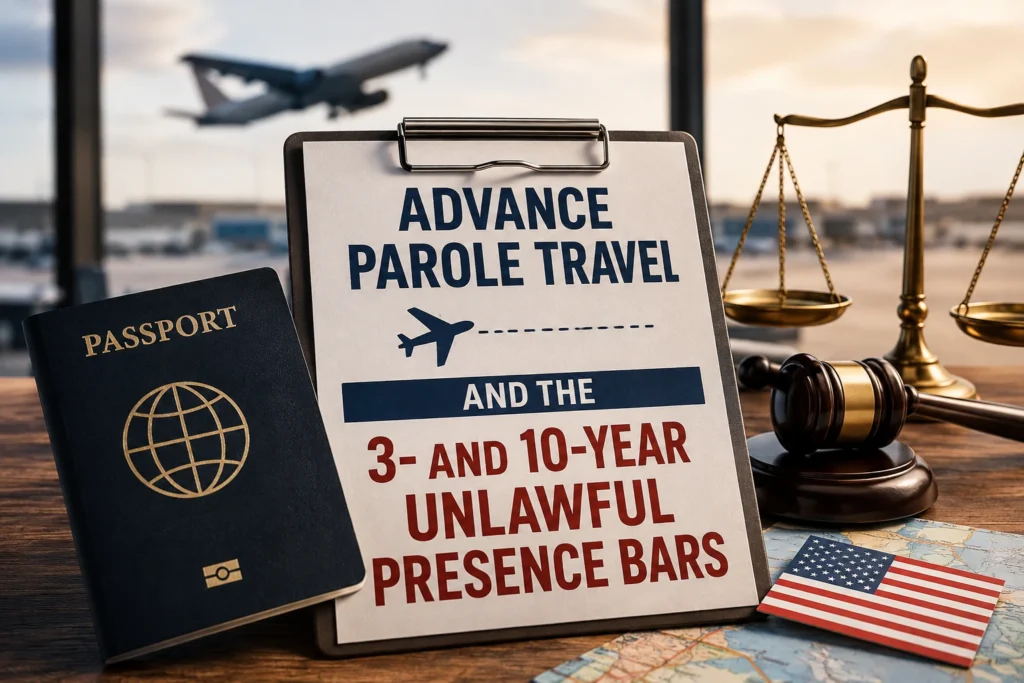
Advance parole can help certain noncitizens who are already in the United States travel abroad for a short time. The legal effect of using it changed significantly on August 13, 2026.
For years, Matter of Arrabally and Yerrabelly usually kept qualifying advance-parole travel from counting as the kind of “departure” that started the 10-year unlawful-presence bar. Matter of Delcarmen-Lara threw that protection out. Not every person who travels with advance parole becomes inadmissible. What matters now is the person’s full immigration history before the trip.
The primary issues include whether the individual accrued unlawful presence before departure, the amount of unlawful presence, if any, whether the rules for the 3-year or 10-year bar are satisfied, and whether there is another ground of inadmissibility or removal.
Key takeaways
- Matter of Delcarmen-Lara overruled Arrabally and treats advance-parole travel as a “departure” under INA § 212(a)(9)(B)(i)(II).
- USCIS now states that, as of August 13, 2026, departing after obtaining an Advance Parole Document is a departure for purposes of inadmissibility under INA § 212(a)(9)(B)(i).
- The BIA’s formal holding specifically addressed the 10-year provision. The 3-year provision has additional statutory requirements and must be analyzed separately.
- Advance parole does not create unlawful presence. The risk depends primarily on unlawful presence accrued before departure and the traveler’s complete immigration history.
- The BIA made its new holding prospective because people had relied on the prior Arrabally rule.
- An approved Advance Parole Document is not a legal determination that travel is safe and does not guarantee that CBP will parole the traveler into the United States.
1. What is advance parole?
Advance parole allows some noncitizens already in the United States to depart and return temporarily at a U.S. port of entry. It is typically requested on Form I-131. Adjustment-of-status applicants and some humanitarian and deferred-action protection recipients, such as eligible DACA recipients, commonly use it.
Advance parole is not a visa. It does not give lawful immigration status by itself. It also does not promise that CBP will let the person back in. Customs and Border Protection decides at the port of entry whether to grant parole.
2. What are the 3-year and 10-year unlawful presence bars?
INA § 212(a)(9)(B) can bar a noncitizen from admission after certain amounts of unlawful presence followed by a qualifying departure or removal. The 3-year and 10-year rules are related but not the same.
The 3-year bar
Under INA § 212(a)(9)(B)(i)(I), a person who built up more than 180 days but less than one year of unlawful presence during a single stay, left the United States on their own before proceedings under INA § 235(b)(1) or § 240 started, and then tries to enter within three years of that departure can be inadmissible.
The 10-year bar
Under INA § 212(a)(9)(B)(i)(II), a person who built up one year or more of unlawful presence during a single stay and later left or was removed can be inadmissible when seeking admission within ten years of that departure or removal.
Unlawful presence is a technical calculation
Being “out of status” and building up “unlawful presence” are not always the same. The count can depend on age, the type and timing of filings, deferred action, periods of authorized stay, asylum rules, and statutory exceptions.
Examples of periods that may not count, depending on the facts and applicable law, include:
- time before the person turns 18;
- time spent during a valid DACA or deferred action for purposes of USCIS unlawful-presence policy;
- temporary period of time when a person’s Form I-485 is pending, which USCIS typically considers to be a temporary period of time in which the person is authorized to stay in the United States for unlawful-presence purposes; or
- certain periods while a bona fide asylum application is pending, subject to statutory limitations; and
- other statutory exceptions or special protections applicable to particular individuals.
Because one date can change everything, unlawful presence has to be counted from the actual immigration file, not from memory.
3. What did Matter of Delcarmen-Lara change?
In Matter of Arrabally and Yerrabelly, 25 I&N Dec. 771 (BIA 2012), the BIA held that a temporary trip under advance parole is not a “departure” for the 10-year unlawful-presence rule. The decision remained in effect for some fourteen years.
The Board did not agree in Matter of Delcarmen-Lara, 29 I&N Dec. 830 (BIA 2026). It said the word “departure” in the statute does not carve out an exception for someone who leaves for a short time with advance parole. The BIA therefore overruled Arrabally and held that advance-parole travel can count as a departure under INA § 212(a)(9)(B)(i)(II).
One important line still holds: the BIA’s formal decision spoke only to the 10-year provision. USCIS has updated its guidance under INA § 212(a)(9)(B)(i) as a whole, which covers both the 3-year and 10-year rules. Because the 3-year bar has extra statutory pieces, it should not be treated as the exact same thing.
4. The new holding is prospective
The BIA clearly refused to make its new reading retroactive. It noted that Arrabally had been the rule for a long time, that people had counted on it, and that changing the meaning of “departure” could hit adjustment-of-status eligibility hard.
The respondent in Delcarmen-Lara had traveled with advance parole and come back in January 2024. Even though the Board decided the case in 2026, it refused to apply the new departure rule to that earlier trip and made the holding prospective.
The latest USCIS guidance will now clarify that, effective Aug. 13, 2026, an advance-parole departure will be considered a departure for INA § 212(a)(9)(B)(i) purposes. For individuals with an advance parole trip that ended before August 13, 2026, the trip is not normally considered a triggering departure because of Delcarmen-Lara’s late arrival. Other grounds of inadmissibility or separate immigration problems can still apply.
Odd transition facts need their own review. A person who had departed prior to August 13 but remained overseas at the time of the release of the decision must not use only a general article.
5. Who is most likely to be affected?
The first question is not simply whether the traveler has advance parole. It is what happened before the planned departure.
Potential risk may exist where a person:
- accrued more than 180 days of unlawful presence before the trip;
- accrued one year or more of unlawful presence before the trip;
- had gaps before or between DACA or other deferred-action periods;
- entered without inspection and later accumulated sufficient unlawful presence;
- made an earlier departure that may already have triggered an unlawful-presence bar;
- has an outstanding or previous removal, deportation or exclusion order;
- has an unlawful reentry or attempted reentry history that could raise INA § 212(a)(9)(C) or another ground of inadmissibility.
Two persons with valid APDs may thus be left with two vastly different legal outcomes.
6. What does this mean for DACA recipients?
Delcarmen-Lara does not mean that DACA will be revoked or that every DACA recipient who visits will face an unlawful-presence bar. The analysis turns on how much unlawful presence built up before departure and the other statutory requirements.
Unlawful presence will not count against a DACA student during a valid DACA process. Children under 18 are also not included in the 3-year or 10-year unlawful-presence period. However, a time lapse between the DACA grants, after the 18th birthday but before the first DACA grant, can count.
If a DACA recipient considers traveling, they will need to reconstruct the timeline from previous I-94 records, DACA approval notices, filing dates and expiration dates, previous applications, and all travel and return dates. Being current with DACA does not address travel risk.
7. What about applicants with a pending Form I-485?
An applicant with a valid and pending Form I-485 is considered to be in a period of stay authorized for unlawful-presence purposes. That doesn’t eliminate unlawful presence that may have accrued before the adjustment application was submitted.
This distinction matters more now. A person may have stopped adding unlawful presence when the I-485 was properly filed but still have enough earlier unlawful presence to create a problem when leaving on or after August 13, 2026.
Parole after travel may help meet the “inspected and admitted or paroled” requirement in INA § 245(a) for an otherwise eligible applicant, but it does not by itself prove admissibility for permanent residence or fix every other adjustment requirement.
8. A previously triggered bar may already have expired
An older departure needs its own look. In Matter of Duarte-Gonzalez, 28 I&N Dec. 688 (BIA 2023), the BIA held that a person subject to a temporary bar under INA § 212(a)(9)(B)(i) does not have to stay outside the United States for the whole three- or ten-year period for that statutory period to run.
For example, if a qualifying departure started the 10-year bar more than ten years ago, that particular § 212(a)(9)(B) period may have finished. But the end of that bar does not erase a prior removal order, fraud or misrepresentation, unlawful reentry, criminal grounds, or other inadmissibility issues. INA § 212(a)(9)(C), in particular, can create much more serious problems in certain unlawful-reentry situations.
9. What happens at the airport versus at the green card decision?
At the port of entry
Having an Advance Parole Document does not guarantee parole. CBP makes the inspection and parole decision when the traveler returns. Issuing the travel document is not an advance ruling that no ground of inadmissibility exists.
At adjustment of status
An adjustment applicant must separately prove eligibility for permanent residence, including admissibility, unless an applicable exception or waiver is available. A traveler who is paroled back into the United States should not assume that the parole decision settled the later I-485 inadmissibility analysis.
10. Is a waiver available?
INA § 212(a)(9)(B)(v) gives a discretionary waiver of the 3-year and 10-year unlawful-presence bars for qualifying applicants who show extreme hardship to a U.S. citizen or lawful permanent resident spouse or parent.
For the ordinary waiver under this provision, a child is not a qualifying relative on its own. A child’s circumstances may still matter when they add to the hardship suffered by a qualifying spouse or parent.
The typical applicant for this waiver is an adjustment applicant. Form I-601A is a separate provisional unlawful-presence waiver process for certain individuals seeking immigrant-visa processing in a foreign country before departure. It generally is not the process used to fix a bar already triggered by an advance-parole departure in a pending adjustment case.
11. Prior removal orders and unlawful reentry require separate analysis
Advance parole does not wipe out a prior or outstanding removal, deportation, or exclusion order. That history may implicate INA § 212(a)(9)(A), and unlawful reentry or attempted unlawful reentry can implicate INA § 212(a)(9)(C). These rules are in addition to the temporary unlawful-presence bars discussed in Delcarmen-Lara.
Persons who have been deported, have a history of removal, are subject to expedited removal, have voluntary-departure problems, or have an unlawful reentry history should seek individual counsel before departing the United States, even if advance parole has been granted.
12. TPS travel authorization requires its own analysis
TPS travel should not automatically be treated the same as advance-parole travel. USCIS issues Form I-512T, Authorization for Travel by a Noncitizen to the United States, to qualifying TPS beneficiaries who receive TPS travel authorization. Delcarmen-Lara addressed a departure under advance parole.
Because TPS travel rests on different statutory and regulatory rules, TPS beneficiaries should have the specific document and immigration history reviewed before departure rather than assume that every result described in Delcarmen-Lara applies in exactly the same way.
13. Before traveling on advance parole: Practical checklist
- List every entry into and departure from the United States, including dates and manner of entry.
- Identify every period of lawful nonimmigrant status and the date each authorized stay ended
- Confirm the traveler’s 18th birthday and immigration situation on that date
- All DACA, TPS, asylum, adjustment, deferred action, and other types of filing and grants, including gaps.
- Determine the unauthorized period of time prior to the proposed departure
- Determine whether an earlier departure already triggered a 3-year or 10-year bar and whether that period has run.
- For the 3-year bar, analyze the additional statutory requirements involving voluntary departure and the commencement of proceedings.
- Review any prior or outstanding removal, deportation, or exclusion order
- Review unlawful reentry or attempted reentry for possible INA § 212(a)(9)(C) consequences.
- If a waiver may be needed, identify the statutory qualifying relative and the evidence required for the hardship standard.
For a real emergency, the legal answer is not automatically “do not travel.” The right answer comes from rebuilding the actual record and measuring the legal risk before departure.
Frequently asked questions
1. I traveled on advance parole before August 13, 2026. Did Delcarmen-Lara automatically trigger a bar in my case?
No. The BIA made its new interpretation prospective, and USCIS states that the new treatment applies as of August 13, 2026. A completed earlier advance-parole trip generally should not become a triggering departure solely because Delcarmen-Lara was issued later. Separate grounds of inadmissibility or other immigration consequences may still apply.
2. My I-485 is still pending, but I traveled on advance parole in 2023 or 2024. Does the new rule apply because USCIS will decide my case after August 13, 2026?
The BIA’s prospective analysis strongly supports focusing on the departure date. The respondent in Delcarmen-Lara traveled in January 2024, and the Board declined to apply its new interpretation to that trip. Individual facts should still be reviewed.
3. I have DACA. Am I automatically subject to a 3-year or 10-year bar if I travel?
No. The first question is whether you accrued sufficient unlawful presence before departure. Time before age 18 does not count, and USCIS does not count unlawful presence while a valid DACA grant is in effect. Time after age 18 before the first DACA grant and gaps between grants may be important.
4. Does approval of my Advance Parole Document mean USCIS has decided that travel is legally safe?
No. Approval of the document is not a legal determination that departure will have no immigration consequences. Unlawful presence, prior removal orders, prior entries and departures, fraud or misrepresentation, criminal issues, and other grounds of inadmissibility must be evaluated separately.
5. Is the 3-year bar affected, or did the BIA only decide the 10-year bar?
The BIA’s formal holding specifically addressed INA § 212(a)(9)(B)(i)(II), the 10-year provision. USCIS has updated its public guidance under INA § 212(a)(9)(B)(i) more generally. Because the 3-year provision has additional statutory requirements, it should be analyzed separately rather than assumed to operate the same way.
6. Can CBP still parole me into the United States if I have an unlawful-presence issue?
Parole decisions are discretionary and made by CBP at the port of entry. If CBP paroles a traveler into the United States, that does not necessarily resolve whether an unlawful-presence bar or another ground of inadmissibility affects a later adjustment-of-status decision.
7. Can an unlawful-presence bar be waived?
In many cases, a waiver may be available. INA § 212(a)(9)(B)(v) permits a discretionary waiver for eligible applicants who establish extreme hardship to a U.S. citizen or lawful permanent resident spouse or parent. Adjustment applicants generally request this waiver on Form I-601.
8. Does hardship to my U.S. citizen child qualify for the ordinary unlawful-presence waiver?
A child is not independently a qualifying relative for the ordinary INA § 212(a)(9)(B)(v) waiver. The statutory qualifying relative is a U.S. citizen or lawful permanent resident spouse or parent. A child’s circumstances may still be relevant indirectly if they affect hardship to a qualifying spouse or parent.
9. Do I have to spend the entire three or ten years outside the United States for the bar to expire?
Not necessarily. Matter of Duarte-Gonzalez holds that the temporary period under INA § 212(a)(9)(B)(i) can run without requiring the person to remain abroad for the entire period. But expiration of that bar does not cure other grounds such as unlawful reentry, prior removal, fraud, or criminal inadmissibility.
10. I have a prior removal order. Can I safely travel on advance parole?
Do not assume so. Prior or outstanding removal, deportation, or exclusion orders raise separate legal issues that Delcarmen-Lara does not resolve. INA §§ 212(a)(9)(A) and 212(a)(9)(C), among other provisions, may apply depending on the history.
11. I have TPS and Form I-512T. Is Delcarmen-Lara automatically applicable to me?
No automatic conclusion should be drawn. TPS travel authorization is issued on Form I-512T and involves distinct legal provisions. Delcarmen-Lara addressed advance parole, so TPS travel should be reviewed separately.
12. Can I still apply for advance parole?
Yes. Delcarmen-Lara did not eliminate advance parole or Form I-131. It changed the legal consequences of using advance parole for some people who accrued unlawful presence before departure.
13. Could the law change again?
Yes. BIA precedent can be reviewed by federal courts, reconsidered by the Board or Attorney General, or altered by legislation. Agency guidance can also change. Travel decisions should be made under the law and official guidance in effect at the time of departure.
14. What is the safest first step before international travel?
Have the complete immigration timeline reconstructed before departure. The review should include age, status history, deferred action, pending applications, every prior departure, removal history, unlawful-reentry issues, and possible waiver eligibility. A missing date can change the legal analysis.
Talk to Kenjay Law before you travel
The August 13, 2026, decision makes advance-parole travel far more fact-sensitive for anyone with a history of unlawful presence. The correct answer depends on the individual timeline, not simply on possession of an approved travel document.
Kenjay Law Offices Ltd. can review prior entries and departures, unlawful-presence calculations, removal history, adjustment eligibility, and potential waiver issues before you make an international travel decision.
Kenny Bhatt, Esq. | Kenjay Law Offices Ltd. | (224) 800-1585 | info@kenjaylaw.com | KenjayLaw.com
Legal disclaimer
This article provides general educational information about U.S. immigration law and is not legal advice. Unlawful-presence calculations, admissibility, travel consequences, and waiver eligibility are highly fact-specific and depend on the law in effect at the relevant time. Reading this article, contacting the firm, or interacting with this content does not create an attorney-client relationship. Anyone considering international travel should obtain individualized legal advice based on a complete immigration history.
Primary legal authorities and official sources
- Matter of Delcarmen-Lara, 29 I&N Dec. 830 (BIA 2026).
- Matter of Arrabally and Yerrabelly, 25 I&N Dec. 771 (BIA 2012), overruled.
- Matter of Duarte-Gonzalez, 28 I&N Dec. 688 (BIA 2023).
- INA § 212(a)(9)(B), 8 U.S.C. § 1182(a)(9)(B).
- USCIS, Unlawful Presence and Inadmissibility (updated to reflect Matter of Delcarmen-Lara).
- USCIS, Form I-131, and related travel-document guidance.
- USCIS Policy Manual, Vol. 7, Part B, 245(a) Adjustment.
- USCIS Policy Manual, Vol. 3, Part B, Ch. 12, Travel Outside the United States.
- USCIS, Form I-601, and Form I-601A guidance.
KenjayLaw.com | (224) 800-1585 | info@kenjaylaw.com