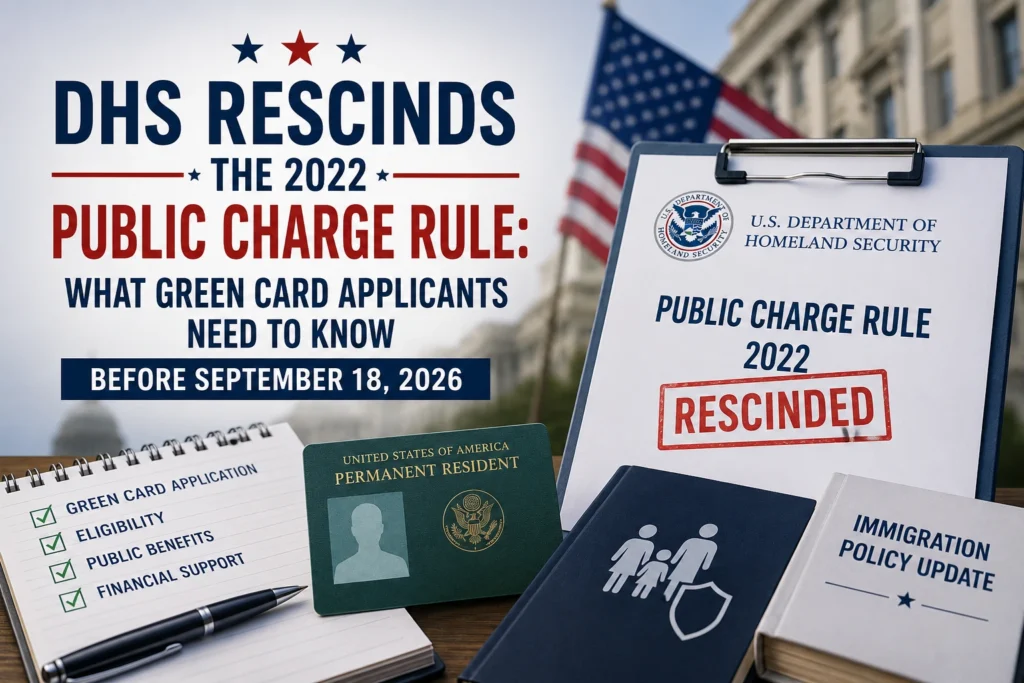
Important update: On July 16, 2026, the Department of Homeland Security (DHS) announced a final rule rescinding the public charge regulations that have governed adjustment of status cases since late 2022. The rule is scheduled for publication in the Federal Register on July 20, 2026, and takes effect on September 18, 2026. To be clear at the outset: this change does not eliminate the public charge ground of inadmissibility. What it does is remove the narrower 2022 regulatory framework and restore broader, case-by-case discretion to USCIS officers deciding whether an applicant is likely at any time to become a public charge under the Immigration and Nationality Act (INA).
In practical terms, certain applicants filing for adjustment of status on or after September 18, 2026 should expect a broader and more individualized review of their financial circumstances and their own history involving means-tested public benefits. Here is what our office is telling clients right now.
This article primarily addresses public-charge determinations made by DHS and USCIS, particularly in adjustment-of-status cases. Applicants pursuing immigrant visas through U.S. consulates are subject to Department of State procedures and should obtain advice specific to consular processing.
Key takeaways
- The final rule is scheduled for Federal Register publication on July 20, 2026 and takes effect on September 18, 2026.
- Until the effective date, the 2022 rule remains controlling. Adjustment-of-status applications properly postmarked or electronically submitted and accepted before September 18, 2026 generally remain governed by the 2022 public-charge framework.
- The statutory public charge ground in INA § 212(a)(4) is unchanged; only the 2022 regulatory framework (8 C.F.R. §§ 212.20–212.23) is being removed.
- For adjustment of status, the new framework applies to Form I-485 applications postmarked or electronically submitted on or after September 18, 2026 and accepted by USCIS.
- USCIS will publish a revised Form I-485 and will not accept older editions postmarked or submitted electronically on or after the effective date. Always confirm the current edition on the day you file.
- Receipt of a means-tested public benefit is not an automatic denial. USCIS must weigh the totality of the applicant’s circumstances.
- Benefits received by U.S.-citizen children or other household members generally are not treated as benefits received by the applicant.
What is the public charge ground of inadmissibility?
Under INA § 212(a)(4), a person may be found inadmissible if, in the opinion of the adjudicating officer, that person is likely at any time to become a public charge. The test is forward-looking: the question is not simply whether someone has received assistance in the past, but whether the record as a whole suggests future dependence on the government. The ground applies only where the statute makes it relevant to the particular application for admission or adjustment of status.
Congress requires officers to consider, at a minimum, the applicant’s age; health; family status; assets, resources, and financial status; and education and skills. Where the statute requires it, a sufficient Form I-864, Affidavit of Support Under Section 213A of the INA, must also be filed. The 2026 rescission does not change the legally binding nature of Form I-864 and does not eliminate the statutory affidavit of support requirement.
How the September 2026 change alters USCIS review
The 2022 rule confined the analysis to a defined framework centered on likely primary dependence on the government essentially, reliance on public cash assistance for income maintenance or long-term institutionalization at government expense. Under the 2022 DHS framework, noncash benefits such as SNAP, most Medicaid benefits, CHIP, WIC, and housing assistance generally were not considered in the public-charge determination.
The 2026 final rule removes that framework from the Code of Federal Regulations and restores a broader, individualized inquiry guided by the statute itself, controlling precedent, and USCIS policy guidance. After September 18, 2026, officers may weigh the mandatory statutory factors together with the applicant’s own application for, approval or certification to receive, or receipt of means-tested public benefits, along with any other case-specific facts the officer finds relevant. DHS has not published a closed regulatory list of every benefit that may be considered.
How much weight a benefit carries will depend on the facts: the nature of the program, the amount and duration of assistance, why it was received, whether the underlying need is temporary or likely to continue, and the applicant’s overall prospects for self-sufficiency. A single unfavorable fact should not be treated as automatically decisive. The ultimate question remains whether, on the whole record, the applicant is likely at any time to become a public charge.
2022 public charge rule vs. the new framework
The following comparison provides a general overview of how public charge review is expected to change after the rescission becomes effective.
| Issue | Before September 18, 2026 | On or After September 18, 2026 |
|---|---|---|
| Governing framework | 2022 public charge regulations | Broader case-by-case review |
| USCIS officer discretion | Guided by a narrower regulatory framework | Broader discretion based on the totality of circumstances |
| Benefits considered | Primarily specified cash assistance and qualifying long-term institutionalization | The applicant’s receipt of means-tested public benefits may be considered more broadly |
| Noncash benefits | SNAP, most Medicaid, CHIP, WIC, and housing assistance generally excluded | Some means-tested noncash benefits may be considered depending on USCIS guidance and individual facts |
| Form I-485 | Current accepted edition | Revised Form I-485 required |
| Statutory factors | Age, health, family status, financial status, education, and skills | The same statutory factors continue to apply |
| Automatic denial based on one benefit | No | No |
| Review standard | Forward-looking assessment | Forward-looking totality-of-the-circumstances assessment |
The table is a general comparison only. The effect of the new framework will depend on the applicant’s filing date, immigration category, benefit history, financial circumstances, and the USCIS guidance in effect when the case is reviewed.
Is the 2019 public charge rule returning?
The rescission of the 2022 public charge regulations does not necessarily mean that every provision, definition, form requirement, or evidentiary standard associated with the 2019 public charge rule will automatically return.
Instead, USCIS will conduct public charge determinations under the governing statute, applicable legal precedent, agency policy guidance, and the totality of the applicant’s circumstances.
Applicants should therefore avoid assuming that the complete 2019 framework will apply after September 18, 2026. They should also avoid assuming that benefits excluded under the 2022 rule will remain categorically excluded.
The precise approach will depend in part on the revised USCIS Policy Manual guidance, Form I-485 questions, form instructions, and any additional implementation materials issued before or after the effective date.
What details are still awaiting USCIS guidance?
Although the final rule establishes the effective date and transition framework, several practical details may require further clarification from USCIS.
These may include:
- The complete range of means-tested public benefits that officers may consider
- How different benefit types will be weighed
- Whether USCIS will distinguish between short-term and long-term benefit receipt
- What information the revised Form I-485 will require
- What documents applicants may need to submit with the revised form
- How USCIS will evaluate benefits received while an application is pending
- How officers will evaluate temporary unemployment or financial hardship
- How much weight will be given to employment, insurance, assets, education, and family support
- Whether applicants will receive specific opportunities to explain benefit receipt
- How the new guidance will apply to unusual or mixed-status household situations
Applicants should review the USCIS website, Form I-485 page, form instructions, and Policy Manual immediately before filing. USCIS has announced that a revised Form I-485 will be published in connection with the September 18, 2026 change.
Timing rules: The filing date and the benefit-receipt date both matter
Adjustment applications filed before September 18, 2026
A Form I-485 postmarked or electronically submitted before September 18, 2026 and accepted by USCIS remains governed by the 2022 rule. Be careful here: a rejected filing does not preserve the original mailing date. USCIS looks to the postmark or submission date of the application it actually accepts, which is one more reason not to file a defective or incomplete package in a rush.
Adjustment applications filed on or after September 18, 2026
The new framework applies. USCIS has announced a revised Form I-485 and will reject older editions postmarked or submitted electronically on or after the effective date. Because form editions and instructions can change with little notice, verify the USCIS form page on the day you file.
Benefits received before September 18, 2026
DHS has stated that benefits received before the effective date will be treated consistently with the 2022 rule. In general, noncash benefits that were excluded under the 2022 framework will not be newly counted against an applicant simply because the case is decided after the new rule takes effect. Under that earlier framework, the benefits that could be considered were Supplemental Security Income (SSI), Temporary Assistance for Needy Families (TANF), state, Tribal, territorial, or local cash assistance for income maintenance, and long-term institutionalization at government expense. Medicaid received before the effective date is relevant only in the limited context of qualifying long-term institutionalization.
Benefits received on or after September 18, 2026
From the effective date forward, the applicant’s own receipt of means-tested benefits — including categories that the 2022 rule excluded may be considered as one part of the totality of the circumstances. Continued receipt after the effective date may be weighed even if enrollment began earlier. Importantly, the rule does not order anyone to disenroll from benefits, and whether to change enrollment is a decision that should be made only with individualized legal advice.
Does the rule apply to consular green card applications?
This article focuses primarily on adjustment-of-status applications decided by DHS and USCIS.
Applicants pursuing an immigrant visa through a U.S. embassy or consulate are reviewed under Department of State procedures. The forms, documentation requirements, benefit-related questions, affidavit-of-support procedures, and public charge analysis used in consular processing may differ from those used by USCIS.
A person applying through consular processing should not rely solely on Form I-485 guidance. The applicant should review the procedures applicable to the relevant embassy or consulate and obtain advice based on the specific immigrant visa category.
Whose benefits may USCIS consider?
For adjustment cases, USCIS generally collects and considers information about benefits sought or received by the applicant personally not benefits received by other members of the household. A U.S.-citizen child’s Medicaid, CHIP, SNAP, or similar assistance generally is not attributed to a parent merely because the parent applied on the child’s behalf.
That said, household finances can still matter indirectly. An applicant’s income level, legal support obligations, or reliance on assistance received by a family member may bear on the applicant’s own financial circumstances. Families in mixed-status households should not make assumptions in either direction; obtain case-specific advice before changing benefits or filing strategy.
Who is exempt?
The rescission removes the regulatory list of exemptions, but it does not and cannot repeal exemptions created by Congress. Depending on the statutory basis for the application, exempt categories include refugees and asylees adjusting under INA § 209, certain VAWA self-petitioners, T and U nonimmigrants adjusting under their designated provisions, Special Immigrant Juveniles, and certain applicants under the Cuban Adjustment Act, among others. The applicable exemption must be confirmed under the specific filing category. Naturalization applicants are not subject to the public charge inadmissibility test.
Can a public charge bond resolve inadmissibility?
In limited circumstances, immigration law provides for the possibility of a public charge bond.
However, a public charge bond is not automatically available to every applicant and should not be viewed as a routine substitute for proving admissibility. Its availability may depend on the applicant’s immigration category, the legal basis for the public charge concern, agency discretion, and the procedures in effect when the case is adjudicated.
An applicant should not assume that offering a bond will cure an insufficient Form I-864 or resolve every public charge issue. Any potential bond option should be evaluated by an immigration attorney based on the specific facts of the case.
Practical steps for applicants and sponsors
- Confirm whether INA § 212(a)(4) applies to your immigration category and whether a statutory exemption or waiver is available.
- Review filing timing carefully but do not rush an incomplete or unsupported Form I-485 solely to beat the transition date. A rejected filing loses its original date.
- Use the correct USCIS form edition and instructions in effect on the day you file.
- Build an accurate history of benefits applied for, approved, certified, or personally received, including program names, dates, amounts, and the reasons for receipt.
- Preserve evidence of employment, income, assets, health insurance, education, skills, family support, and any temporary circumstances that explain a period of need.
- Make sure any required Form I-864 is complete and well supported. A sufficient affidavit remains mandatory where the statute requires one, but it does not necessarily resolve every public charge concern on its own.
- Do not cancel health, nutrition, housing, or other assistance based on a headline or a social media post. Get advice tailored to your benefit, your immigration category, and the relevant dates.
What applicants and financial sponsors should prepare
The applicant and the financial sponsor may need to prepare different types of documentation. Separating their responsibilities can help reduce errors and avoid delays.
Documents the green card applicant may need
Depending on the facts of the case, the applicant may need to collect:
- Employment verification letters
- Recent pay statements
- Federal tax returns
- Evidence of self-employment or business income
- Bank statements
- Investment or retirement account records
- Property or other asset documents
- Health insurance records
- Educational degrees and diplomas
- Professional licences and certifications
- Employment history
- Evidence of vocational or professional skills
- A complete personal benefit history
- Benefit approval, certification, or termination notices
- Evidence explaining temporary unemployment, illness, or financial hardship
- Documents showing which household member was the actual benefit recipient
- Evidence of family or community support
Documents the financial sponsor may need
Where Form I-864 is required, the sponsor may need to provide:
- A properly completed and signed Form I-864
- The most recent required federal tax documentation
- Proof of current employment
- Recent pay statements
- An employment verification letter
- Evidence of U.S. citizenship or lawful permanent resident status
- Evidence of U.S. domicile
- Accurate household-size information
- Evidence of qualifying assets, when assets are being used
- Documentation from a household member contributing income
- A separate Form I-864 from a joint sponsor, when necessary
Submitting a sufficient Form I-864 does not necessarily prevent USCIS from examining other public charge factors. However, an incomplete or unsupported affidavit can independently create serious problems for an application where the affidavit is legally required.
Practical examples of how the new rule may apply
The following examples are for general illustration only. They do not predict how USCIS will decide a particular case.
Example 1: Benefits received by a U.S.-citizen child
A U.S.-citizen child receives Medicaid and SNAP, while the child’s parent applies for adjustment of status. The parent completed the benefit application on behalf of the child but was not personally eligible for or certified to receive the benefits.
The benefits should not automatically be described as benefits personally received by the parent. However, the applicant should preserve documents identifying the child as the beneficiary and should be prepared to explain the household’s financial circumstances if USCIS asks.
Example 2: Temporary assistance followed by stable employment
An applicant received short-term cash assistance during a period of unemployment but later obtained stable full-time employment, secured health insurance, and developed savings.
USCIS may consider the prior benefit receipt, but it should also consider the temporary reason for the assistance and the applicant’s current and future financial circumstances. One period of assistance does not automatically determine the outcome.
Example 3: Form I-485 rejected and refiled after the effective date
An applicant mails Form I-485 before September 18, 2026, but USCIS rejects the filing because the payment amount is incorrect. The applicant corrects the error and mails a new application after September 18, 2026.
The original rejected package may not preserve the earlier filing date. The later accepted filing may be reviewed under the new framework.
Example 4: Applicant in an Exempt Humanitarian Category
A refugee applies for adjustment of status under INA § 209.
Because Congress created public charge protections for certain humanitarian categories, the applicant may be exempt from the public charge ground. The precise exemption should still be confirmed under the provision governing the application.
Example 5: Applicant has limited income but significant assets
An applicant has limited current employment income but owns accessible assets, has professional qualifications, carries health insurance, and has a strong employment history.
USCIS should evaluate the applicant’s complete circumstances rather than relying on current income alone. Assets, education, skills, insurance, and future employment prospects may all be relevant.
Example 6: Sponsor meets the income requirement
A family-based applicant submits a sufficient Form I-864 from a qualified sponsor whose income exceeds the applicable requirement.
The affidavit is important and legally required in many family-based cases. However, it may not prevent USCIS from considering the applicant’s other statutory factors where the public charge ground applies.
What happens if USCIS raises a public charge concern?
USCIS may identify a public charge issue while reviewing Form I-485, the supporting evidence, the applicant’s benefit history, or the financial sponsor’s Form I-864.
Depending on the issue and applicable procedures, USCIS may request additional evidence or clarification concerning:
- Employment and current income
- Assets and financial resources
- Health insurance
- Medical circumstances
- Education and professional skills
- Benefit applications or receipt
- The identity of the actual benefit recipient
- Form I-864 eligibility
- Sponsor income
- Household size
- Joint-sponsor qualifications
- Temporary hardship or unemployment
- Changes that occurred after Form I-485 was filed
An applicant responding to a Request for Evidence or other USCIS notice should address every issue raised and provide organised, accurate, and consistent supporting documentation.
Applicants should not assume that USCIS must issue a Request for Evidence before taking an adverse action in every case. The safest approach is to submit a complete and well-supported application from the beginning.
Frequently asked questions
Did DHS eliminate the public charge test?
No. DHS rescinded the 2022 regulations, but INA § 212(a)(4) remains the law. Beginning September 18, 2026, USCIS will apply a broader, case-specific totality-of-the-circumstances analysis.
Does receiving SNAP, Medicaid, CHIP, or housing assistance automatically cause a denial?
No. An applicant’s own receipt of a means-tested benefit on or after the effective date may be considered, but it is not an automatic bar. The officer must evaluate all relevant circumstances, and how much weight a particular program receives is a fact-specific question.
Will my child’s benefits count against me?
Generally, no. USCIS does not treat benefits received by a U.S.-citizen child or another family member as benefits received by the applicant, although related household financial facts may still be relevant in limited ways.
Does the change affect a Form I-485 that is already pending?
A Form I-485 properly postmarked or electronically submitted and accepted before September 18, 2026 remains subject to the 2022 rule. Keep proof of timely filing and acceptance.
Should I file before September 18, 2026?
The filing date can determine which framework applies, but timing is only one consideration. A premature, inaccurate, or incomplete filing can create serious problems that outlast any transition-date advantage. Get a case-specific assessment before deciding.
Does public charge apply when I apply for U.S. citizenship?
No. Naturalization is not an application for admission or adjustment of status, and the public charge ground is not itself a naturalization requirement. Other issues such as eligibility, prior fraud, or misrepresentation — may still require review.
How Kenjay Law can help
The September 2026 change puts a premium on careful preparation. Our office can evaluate whether the public charge ground applies to your case, identify any exemption, review your benefit history, assess the totality of your circumstances, prepare the required affidavit of support, and build a filing strategy around the controlling rules and your individual facts.
Contact Kenjay Law Offices Ltd. to schedule a confidential immigration consultation with Kenny Bhatt, Esq.
Sources
- USCIS, “U.S. Citizenship and Immigration Services Rescinds 2022 Public Charge Regulation” (news release, July 16, 2026).
- DHS/USCIS, Public Charge Ground of Inadmissibility, Final Rule, DHS Docket No. USCIS-2025-0304, RIN 1615-AD06, scheduled for Federal Register publication July 20, 2026.
- Immigration and Nationality Act §§ 212(a)(4), 213A, 291; 8 U.S.C. §§ 1182(a)(4), 1183a, 1361.
- USCIS Policy Manual, Volume 8, Part G, Public Charge Ground of Inadmissibility (consult the version in effect on the relevant filing or adjudication date).
Attorney advertising / legal disclaimer
This article is provided by Kenjay Law Offices Ltd. for general informational purposes only and reflects the law as of July 17, 2026. It is not legal advice and should not be relied upon as such. Immigration statutes, regulations, forms, filing instructions, agency guidance, and related litigation change frequently, and the information here may not reflect the most current developments at the time you read it. Reading this article, or contacting our office through this website, does not create an attorney-client relationship. Every case is different, and outcomes depend on the specific facts and the law applicable to each matter. Before making any decision about public benefits, filing timing, or immigration strategy, consult a licensed immigration attorney about your individual situation. Prior results do not guarantee a similar outcome.