| Important Effective-Date Update DHS’s current final rule will go into effect on September 15, 2026. However, the U.S. Government Accountability Office (GAO) determined on August 4, 2026, that the proposed September 15 date does not provide a full 60-day delay for a major rule under the Congressional Review Act, as the Senate received this rule on July 20. September 15 remains the effective date listed in the Federal Register, and DHS has stated it will issue another Federal Register notice if congressional review changes the effective date or terminates the rule. As of August 16, 2026, students should treat September 15 as DHS’s stated and currently planned date but verify the rule’s status before making filing, travel, employment, or academic decisions. |
| New USCIS Form Alert – August 14, 2026 USCIS published new 09/15/26 versions of Form I-539 and Form I-765. USCIS notes that for applications filed on or after September 15, 2026, it will only consider the 09/15/26 versions of those applications. Anyone filing around the transition should confirm the rule’s current status and the correct form edition immediately before submission. |
For decades, most F-1 students entering the United States were admitted for “Duration of Status,” commonly shown as “D/S” on Form I-94. Instead of receiving a fixed immigration expiration date, a student generally could remain while properly maintaining F-1 status through the authorized academic program and permitted practical training.
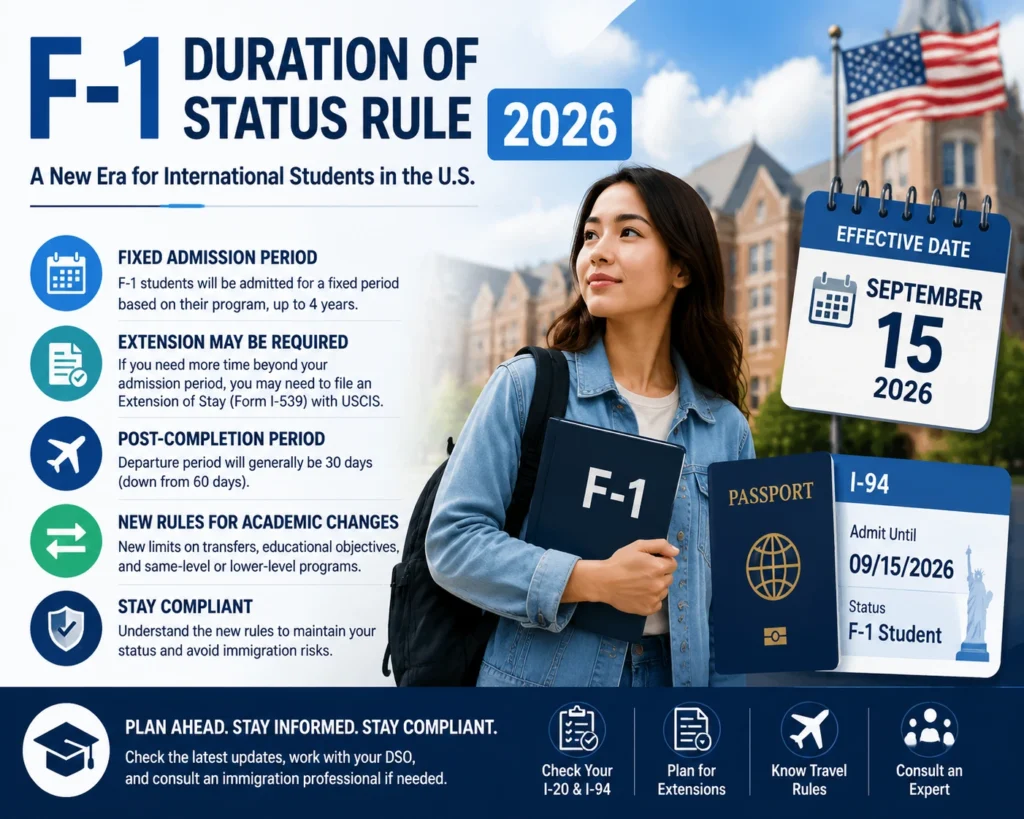
DHS has finalized a major change. Once the rule becomes effective, F-1 admissions will generally be for a fixed period tied to the authorized program, subject to a four-year maximum for a single admission period. Students who need additional time may need to apply for an extension of stay with USCIS, not just an updated Form I-20 and SEVIS from their DSO.
Among other things, the final rule also includes coverage for the post-completion departure period, OPT and STEM OPT planning, departure prior to completion pending an extension, school transfers, changes of educational objective, same-level or lower-level degree programs, English-language training, and unlawful-presence risk.
Who is affected by the new F-1 fixed admission rule?
The new F-1 fixed admission framework may affect international students entering or maintaining F-1 status in the United States. The impact can vary depending on when a student entered the country, their current immigration status, academic program, and future plans.
Students who may need to pay closer attention to the updated requirements include:
- New F-1 students entering the United States.
- Current F-1 students continuing their academic programs.
- Students changing schools or academic programs.
- Graduate students extending their studies.
- Students applying for Optional Practical Training (OPT).
- Students applying for STEM OPT extensions.
- Students planning additional academic programs after completing their current degree.
Under the previous duration of status (D/S) system, many F-1 students were admitted for the length of their approved academic program plus authorized practical training. Under a fixed admission period system, students may need to monitor their Form I-94 expiration date more carefully and take additional steps if they require more time to complete their academic objectives.
Students should review their individual circumstances and maintain communication with their designated school official (DSO) to understand how the rule may affect their specific situation.
What is changing from duration of status?
Under the traditional D/S system, a properly maintained F-1 student was generally admitted for the duration of status rather than until a specific calendar date. A DSO could authorize an eligible program extension in SEVIS and issue an updated Form I-20 without a separate USCIS extension-of-stay application solely because the program took longer.
Under the new fixed-admission framework, admission generally will be tied to the period necessary to complete the program shown on Form I-20, up to four years per admission, with the regulatory post-program period added separately. If the student needs additional immigration time beyond the authorized admission period, a USCIS extension of stay generally will be required.
| Issue | Traditional D/S Framework | New Fixed-Admission Framework |
| Form I-94 | Generally “D/S” | Specific Admit Until Date |
| Admission period | Based on maintaining F-1 status | Program period, generally up to four years per admission |
| Program extension | Primarily the DSO/SEVIS process | May also require USCIS extension of stay |
| Post-completion departure period | Generally 60 days | Generally 30 days for students governed by the new fixed-date framework |
| Long programs | No separate I-539 solely because the program exceeds four years | Extension may be required |
| Academic mobility | Broader flexibility under prior rules | New restrictions on transfers, educational objectives, and same/lower-level study |
Think of four years as the general ceiling for one admission or extension period—not as a four-year cap on an entire F-1 academic career. A student who remains eligible may continue in F-1 status beyond four years by obtaining a new authorized period when required.
What is changing from duration of status?
Understanding the difference between the traditional duration of status system and the new fixed admission framework can help international students prepare for potential changes.
| Topic | Previous duration of status system | Fixed admission period system |
|---|---|---|
| Admission period | Students were generally admitted for “Duration of Status” (D/S) | Students may receive a specific admission end date |
| Form I-94 | Typically showed D/S | May include a specific “Admit Until Date” |
| Program extensions | Often managed through SEVIS updates and school authorization | Additional USCIS procedures may be required in certain situations |
| Deadline awareness | Students mainly monitored SEVIS and program requirements | Students may need to monitor their I-94 expiration date |
| Immigration planning | More flexibility for certain academic changes | Requires earlier planning for extensions and status maintenance |
The new framework places greater importance on understanding authorized stay periods, filing deadlines, and immigration planning throughout an F-1 student’s academic journey.
Form I-94 becomes a critical immigration deadline
Students are advised to differentiate between the F-1 visa in their passport, the Form I-20 issued by the school, and the Form I-94 issued upon admission. These documents have various legal meanings.
The visa is usually valid for applying for admission to a country and does not automatically mean the person can stay once they arrive. The new scheme means the Form I-94 will always include a specific Admit Until Date, which will become a key immigration deadline.
The admission period usually is the same as the authorized program as indicated on the Form I-20, with a maximum of four years. The regulation also sets the period for departure and/or other immigration actions that may be taken up to 30 days before the program or authorized training begins and up to 30 days after the program or authorized training ends. The 30-day time frame does not count toward the program’s 4-year maximum.
Every time they are admitted into the United States, students are to get a copy of their I-94 and correct any discrepancies as soon as possible.
What happens to F-1 students who already have D/S?
One of the key components of the final rule is the transition rules. A qualifying student who meets the requirements for F-1 at the time of admission for D/S, is in the United States at the time of the effective date of the rule, and is maintaining F-1 status does not necessarily receive a replacement I-94 with a fixed date on the date of the rule’s effective date.
The regulatory transition language of the EADs provides that qualifying F and J nonimmigrants can stay until the later of the applicable EAD expiration date or the program end date on the Form I-20 or DS-2019 that is valid on the effective date of the EADs, with an outside cap of four years from the effective date of the EADs. Qualifying F-1 students also retain the 60-day departure period for that transition admission.
If September 15, 2026, remains the actual effective date, the four-year F/J transition ceiling would run from that date. Because GAO has identified a CRA timing defect, students should not hard-code the transition date into personal planning without confirming the final effective date.
A student whose program or OPT has already ended when the rule takes effect does not receive a new four-year period merely because the regulation changed. The applicable remaining departure period and any pending benefit request must be reviewed separately.
International travel can change which framework applies
A student protected by the D/S transition rule may move into the fixed-date framework after leaving the United States and seeking readmission once the new system is effective. DHS states that such students may be admitted with a new fixed period based on the Form I-20 and the new admission rules.
Travel may still be appropriate, but students should understand the consequences before departure, especially if they are in a long doctoral or research program, approaching OPT, expecting to need additional academic time, considering a transfer, or have an extension application pending.
Program extensions may require Form I-539
Under the new framework, an updated Form I-20 does not, by itself, necessarily extend the period of admission shown on Form I-94. A student who needs to remain beyond the authorized period generally must request an extension of stay from USCIS, typically on Form I-539, with the required fee, supporting evidence, an appropriately endorsed Form I-20, and any biometrics USCIS requires.
USCIS will evaluate extension requests individually. The regulation contemplates extensions for students who have maintained status but cannot complete the program within the authorized period. Documentary evidence will be important. Problems such as late program-extension requests, repeated academic failures, or failure to maintain status can create significant difficulties.
F-1 extension of stay and Form I-539 requirements
Under a fixed admission period system, some F-1 students who need additional time beyond their authorized stay may need to request an extension through U.S. Citizenship and Immigration Services (USCIS).
A student may need additional time because of circumstances such as:
- Delays in completing an academic program.
- Additional required coursework.
- Changes in educational objectives.
- Extended research or academic activities.
- Other circumstances affecting program completion.
Students considering an extension should review:
- Their Form I-94 expiration date.
- Their Form I-20 validity period.
- SEVIS information.
- USCIS filing requirements.
- Applicable deadlines.
Failing to take action before an authorized stay period expires may create immigration complications. Students should consult with their school officials and, when appropriate, an immigration attorney before submitting an extension request.
Timely filing is critical
Once USCIS receives a valid, timely request for the extension of the F-1 status, the student is generally in a period of authorized stay as long as the application is pending and may continue full course of study. A timely pending extension is not an extension of status, but it can prevent accrual of unlawful presence simply because the prior I-94 has expired while the extension is pending.
The final rule defines a timely extension as an extension received by USCIS no later than the end of the authorized period, including the final 30-day post-completion period. Once the 30-day period has passed, however, a student who waits until then to file may continue studying where permitted but generally may not pursue further education, practical training, or other employment just because the extension is filed.
Students who require extended employment should make extensive arrangements well in advance of the program end date and not wait until the last 30 days.
Certain employment may continue for up to 240 days
The final rule provides limited automatic employment-continuation protection while a timely F-1 extension remains pending. Qualifying on-campus employment, CPT, and certain severe economic hardship employment can continue for up to 240 days, subject to the regulatory conditions and earlier terminating events.
This is not a blanket 240-day extension for every type of F-1 employment. OPT, STEM OPT, pre-completion OPT, employment with an international organization, and other EAD-based categories have separate rules. Review the student’s actual employment category and filing history.
OPT and STEM OPT require earlier coordination
Under the fixed-date framework, post-completion OPT or STEM OPT can require coordination between Form I-765 for employment authorization and Form I-539 for the necessary period of F-1 stay. Approval of an I-765 should not be assumed to extend every fixed period of admission automatically.
DHS created transition relief for certain students admitted for D/S. A qualifying F-1 student who timely files Form I-765 for post-completion OPT or a STEM OPT extension on or before March 18, 2027, may be exempt from filing a separate Form I-539 for the requested practical-training period. DHS reserved authority to extend this temporary relief in six-month increments by Federal Register notice.
A student who departs before filing for post-completion OPT or STEM OPT and is later admitted under the fixed-date framework may instead be required to file both the I-765 and the I-539. Travel timing can therefore change the filing strategy.
How the new F-1 rule affects OPT and STEM OPT students
Optional Practical Training (OPT) and STEM OPT allow eligible F-1 students to gain practical work experience related to their field of study. The new admission framework may require students to pay closer attention to their immigration timelines while planning employment authorization.
Students preparing for OPT or STEM OPT should consider:
- Their current F-1 admission period.
- OPT application deadlines.
- STEM OPT extension eligibility requirements.
- Employment authorization timelines.
- Travel plans during pending applications.
- Future immigration options after graduation.
Students should not assume that approval of employment authorization automatically resolves every immigration status requirement. Maintaining valid F-1 status involves meeting academic, reporting, employment, and immigration obligations.
International students planning to transition from F-1 status to employment-based immigration options, such as H-1B classification, should begin planning early to avoid unnecessary timing issues.
New USCIS editions of Form I-539 and Form I-765
The revised versions of Form I-539 and Form I-765 were published on USCIS’s websites on August 14, 2026, both with an “edition date” of 09/15/26. USCIS has indicated that the 09/15/26 versions of the documents must be submitted on or after September 15, 2026.
Under the Congressional Review Act, the issue of when the final rule took effect is still important for applicants who wish to apply close to the transition, so it is best to check two things immediately before applying: (1) whether the final rule was in effect on the date of the application; and (2) which form edition USCIS is taking at its filing date.
The post-completion departure period is generally reduced to 30 days
For students admitted under the new fixed-date framework, the normal period after completion of the academic program or authorized post-completion practical training generally changes from 60 days to 30 days.
Students covered by the D/S transition provisions generally retain the 60-day departure period for that transition admission. The rule doesn’t therefore subtract 30 days from the effective date of each existing student. This could significantly affect OPT, school transfers, job planning, and other immigration applications.
New restrictions on school transfers and changes of educational objective
The final rule also restricts academic mobility. For students below the graduate level, school transfers and changes of educational objectives during the first academic year are generally restricted, subject to SEVP-authorized exceptions for qualifying extenuating circumstances.
Graduate-level students face stricter rules. The final regulation generally prohibits graduate students from changing educational objectives during the program and generally prohibits transfers, although SEVP may authorize an exception to the transfer restriction for qualifying extenuating circumstances.
DHS also has limited authority to delay or deny implementation of certain provisions related to academic-mobility requirements if system or implementation issues make those provisions impracticable. Students are therefore encouraged to consult current SEVP guidance when changing schools, majors, laboratories, advisers, or degree programs.
Can an F-1 student complete another degree at the same or a lower level?
Under the final rule, a student who completes an F-1 program after the rule becomes effective generally may not maintain, obtain, or be admitted to F-1 status for another program at the same educational level or a lower educational level.
Programs completed before the rule’s actual effective date do not count toward this new restriction. A student considering a second master’s degree, second bachelor’s degree, certificate program, or another same-level or lower-level program should obtain case-specific advice before enrolling, transferring, traveling, or filing an immigration application.
English-language training is subject to a 24-month aggregate limit
The final rule establishes a prospective aggregate 24-month limit for F-1 participation in English-language-training programs under the new framework. DHS states that programs completed before the effective date do not count toward the new cap.
Students who plan to move from stand-alone language training into an academic degree program should coordinate the timing carefully and confirm current SEVP implementation guidance.
Travel while Form I-539 is pending is more nuanced than a simple “no”
The final rule provides that departure does not automatically abandon every pending F, J, or I extension-of-stay application. If an F-1 student leaves while a timely extension is pending and seeks readmission for the remaining portion of the previously authorized admission period before that period expires, USCIS generally will not treat the extension as abandoned.
However, if the student leaves and seeks admission using a Form I-20 with a program end date beyond the previously authorized period, USCIS may treat the pending extension request as abandoned because CBP has granted a new period of admission. Corresponding employment-authorization applications are treated differently under the regulation.
A change-of-status application is a separate matter, and departure may abandon the requested change of status. Students with pending cases should obtain individualized travel advice.
Unlawful presence becomes a greater calendar risk
Replacing D/S with a fixed admission date creates a clearer calendar-based immigration deadline. For a student admitted until a specific date, remaining beyond the authorized period can cause unlawful presence to begin accruing unless a timely filing or another lawful basis protects the individual.
This issue is especially important in light of the August 13, 2026, BIA decision in Matter of Delcarmen-Lara. That decision changed how advance-parole departures are treated under the unlawful-presence statute. Although most F-1 travel does not involve advance parole, the broader lesson is that unlawful-presence calculations and later departures can create serious inadmissibility consequences.
Under INA § 212(a)(9)(B), more than 180 days of qualifying unlawful presence followed by a qualifying departure can create a 3-year bar, and one year or more can create a 10-year bar, subject to the statute’s distinct requirements and exceptions. Students should not calculate these consequences from an online date counter alone.
H-1B cap-gap protection continues
The final rule does not eliminate F-1 cap-gap protection for otherwise eligible students who are beneficiaries of qualifying, timely filed cap-subject H-1B petitions requesting change of status. The applicable cap-gap period can continue under the governing regulation, subject to the petition, change-of-status request, and any terminating events.
What F-1 students should do now
- Check the most recent Form I-94 and see if it lists D/S or a set expiration date.
- Check the current Form I-20 and make sure the program end date matches the realistic academic plan.
- Verify the SEVIS record with DSO and fix any errors early.
- Determine whether the student would qualify for the D/S transition provision if the rule becomes effective.
- Plan OPT and STEM OPT well before graduation and determine whether Form I-539 will also be required.
- Do not assume that an updated I-20 alone extends a fixed immigration admission period.
- If continued CPT or on-campus employment matters, do not wait until the 30-day post-completion period to address an extension.
- Review international travel before departure, particularly when relying on transition protection or while an application is pending.
- Obtain advice before transferring schools, changing an educational objective, or pursuing another program at the same or a lower level.
- For filings on or after September 15, verify the correct USCIS edition of Forms I-539 and I-765.
- Confirm the rule’s actual effective date immediately before relying on any September 15 deadline because the CRA issue remains unresolved as of August 16, 2026.
Common mistakes F-1 students should avoid under the 2026 rule
Changes to the F-1 admission framework may create new planning responsibilities for international students. Avoiding common mistakes can help students maintain lawful status and protect future immigration options.
Common mistakes include:
Ignoring the Form I-94 expiration date
Students should regularly review their Form I-94 information and understand the date by which they are authorized to remain in the United States.
Assuming the Form I-20 automatically extends immigration status
A valid Form I-20 supports a student’s academic program, but students should understand how their immigration admission period and other requirements apply.
Waiting too long to request an extension
Students who need additional time should begin planning early to allow enough time for required filings and processing.
Travelling without reviewing immigration documents
International travel can affect pending applications, admission records, and future immigration plans. Students should review travel considerations before leaving the United States.
Missing OPT or STEM OPT deadlines
Students should carefully track OPT filing windows and employment authorization requirements to avoid losing eligibility.
Failing to update required information
Students must continue meeting reporting requirements, including maintaining accurate personal and academic information through their school’s international student office.
What do the new F-1 rules mean for international students in Florida?
Many universities, colleges, graduate programs, professional schools, and English-language programs in Florida have large numbers of international students. This could be particularly significant for students pursuing long-term graduate programs, transferring to other universities, attending a second degree program, participating in OPT/STEM OPT, studying English as a foreign language, traveling overseas, or seeking employment-based permanent residency, O1, or H1B status.
Planning in advance can ensure that an academic choice does not cause an unforeseen status, employment, or travel issue.
What the F-1 rule means for international students in Florida
Florida is home to many international students attending universities, colleges, research institutions, and professional programs. Students studying in Florida should understand how changes to F-1 admission rules may affect their academic planning and future immigration options.
International students in Florida may need guidance regarding:
- Maintaining F-1 status.
- Extending academic programs.
- Applying for OPT and STEM OPT.
- Changing educational programs.
- International travel.
- Transitioning from student status to employment-based immigration options.
Students attending schools throughout Florida, including universities and colleges in Miami, Tampa, Orlando, Fort Lauderdale, and other communities, should stay informed about immigration requirements that may affect their studies and future career plans.
Because immigration rules can change, students should rely on official USCIS guidance, their designated school official, and qualified immigration professionals when making important decisions about their status.
Frequently asked questions
1. Is September 15, 2026, definitely the effective date?
DHS still lists September 15 as the planned start date. GAO has already pointed out that this date does not allow the full 60-day CRA delay because the Senate received the rule on July 20, 2026. If congressional review changes the date or terminates the rule, DHS says it will publish another Federal Register notice. Check the latest status yourself before relying on September 15 for a filing, travel, employment, or academic decision.
2. I already have D/S on my I-94. Do I automatically lose D/S when the rule takes effect?
No. Any student already in the United States with D/S admission who maintains proper F-1 status on the day the rule becomes effective generally falls under the transition provisions rather than receiving an immediate replacement I-94.
3. Can my DSO still extend my Form I-20?
Yes. The DSO continues to play an important role in SEVIS and Form I-20. Under the new fixed-date setup, though, that updated I-20 by itself may not extend the student’s authorized immigration stay beyond the Form I-94 period. A USCIS extension of stay may also be required.
4. What happens if my I-94 expires while a timely Form I-539 extension is pending?
File the extension on time and correctly generally places the student authorized stay period while USCIS reviews the request. The student may continue studying full-time and does not accrue unlawful presence solely because the prior I-94 expires while the timely extension is pending. Employment rules still require a separate check.
5. Can I continue CPT or on-campus employment while my extension is pending?
Under specified conditions, qualifying on-campus employment, CPT, and certain severe-economic-hardship employment can continue for up to 240 days while a timely extension remains pending. This protection is not universal and generally is not available merely because an extension is filed during the final 30-day post-completion period.
6. Does every Form I-539 applicant have to attend biometrics?
Not necessarily. Applicants must provide whatever biometrics USCIS requests. Follow the form instructions and any appointment notice issued in the individual case.
7. Can I travel internationally while my F-1 extension is pending?
Travel is possible, but the outcome depends on the details. Travel does not automatically cancel an F-1 extension under the new rule. Results can change if your prior authorized period is still valid and CBP allows you to stay for the remainder of that period, or if you are admitted for a new fixed period on a new Form I-20.
8. Will OPT and STEM OPT now require Form I-539?
Under the fixed-date system, many students will need a separate extension of stay. DHS created temporary relief for some D/S students who filed qualifying post-completion OPT or STEM OPT applications on or before March 18, 2027. Those students may skip a second I-539 during that practical-training period.
9. What changed with Forms I-539 and I-765 on August 14, 2026?
USCIS released new 09/15/26 versions of both forms. Any filing on or after September 15, 2026, must use those editions. Anyone filing near the transition should confirm the correct edition right before you file, especially because the final rule’s effective-date issue remains under active congressional-review timing analysis.
10. Can I pursue a second master’s degree?
Timing decides everything. Once the rule is in force, a student who completes an F-1 program normally blocks you from starting another program at the same or lower level in F-1 status. Programs you completed before the actual effective date do not count toward the new restriction.
11. Can a graduate student transfer to another university?
The final rule mostly blocks graduate-level transfers while the program is still running. SEVP can grant an exception only for qualifying extenuating circumstances. Graduate students also generally cannot change their educational objective during the same program.
12. What happens to my F-2 spouse or children?
F-2 dependents cannot stay beyond the principal F-1 student’s authorized period. When an extension is needed, the eligible F-2 dependents must either be included in the principal’s filing or file their own extension request under USCIS procedures.13. Does the rule eliminate H-1B cap-gap protection?
13. Does the rule eliminate H-1B cap-gap protection?
Not really. Eligible students still receive cap-gap protection under the regular H-1B and F-1 rules, as long as they meet the requirements and no terminating event occurs.
14. Could the rule still change?
Yes. The CRA effective-date issue is real, and DHS has already promised it will publish a further Federal Register notice if congressional review moves the date or ends the rule. Agency implementation guidance or court cases could also impact portions of the rule. Always check the latest official information before you act.
How Kenjay Law can help
The move from Duration of Status to fixed admission periods creates new interaction among Form I-20, SEVIS, Form I-94, employment authorization, travel history, and USCIS filing deadlines. Kenjay Law Offices Ltd. assists with F-1 status reviews, Form I-539 extensions, reinstatement, OPT and STEM OPT planning, international travel strategy, changes of status, academic-program immigration issues, H-1B and cap-gap planning, O-1 petitions, and employment-based immigration strategies.
Kenny Bhatt, Esq. | Kenjay Law Offices Ltd. | (224) 800-1585 | info@kenjaylaw.com | KenjayLaw.com
Legal disclaimer
This article offers general information about education and is not meant to be legal advice. Immigration laws and regulations, effective dates, agency guidance, and court decisions can change rapidly. The information is accurate up to, but not after, August 16, 2026, as noted from official sources consulted for this update. Reading this article or contacting Kenjay Law does not, by itself, create an attorney-client relationship. Individuals should seek advice based on their specific immigration facts before acting.
Primary legal authorities and official sources
- Department of Homeland Security, Final Rule, Establishing a Fixed Time Period of Admission and an Extension of Stay Procedure for Nonimmigrant Academic Students, Exchange Visitors, and Representatives of Foreign Information Media, 91 Fed. Reg. 44976 (July 17, 2026).
- U.S. Government Accountability Office, B-338604 (Aug. 4, 2026), Congressional Review Act determination concerning the final rule’s stated effective date.
- USCIS Alert, Aug. 14, 2026, revised editions of Form I-539 and Form I-765 (edition date 09/15/26).
- DHS/ICE Student and Exchange Visitor Program implementation materials and governing regulation updates.
- USCIS Form I-539 and Form I-765 instructions and current filing pages.
KenjayLaw.com | (224) 800-1585 | info@kenjaylaw.com