The L-1 visa provides companies with a strong way to bring key employees into the United States. It focuses on moving people inside the same company, so multinational businesses can shift executives, managers, or workers with special skills to their American offices.
It opens the door to a job in the U.S. for people working in these roles. They do not need to go for lotteries such as H-1B. Companies also benefit from it as they continue to grow and their operations remain smooth across borders.
Even so, the rules stay tight. U.S. immigration officials expect full compliance on who qualifies, what papers you need, and how the businesses connect. This is exactly why many people turn to an experienced L1 visa lawyer. Good legal help prevents long waits, refusals, or problems with the rules.
What is an L-1 visa?
The L-1 visa is a non-immigrant visa, which means a company can transfer its employee from an office outside the U.S. to an office inside the U.S. Multinational corporations, startups entering the American market, and growing businesses setting up new locations often use it.
There are two main kinds of L-1 visas:
- L-1A Visa: For executives and managers
- L-1B Visa: For employees who have specialized knowledge
Both types need a clear qualifying link between the foreign company and the U.S. company.
L-1 visa requirements
The company and the employee both have to meet the requirements set by U.S. immigration law to obtain an L-1 Visa.
The L-1 visa comes with strict rules for both the employer and the employee. Following these rules helps avoid delays or refusals. Every part of the application must show a real business connection and a role that fits the category.
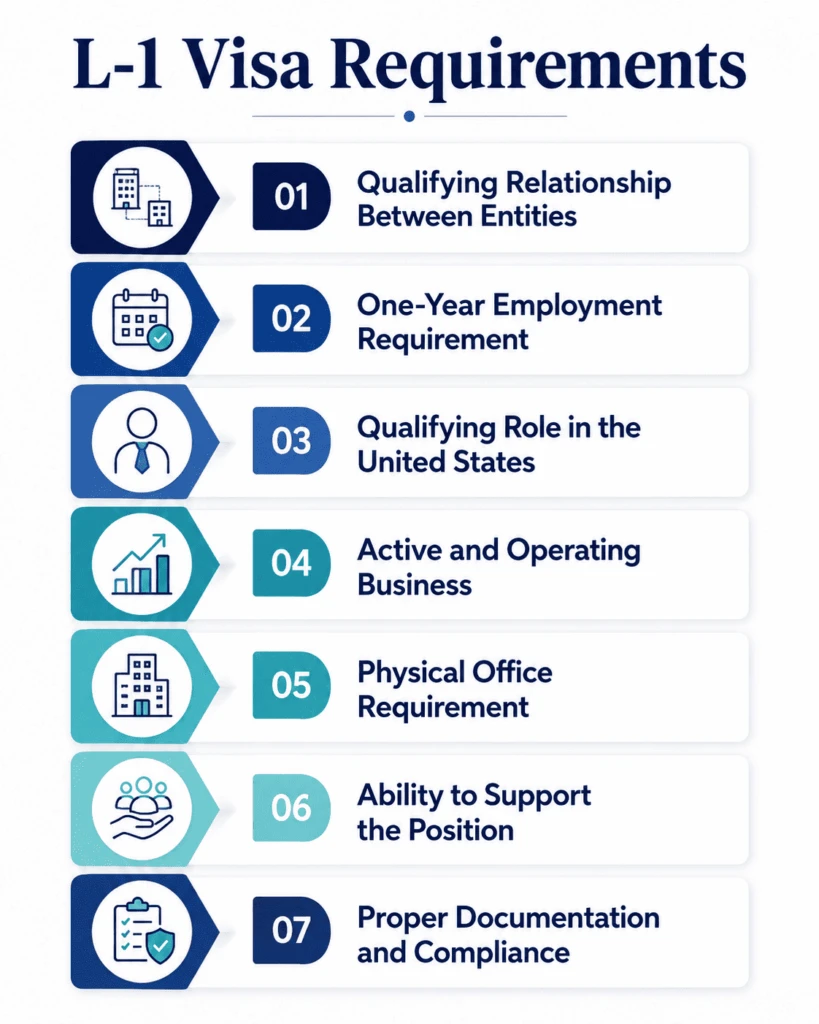
Qualifying relationship between entities
The U.S. company and the foreign company must share a proper business link, such as parent and subsidiary, affiliate, or branch office. You need solid proof through ownership papers, company records, and evidence that the two sides actually work together.
One-year employment requirement
The employee must have worked for the foreign company for at least 1 full year in the 3 years preceding the filing. That work must have been in an executive, managerial, or specialized knowledge position.
Qualifying role in the United States
The job offered in the U.S. must be eligible for the visa type. In simple terms, to get an L-1A visa, the position offered must be at the executive or managerial level. For L-1B, the employee must bring specialized knowledge that the company actually needs for its operations or products.
Active and operating business
Whether it is a U.S. company or an international one, it must be operating actively—selling products and services and paying its employees. Having a paper registration is not enough.
Physical office requirement
The U.S. company needs an actual office space to run its business. For brand-new offices, you must show a lease or ownership papers plus plans that explain how the office will operate and support the transferred employee.
Ability to support the position
The company will have to submit proof that it has enough money to pay the new employee. The files they need to submit are financial records, business growth forecasts, or staffing plans.
Proper documentation and compliance
Every document should be presented accurately and in accordance with USCIS guidelines. Even minor mistakes and slight differences in job descriptions or work histories can result in delays.
Benefits of the L-1 visa
The L1 visa offers many benefits for both employees and employers, including flexibility, room to grow, and more. However, it’s different from other U.S. work visas because it allows only businesses to move employees internally, making it a good choice for companies that want to introduce themselves to the U.S. market.
No annual cap or lottery
A major plus of the L-1 visa is that there is no yearly limit or lottery. Companies can submit petitions at any time of the year. This gives better planning and quicker action than visas like H-1B that have strict caps.
Dual intent flexibility
The L-1 visa offers dual intent flexibility, which means you can apply for a green card even when you carry a non-immigrant status. It is the best pick for people who plan to stay in the U.S. for the long term.
Pathway to permanent residency (especially L-1A)
Executives and managers currently holding L-1A status can easily obtain an EB-1C green card. This path often moves faster and skips the labor certification step.
- No PERM labor certification required
- Faster green card processing in many cases
- Good match for managerial positions
These features make L-1A especially useful for senior staff.
Family benefits through L-2 status
People currently holding an L-1 visa can bring their spouse and unmarried children under 21 to the U.S. on L-2 visas.
- Spouses can work in the United States
- Children can go to school or college
- The whole family can stay together while the visa lasts
This makes the L-1 visa much more family-friendly for longer moves.
Flexibility for multinational companies
The L-1 visa helps businesses expand and move key people within the company. It lets companies send trusted employees to the U.S. instead of hiring new people from outside.
- Keep operations consistent between offices
- Move important knowledge and leadership across borders
- Help with entering or growing in the U.S. market
This kind of flexibility matters a lot to international companies scaling up.
Premium processing availability
Companies can pay for premium processing, which gives a faster decision from USCIS. This option is useful when a transfer needs to happen quickly for business reasons.
New office expansion opportunity
Foreign companies can use the L-1 visa to open a new office in the U.S. by sending over an executive or manager.
- Allows direct entry into the U.S. market
- Supports plans to grow the business
- Creates a clear path for development
This feature turns the L-1 visa into a useful tool for worldwide business growth.
No specific degree requirement
The L-1 visa does not require a particular college degree. It instead looks at the person’s actual role, experience, and knowledge within the company. This gives more room when choosing who qualifies.
Consistency and control for employers
Employers retain greater control because the visa remains tied to internal transfers rather than open hiring. This reduces risks and ensures only trusted people are hired for vacant positions.
Important L-1 visa rules in 2026
The core L1 visa rules concern the relationship between the companies, the employee’s foreign employment, the proposed U.S. role and the organisation’s continuing business activities.
Employers should review these requirements before filing and whenever there is a significant change to the employee’s position or company structure.
1. The employer must file the petition
An employee cannot ordinarily self-petition for an L-1 visa. The qualifying U.S. employer must file Form I-129 and provide evidence supporting the requested L-1A or L-1B classification.
2. The companies must have a qualifying relationship
The foreign and U.S. businesses generally must be related as a:
- Parent company
- Subsidiary
- Affiliate
- Branch
The employer should provide evidence showing the ownership and control of both entities. Registration documents alone may not be enough when they do not clearly demonstrate how the businesses are related.
The qualifying relationship generally must continue during the employee’s L-1 stay.
3. The foreign employment requirement must be met
The employee generally must have completed at least one continuous year of qualifying employment abroad during the applicable three-year period.
The foreign employment must have been with the petitioner or another qualifying organisation and must have been in a managerial, executive or specialized-knowledge capacity.
Documents commonly used to establish foreign employment include:
- Employment verification letters
- Payroll records
- Tax records
- Employment agreements
- Promotion letters
- Organisational charts
- Detailed job descriptions
4. The employee must work in the approved capacity
An L-1A employee must primarily perform managerial or executive duties. An L-1B employee must perform work requiring qualifying specialized knowledge.
The employer should review material changes involving:
- The employee’s responsibilities
- The employee’s work location
- The employing entity
- The company’s ownership
- The company’s organisational structure
- The relationship between the U.S. and foreign businesses
A substantial change may require legal review and potentially a new or amended petition.
5. L-1 employment is employer-specific
L-1 status is connected to employment with the qualifying organisation. The employee cannot use an existing L-1 approval as unrestricted authorisation to work for an unrelated employer.
An employee seeking employment with another organisation generally must qualify for an appropriate immigration classification before beginning that employment.
6. The organisation must continue doing business abroad
The qualifying organisation generally must continue doing business in the United States and at least one other country throughout the employee’s L-1 stay.
Merely maintaining a registered company, office address or bank account may not establish active business operations. The organisation should be able to show regular and continuous commercial activity.
Relevant evidence may include:
- Customer contracts
- Sales invoices
- Payroll records
- Tax returns
- Bank statements
- Employee records
- Vendor agreements
- Business licences
- Evidence of delivered products or services
7. Maximum stay limits apply
The maximum stay depends on the employee’s classification:
| L-1 classification | General maximum stay |
|---|---|
| L-1A manager or executive | Up to seven years |
| L-1B specialized-knowledge employee | Up to five years |
Extensions may be available until the employee reaches the applicable maximum period.
8. New-office petitions have additional requirements
A petition may be treated as a new-office case when the U.S. entity has been doing business for less than one year.
The employer may need to establish:
- Sufficient premises for the U.S. operation
- A credible business plan
- Financial ability to establish the operation
- Expected staffing and organisational growth
- Continued operation of the foreign company
- The employee’s qualifying foreign employment
- How the U.S. business will support the proposed position
The initial approval period for an individual new-office L-1 petition is generally limited to one year. An extension requires updated evidence showing the development of the business and the employee’s continuing qualifying role.
How to apply for an L-1 visa
The L-1 application goes through a few steps and requires some paperwork.
Step 1: Employer files Form I-129
The U.S. employer sends Form I-129 (Petition for Nonimmigrant Worker) to USCIS.
This filing includes:
- Proof of the connection between the companies
- Details about the employee’s background
- Description of the U.S. job
- Business records that support the case
Step 2: Submit supporting documentation
Good paperwork often decides whether the petition succeeds.
Important documents usually cover:
- Company organization charts
- Financial reports
- Records from the employee’s past work
- Business plans for opening a new office
Everything must line up and stay accurate.
Step 3: USCIS review and decision
USCIS reviews the petition to confirm that all requirements are met.
- They may send Requests for Evidence (RFEs)
- They examine whether the business is real and the job fits
- They verify the employee’s qualifications
Step 4: Visa application and interview
After petition approval, the employee applies for the actual visa at a U.S. consulate.
- Fill out the DS-160 form
- Go to the visa interview
- Bring all supporting papers
Step 5: Entry into the United States
Once the visa is approved, the employee can enter the U.S. and start working under L-1 status.
Conclusion
Handling an L-1A visa requires more than just paperwork. It is a serious legal matter where even small errors can lead to long delays, Requests for Evidence (RFEs), or outright denial. Applicants must clearly prove the business relationship, meet the L-1A visa requirements and understand the benefits in 2026, establish the proper job duties, and organize every document correctly to maximize the advantages of the L-1A visa, including no annual visa cap, the ability to transfer executives and managers to a U.S. office, dependent L-2 visas for eligible family members, and a potential pathway to permanent residency. This process can often feel overwhelming.
That is exactly where Kenjay Law steps in. We handle business immigration cases, including L-1A visa petitions. We do more than just submit forms. We build complete applications that meet USCIS requirements and present a clear, convincing case. Our team stays with you from start to finish, helping the process run smoothly and improving the chances of success.
If you want your L-1A visa managed properly and free from avoidable setbacks, contact us today.
Frequently asked questions about L-1 visa requirements
What are the main L-1 visa requirements?
The main requirements generally include a qualifying relationship between the foreign and U.S. businesses, at least one continuous year of qualifying foreign employment, an eligible U.S. position and continued business operations in the United States and another country.
The U.S. employer must file the petition and provide evidence establishing each requirement.
What are the L-1A visa requirements and benefits in 2026?
An L-1A applicant must generally have the required foreign employment with a qualifying organisation and must be transferred to a position that is primarily managerial or executive.
Benefits may include no annual selection lottery, a maximum stay of up to seven years, dual-intent flexibility, L-2 status for qualifying family members and a possible EB-1C pathway when the separate immigrant-category requirements are met.
What is the difference between an L-1A and L-1B visa?
The L-1A visa is for qualifying managers and executives. The L-1B visa is for employees who possess and will use specialized knowledge relating to the organisation’s products, services, processes, systems or other business interests.
What are the main L-1 visa rules for employees?
An L-1 employee must work for the qualifying organisation in the approved capacity, maintain valid immigration status and continue meeting the requirements of the relevant L-1 classification.
Material changes to the position, employer or company structure should be reviewed before they are implemented.
Does the L-1 visa have a lottery?
No. L-1A and L-1B visas are not subject to an annual selection lottery.
How long can an L-1A visa holder stay in the United States?
An L-1A manager or executive may generally remain in L-1 status for a maximum of seven years, subject to approved petition periods and continued eligibility.
How long can an L-1B visa holder stay in the United States?
An L-1B specialized-knowledge employee may generally remain in L-1 status for a maximum of five years.
Can a small company apply for an L-1 visa?
A smaller company may qualify when it can demonstrate the required relationship between the businesses, active operations, qualifying foreign employment and an eligible U.S. position.
Company size alone does not determine eligibility. However, the organisation must provide enough evidence to show how it operates and how it can support the proposed position.
Can an L-1 visa holder change employers?
L-1 employment authorisation is tied to the qualifying organisation. The existing approval ordinarily cannot be used to work for an unrelated employer.
The employee must obtain an appropriate immigration classification and any required approval before beginning employment with another organisation.
What are the L-1 rules for a new U.S. office?
A new-office petition generally requires evidence concerning the premises, business plan, financial resources, staffing projections and expected development of the U.S. operation.
The employer must also establish the qualifying company relationship, the employee’s foreign employment and how the operation will support the proposed U.S. role. The initial approval of an individual new-office petition is generally limited to one year.
Can an L-1A visa lead to a green card?
Some L-1A managers and executives may qualify for the EB-1C multinational manager or executive category. However, L-1A approval does not automatically result in permanent residence.
The employer and employee must independently meet the applicable EB-1C requirements.
Can an L-2 spouse work in the United States?
Qualifying L-2 spouses are generally employment authorised incident to valid status. An unexpired Form I-94 showing the appropriate L-2S classification may serve as evidence of employment authorisation.