I’ve been practicing immigration law for over a decade, and I can count on one hand the number of policy changes that hit employer immigration programs as hard as the $100,000 H-1B fee did when it landed last September. My phone didn’t stop ringing for weeks.
Companies that had budgets locked in for the year suddenly had to rethink everything. Workers who were supposed to start jobs in the U.S. were left wondering if their offers would survive.
Three days ago, a federal court in Massachusetts threw a major wrench into that policy. Here’s where things actually stand, what it means for you, and — just as important — what hasn’t changed.
How we got here
On September 19, 2025, the President signed Presidential Proclamation 10973, which required a $100,000 payment alongside any new H-1B petition filed for a worker outside the United States. It went into effect almost immediately, on September 21, 2025.
For context, the typical price tag for an H-1B petition before this — government filing fees, attorney fees, premium processing if used — usually fell somewhere between $2,000 and $5,000. Adding a flat $100,000 on top of that wasn’t a tweak; for a lot of smaller employers, it was effectively a “don’t bother” sign.
The administration’s legal justification rested on INA Sections 212(f) and 215(a) — provisions that let the President restrict entry of certain noncitizens. The theory was that a $100,000 payment requirement was just another way of restricting who gets to come in, and therefore fell within the President’s existing authority.
As of this week, a federal court doesn’t see it that way.
Three lawsuits, three different courts
This fee didn’t go unchallenged for long. By late 2025, it was being fought on multiple fronts at once.
Washington, D.C. — Chamber of Commerce v. DHS, No. 1:25-cv-03675 (D.D.C., filed Oct. 16, 2025). The U.S. Chamber of Commerce and the Association of American Universities sued first. In a surprising turn for fee opponents, the D.C. district court sided with the government in December 2025 and let the fee stand. That ruling is now on appeal at the D.C. Circuit, which heard arguments back in March 2026. No decision yet.
Northern California — Global Nurse Force v. Trump, No. 3:25-cv-08454 (N.D. Cal., filed Oct. 3, 2025). A separate group made up of healthcare organisations, labor unions, and educational institutions brought this case. It’s still working its way through the court.
Massachusetts — State of California, et al. v. Mullin, et al., No. 1:25-cv-13829 (D. Mass., filed Dec. 12, 2025). This is the case that just made headlines, and it’s worth a quick note on the caption: when the states filed suit in December 2025, the lead federal defendant was then-DHS Secretary Kristi Noem, sued in her official capacity. In March 2026, Noem left DHS and Markwayne Mullin was confirmed as her successor. Under the federal rules, a new Secretary is automatically substituted into a pending case as the official defendant, which is why this case is now referred to as California v. Mullin rather than California v. Noem. Same case, same docket number, just an updated name at the top.
The June 8 ruling: What actually happened
Twenty states, led by California, brought this suit. Their argument had two main parts: first, that the President simply didn’t have the legal authority under the INA to create a charge like this, and second, that even if some authority existed, the way the agencies rolled it out skipped the steps required under the Administrative Procedure Act.
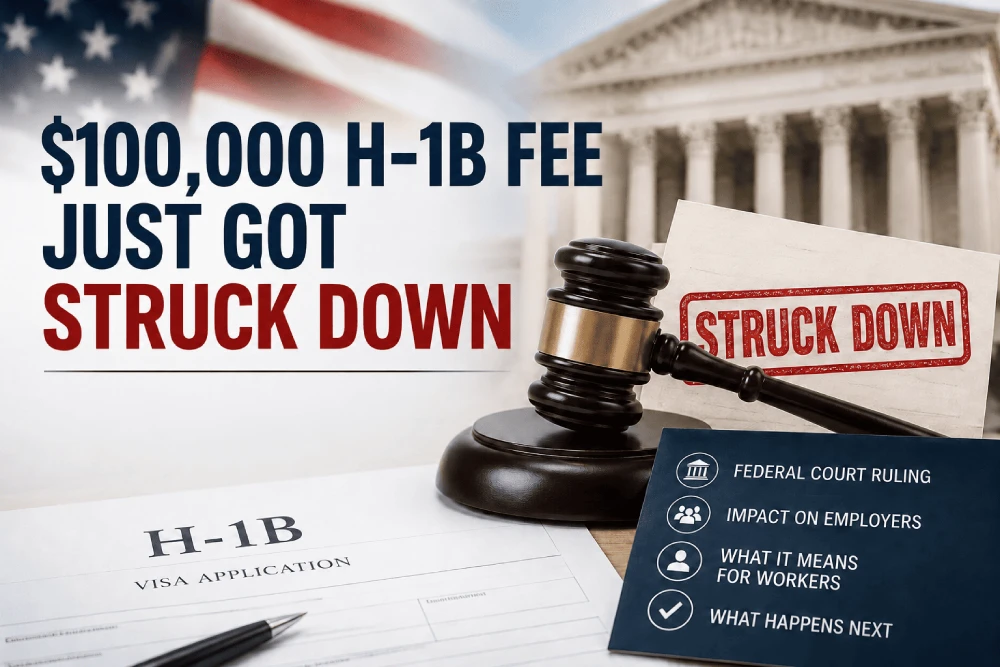
On June 8, 2026, U.S. District Judge Leo T. Sorokin agreed with the states fully. The ruling threw the $100,000 requirement out entirely.
The heart of the decision is worth understanding because it’s a big deal constitutionally, not just for immigration purposes. The court looked at what this $100,000 charge actually does — it raises revenue, it applies regardless of any individualized finding about the worker, and it functions like a toll on entry. To the court, that makes it a tax. And taxing is something the Constitution hands to Congress, not the President. Neither of the statutory provisions the administration relied on — INA 212(f) or 215(a) — gives the President that kind of power, no matter how broadly you read “restrictions” or “limitations” on entry.
Bottom line: as of June 8, 2026, employers filing new H-1B petitions do not have to pay the $100,000 fee. That’s true right now, today — but read on, because “right now” comes with an asterisk.
What this means for you, practically speaking
If you haven’t filed yet: You are not currently required to include the $100,000 payment with a new H-1B petition. That’s real, immediate relief if you’ve been holding off on hiring or transfers because of the cost.
If you already paid it: This is the question I’m getting the most right now, and unfortunately I don’t have a clean answer yet. Reports suggest well over 200,000 H-1B filings have had this fee attached since last September. As of the ruling date, DHS hadn’t said a word about whether — or how — those payments might be refunded. If you’re in this situation, hold onto every receipt, confirmation, and filing record. We’ll be watching for agency guidance closely.
Don’t assume this is the final word. An appeal from the government is, frankly, close to a certainty — this administration has not been shy about pushing back on adverse rulings, and immigration enforcement funding is a priority. There’s also a real possibility the government asks for a stay, which could put the fee back in place while the appeal plays out. And remember — the D.C. Circuit is sitting on a separate case where a lower court already upheld this same fee. If that court goes the other way from Massachusetts, you’d have a circuit split, and this could very well be Supreme Court material down the line.
For now, my advice is simple: don’t pay a fee that a federal court has vacated, but don’t tear up your contingency planning either. This is a moving target.
Don’t forget: Other H-1B changes are still very much alive
The $100,000 fee may have been the headline, but it wasn’t the only thing that changed about H-1B in the last year. A few things employers and workers should keep on their radar regardless of how the fee litigation shakes out:
A New Way the Lottery Works. As of February 27, 2026, USCIS no longer runs a purely random H-1B cap lottery. The new system weights selection toward registrations associated with higher-paying positions — meaning the wage level an employer commits to now plays a real role in whether a registration even gets picked, not just in the eventual labor condition application. If you’re planning ahead for the next cap cycle, compensation strategy and lottery odds are now linked in a way they weren’t before.
Immigrant Visa Issuance Paused for Many Countries. Since January 21, 2026, the State Department has not been issuing immigrant visas to applicants from 75 countries. H-1B status itself isn’t affected, but if you’re an H-1B holder with a pending green card case that involves consular processing, this could directly affect your timeline. Worth checking whether your country of origin or chargeability country is on that list.
Alien Registration Is Being Enforced. DHS has been pushing harder on the long-standing — but rarely enforced — requirement under INA 262 that certain noncitizens register with the government. This used to be something most people never thought about. That’s changing, and not registering when required can now lead to real consequences. If you’re not sure whether this applies to you or your dependents, it’s worth a quick check.
Prevailing Wage Rules May Be Next. The same proclamation that created the $100,000 fee also instructed the Department of Labor to start working on revised prevailing wage levels. Nothing final has come out yet, but when it does, it could reshape what employers need to pay to sponsor H-1B workers — independent of whatever happens with the fee.
My honest take
I tell my clients this a lot lately, and I’ll say it here too: the rules aren’t just changing, they’re changing on a timeline that outpaces most companies’ internal processes. A policy that was law in September can be vacated by June. A rule that takes effect in February can reshape an entire hiring cycle that started months earlier. If your HR team, your hiring managers, and your legal counsel aren’t all looking at the same up-to-date information, something is going to fall through the cracks — and in immigration, the things that fall through the cracks tend to be expensive or time-consuming to fix.
Whether you’re an employer trying to figure out what your 2027 cap season strategy should look like, an H-1B worker trying to understand how the new lottery weighting affects you, or someone who paid the $100,000 fee and wants to know your options — these are exactly the kinds of questions we work through with clients every day.
Contact Kenjay Law Offices Ltd
📞 (224)800-1585
📧 info@kenjaylaw.com
🌐 kenjaylaw.com
This blog is for general informational purposes only and does not constitute legal advice. No attorney-client relationship is formed by reading this post. Immigration law is highly fact-specific and changes quickly — please consult with a qualified immigration attorney regarding your individual circumstances.