September 2026 U.S. Immigration Update
September 2026 U.S. immigration update featuring an American flag, U.S. passport, immigration law books and the U.S. Capitol.
September 2026 has brought several important developments in U.S. immigration law. New public charge regulations are now in effect, the administration has announced additional H-1B measures, and federal courts have intervened in rules affecting international students and immigrant visa applicants.
At the same time, September 30 marks the end of the federal government’s fiscal year. This brings important deadlines for green card applicants and individuals selected through the Diversity Visa program.
One of the biggest challenges for immigrants today is understanding which rules have actually changed. Some government announcements take effect immediately. Others are only proposals, while certain measures are subject to ongoing litigation.
This month’s immigration update explains the changes that could affect your employment, green card application, student status or international travel.
1. H-1B visa changes: Additional fees, entry restrictions and increased employer scrutiny
The H-1B program continues to undergo significant changes affecting U.S. employers and foreign professionals.
On September 18, 2026, the administration extended its earlier H-1B entry restrictions for another year, through September 21, 2027.
The proclamation concerns certain H-1B workers outside the United States and includes a $100,000 employer payment, subject to specified exceptions. However, implementation of that payment requirement remains affected by federal litigation. A federal district court ruled against the requirement in June 2026, and the government appealed.
Employers should therefore review the applicable court orders and current agency instructions before assuming that a particular H-1B petition requires the payment.
Proposed $103,265 H-1B fee
Separately, the Department of Homeland Security proposed an additional $103,265 fee for cap-subject H-1B petitions, including petitions eligible for the advanced-degree exemption.
The public comment period closed on September 24, 2026. As of September 25, the proposal has not been finalized, and the additional fee is not currently payable. It is separate from the $100,000 proclamation payment and ordinary H-1B filing fees.
Employers planning future H-1B sponsorship should follow the proposed rule’s progress rather than treat it as an existing filing requirement.
Increased scrutiny of sponsoring employers
A separate executive order issued on September 18 directs federal agencies to coordinate more closely when reviewing H-1B petitions and related applications.
The order instructs agencies to consider whether a sponsoring employer has laid off similarly situated U.S. workers during the preceding year or plans layoffs that may affect those workers. It also calls for greater information sharing concerning wages, employment conditions and program compliance.
Employers should ensure that their H-1B petitions accurately describe the offered position, wages, worksite and actual employment conditions. Businesses considering layoffs while sponsoring foreign workers should review the immigration implications before proceeding.
For additional background, see Kenjay Law’s H-1B fee update.
2. New public charge regulations are now in effect
One of September’s most important changes for certain green card applicants concerns the public charge rule.
DHS rescinded the 2022 public charge regulations, effective September 18, 2026. The change gives immigration officers broader discretion to consider relevant circumstances when deciding whether an applicant is likely at any time to become a public charge under Section 212(a)(4) of the Immigration and Nationality Act.
What does the new public charge rule mean?
A public charge determination is a forward-looking assessment. Officers consider the applicant’s individual circumstances, including age, health, family status, assets, resources, financial status, education and skills. Where required, a legally sufficient affidavit of support is also relevant.
Under the revised framework, officers may consider a broader range of means-tested public benefits, including certain noncash benefits, as part of the overall assessment.
Receiving a public benefit does not automatically result in a green card denial. The decision depends on the applicant’s circumstances, and certain immigration categories remain exempt from the public charge ground.
Does the new rule affect applications already filed?
The filing date is important.
An adjustment-of-status application properly filed before September 18, 2026, and accepted by USCIS generally remains subject to the earlier framework. Applications filed on or after September 18 are subject to the revised regulations. Benefits received before that date are evaluated consistently with the 2022 rules.
Applicants should not discontinue medical coverage or other public benefits without first understanding whether the public charge rule applies to their immigration case.
A new Form I-485 is required
USCIS also introduced a revised Form I-485 with an edition date of September 18, 2026.
There is no grace period for using earlier editions for applications filed on or after September 18. Applicants should download the current form directly from USCIS and carefully review the revised questions before filing.
For a more detailed explanation, read Kenjay Law’s public charge article.
3. International students: Duration-of-status rule postponed, but CPT faces increased scrutiny
International students received two important developments in September.
Federal court postpones the fixed-admission rule
DHS had scheduled a new rule to take effect on September 15, 2026, replacing the longstanding duration-of-status framework with fixed admission periods for F-1 students, J-1 exchange visitors and certain foreign media representatives.
On September 14, a federal district court in Massachusetts issued nationwide preliminary relief preventing the rule from taking effect while litigation continues.
For now, eligible F-1 and J-1 nonimmigrants continue under the existing duration-of-status framework.
Students must still maintain their status, keep their SEVIS records current and comply with applicable academic and employment requirements. The court’s order does not permanently invalidate the new rule, so further developments should be monitored.
SEVP takes a stricter approach to CPT
Separately, the Student and Exchange Visitor Program issued guidance in August 2026 taking a more restrictive approach to Curricular Practical Training (CPT).
Under SEVP’s August 12 and August 24 guidance, CPT should be authorized only when the practical training is required for all students in the established curriculum and is necessary to complete the degree. Enrollment in an elective internship course or the award of academic credit alone may no longer establish eligibility under this interpretation.
The underlying regulation has not changed, but the guidance is affecting how schools review CPT requests.
Students considering internships, particularly programs commonly described as Day 1 CPT, should consult their designated school official before beginning employment. Unauthorized employment can create serious complications for maintaining F-1 status and obtaining future immigration benefits.
4. September Visa Bulletin: Green card backlogs and the approaching fiscal-year deadline
September 30 is the final day of fiscal year 2026. Annual visa limits are particularly important at this stage because some categories have exhausted their available numbers.
For September, USCIS requires employment-based adjustment applicants to use the Final Action Dates chart and family-sponsored preference applicants to use the Dates for Filing chart.
The following are selected employment-based Final Action Dates from the September 2026 Visa Bulletin.
| Category | India | Mainland China |
| EB-1 | October 15, 2022 | July 1, 2023 |
| EB-2 | Unavailable | September 1, 2021 |
| EB-3 | January 1, 2014 | January 1, 2022 |
| EB-5 unreserved | Unavailable | December 1, 2016 |
| EB-5 rural set-aside | Current | Current |
Source: U.S. Department of State, September 2026 Visa Bulletin. These are Final Action Dates, not estimates of waiting periods.
What should Indian green card applicants know?
EB-2 India and unreserved EB-5 India are unavailable under September’s Final Action Dates chart. Visa numbers cannot be allocated under those listings during September.
Fiscal year 2027 begins on October 1, bringing new annual visa allocations. However, applicants should not assume that their priority dates will automatically become current or that pending cases will be approved immediately.
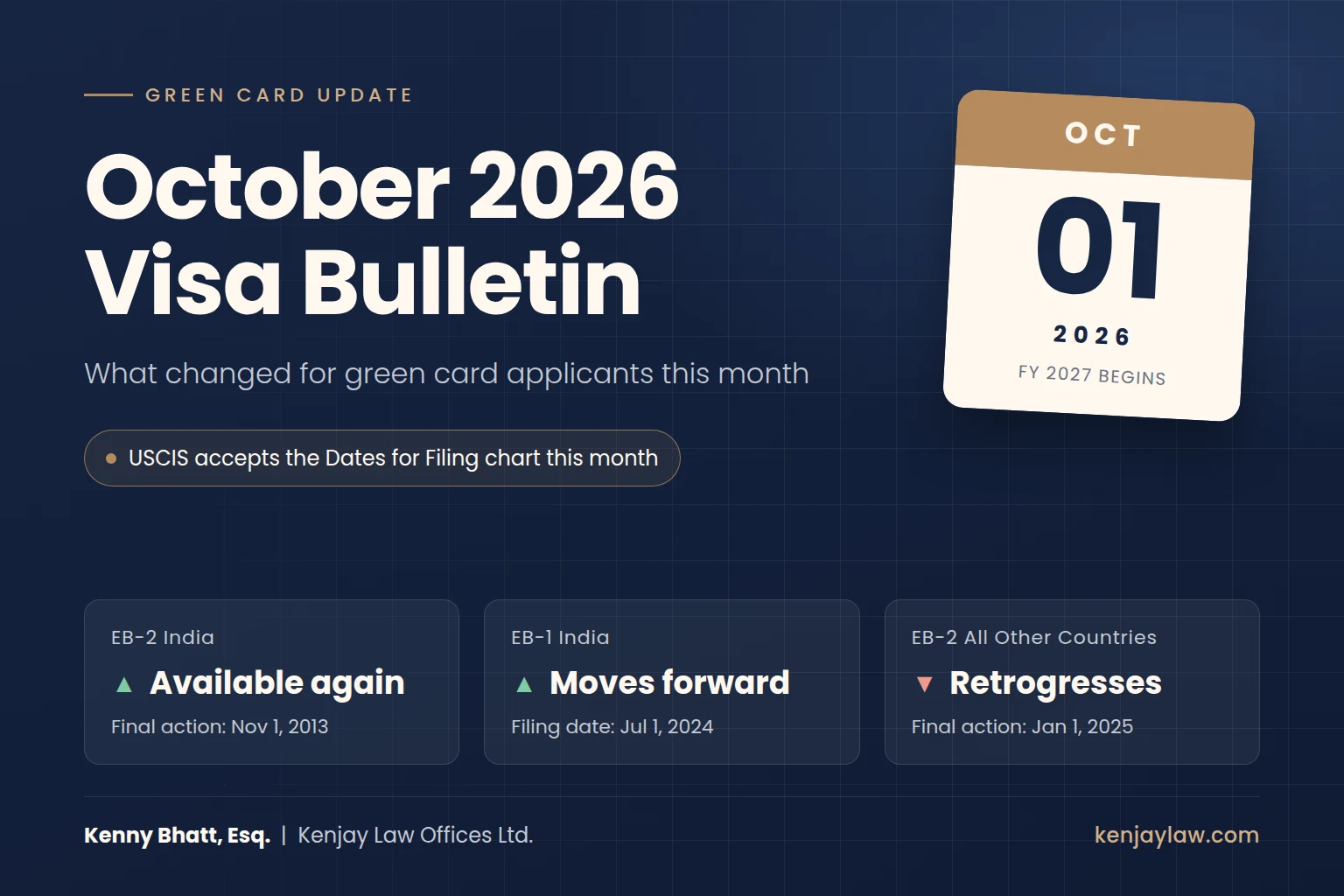
As of September 25, the State Department has not yet published the October 2026 Visa Bulletin. Applicants should monitor the official Visa Bulletin and USCIS’s corresponding filing-chart instructions before filing.
For family-based applicants, the F2A category is current under September’s Dates for Filing chart. This may allow otherwise eligible spouses and children of lawful permanent residents to submit adjustment applications, but it does not guarantee immediate approval.
5. Temporary Protected Status: Different developments for El Salvador and Haiti
Temporary Protected Status continues to change, with different consequences depending on the country.
El Salvador TPS continues pending a further decision
El Salvador’s TPS designation had been scheduled to end on September 9, 2026.
USCIS subsequently indicated that Salvadoran individuals present in the United States under TPS would retain protection, including work authorization, while the government considers the designation’s future. The announcement did not provide a conventional new fixed expiration date.
Beneficiaries should preserve their TPS notices and employment authorization documents and review current USCIS instructions.
Employers should verify acceptable Form I-9 documentation rather than rely solely on earlier guidance referring to September 9. The continued-protection announcement has left some documentation questions unresolved.
Haiti TPS termination
Haiti’s TPS designation was terminated effective July 27, 2026, following litigation concerning the government’s decision.
USCIS has instructed employers to reverify affected workers whose employment authorization depended on Haitian TPS.
Former TPS beneficiaries should review whether they qualify for another immigration benefit or have a separate basis for remaining in the United States.
A pending asylum application, family petition or other immigration filing may be relevant to that assessment, but it does not automatically provide lawful status or employment authorization.
6. The 75-country immigrant visa pause has ended, but separate restrictions remain
The State Department’s earlier pause on immigrant visa issuance for nationals of 75 countries is no longer in effect as of August 21, 2026, following a federal court order in CLINIC v. Rubio.
This development is relevant to applicants whose immigrant visa cases were affected by the January 2026 pause.
However, the removal of that particular restriction does not mean every previously affected applicant can now obtain a visa.
Separate nationality-based restrictions under Presidential Proclamation 10998 continue to fully or partially restrict entry and visa issuance for nationals of 39 countries and certain other applicants, subject to applicable exceptions.
Applicants should confirm whether another restriction applies to their nationality and visa category before booking travel or assuming that a previously delayed consular case can now be completed.
7. Diversity Visa applicants face a September 30 deadline and an issuance pause
Diversity Visa applicants face an especially difficult situation as fiscal year 2026 approaches its end.
The State Department announced a new pause on all Diversity Visa issuance on August 31, 2026. Under its current guidance, DV applicants may continue submitting applications and attending scheduled interviews, but no Diversity Visas will be issued while the pause remains in effect. The Department has announced no exceptions.
The statutory deadline for DV-2026 remains September 30, 2026. Applicants generally must obtain their immigrant visas or complete an eligible adjustment-of-status process before the fiscal year ends. A DV-2026 selection does not carry over to fiscal year 2027.
Applicants pursuing adjustment of status through USCIS should review their eligibility and the applicable procedures separately from the State Department’s consular issuance pause.
Anyone approaching the September 30 deadline should carefully monitor current agency instructions and relevant court developments.
8. Expanded social media screening begins October 1
The State Department announced another change to visa screening that is scheduled to begin October 1, 2026.
Online presence review will expand to applicants for I visas for foreign media representatives and TN and TD visas for qualifying USMCA professionals and their dependents.
Visa applicants in these categories are instructed to make their social media profiles publicly accessible for screening. Similar screening requirements already apply to several other visa categories, including F-1 students, J-1 exchange visitors, H-1B workers and certain dependents.
Applicants should ensure that the information provided in their visa applications is complete and accurate and should follow the State Department’s current instructions.
What should applicants and employers do now?
The developments in September show why immigration planning must be based on the rules that are actually in effect, not simply on policy announcements.
- Green card applicants: Verify your priority date, the applicable public charge framework and the current edition of Form I-485.
- H-1B employers and workers: Review applicable payment requirements, pending litigation, employer compliance and international travel plans.
- International students: Maintain valid status and confirm CPT eligibility with your school before beginning employment.
- TPS beneficiaries: Check current country-specific guidance and acceptable employment authorization documents.
- Consular and Diversity Visa applicants: Review any applicable restrictions, issuance pauses and approaching deadlines.
Taking an immigration step based on outdated information can result in rejected applications, interrupted employment or unexpected travel difficulties. Confirming the applicable requirements before acting can help avoid those problems.
Frequently Asked Questions
1. Is the proposed $103,265 H-1B fee now required?
No. The public comment period closed on September 24, 2026, but the additional fee remains a proposal as of September 25. It has not been finalized and is not currently payable. It is separate from the $100,000 proclamation payment, which remains affected by federal litigation.
2. Does the new public charge rule apply to green card applications already pending?
Applications properly filed before September 18, 2026, and accepted by USCIS generally remain subject to the earlier framework. Applications filed on or after September 18 are subject to the revised regulations. The outcome of an individual case depends on its circumstances and applicable exemptions.
3. Will receiving Medicaid or SNAP automatically result in a green card denial?
No. Under the revised public charge framework, certain means-tested benefits may be considered as part of the overall assessment. Receiving a benefit does not automatically result in inadmissibility. The type and timing of benefits, the applicant’s circumstances and any statutory exemption are important.
4. Has the F-1 duration-of-status system ended?
No. The September 14 federal court order postponed implementation of the fixed-admission rule. The existing duration-of-status framework remains in effect for eligible F-1 and J-1 nonimmigrants while litigation continues.
5. Can international students still obtain CPT authorization?
Yes, where the applicable requirements are met. However, SEVP’s August guidance adopts a narrower interpretation of qualifying practical training. Students should confirm eligibility and obtain proper authorization from their designated school official before starting any internship or other employment.
6. Will EB-2 India become available again in October 2026?
The new fiscal year begins October 1, bringing new annual visa allocations. However, the October 2026 Visa Bulletin has not yet been published as of September 25. Applicants must wait for the official bulletin and USCIS filing-chart instructions to determine the applicable dates and filing eligibility.
7. Can Salvadoran TPS beneficiaries continue working after September 9, 2026?
Eligible Salvadoran TPS beneficiaries retain protection and work authorization pending a further government announcement. However, beneficiaries and employers should verify the latest USCIS instructions concerning acceptable employment-authorization documents and Form I-9 requirements.
8. Are the restrictions affecting nationals of the previously listed 75 countries completely removed?
No. The specific January 2026 immigrant visa issuance pause ended in August, but independent nationality-based restrictions and ordinary visa eligibility requirements may still apply. Applicants should review their circumstances under the currently applicable rules.
9. Can DV-2026 applicants receive visas before September 30?
The State Department’s current guidance pauses all Diversity Visa issuance without exceptions, although applicants may continue attending interviews. The statutory DV-2026 deadline remains September 30, 2026. Applicants should monitor current instructions and seek case-specific advice about any available options.
10. Does the expanded social media screening apply to TN visa applicants?
The State Department announced that online presence review will expand to TN and TD visa applicants, as well as I visa applicants, beginning October 1, 2026. Applicants should follow the Department’s instructions when preparing their visa applications.
Speak With Kenjay Law Offices Ltd.
Immigration law can change through federal regulations, executive actions, agency guidance and court decisions. A development affecting one immigration category may not apply to another, and the outcome of an individual case depends on its particular facts.
Kenjay Law Offices Ltd., led by Kenny Bhatt, Esq., assists individuals, families and businesses with U.S. immigration matters, including employment-based immigration, family petitions, adjustment of status and other immigration proceedings.
If a recent immigration change may affect your application, employment, travel plans or green card eligibility, contact Kenjay Law Offices Ltd. to discuss your circumstances.
Phone: (224) 800-1585 Email: info@kenjaylaw.com
Disclaimer: This article provides general information about U.S. immigration developments as of September 25, 2026. It is not legal advice and does not establish an attorney-client relationship.